

Physically demanding Hajj journeys echo pilgrimages of the past 

1 / 4
Adam Mohammed walked nearly 6,500 km to complete his pilgrimage. (Supplied)
2 / 4
A group of British adventurers are taking part in an extraordinary sailboat journey from the UK to Makkah to perform Hajj. (Supplied)
3 / 4
Abdelkader Harkassi, Abdallah Hernandez and Tariq Rodriguez are fulfilling a long-held ambition by completing a historic Hajj pilgrimage on horseback. (Supplied)
4 / 4
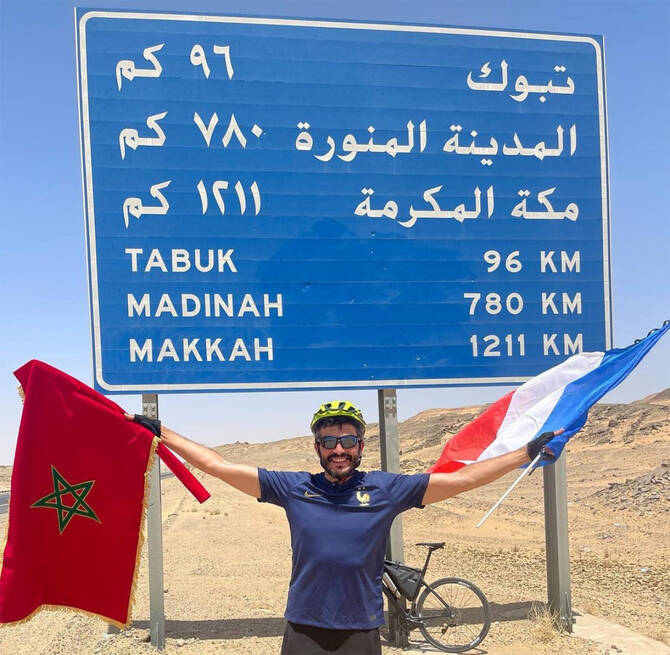
French cyclist Nabil Ennasri at the Prophet’s Mosque in Madinah, after crossing 11 countries on bicycle to perform Hajj this year. (Instagram/nabilennasr)
Short Url
Updated 05 June 2025
Follow

Physically demanding Hajj journeys echo pilgrimages of the past 

  • Adventurous Muslims challenge themselves by walking, cycling, riding and sailing to Hajj
  • Horseriders take seven months to make journey from Spain to Makkah 

RIYADH: While some worshippers choose to travel to Hajj in comfort, others see the pilgrimage as an opportunity to test their physical and spiritual fortitude.

Following in the long tradition of epic journeys that led the faithful of history to Makkah, adventurous Muslims today are challenging themselves in a variety of ways.

This year, three friends on horseback rode more than 8,000 kilometers over seven months from the south of Spain to Saudi Arabia to complete the Islamic rites in the holy capital.

Their route retraced a historic one first trod by Andalusian Muslims living in Europe more than 500 years ago.

Abdelkader Harkassi, Abdallah Hernandez and Tariq Rodriguez travelled through Spain, France, Italy, Slovenia, Croatia, Bosnia, Serbia, Turkiye, Syria and Jordan before crossing into Saudi Arabia’s Northern Borders region and making their way to Makkah.

Hernandez told Arab News that the ride was a “trip of challenges where every step (was) felt by us and the horses, but (was) also a journey for the soul.”

The riders set off with limited funds and were supported by Muslims that they met along the way.

Another group of worshippers took to the seas, taking about two months to sail more than 7,400km from London to Makkah.

Abdul Wahid, Tauseef Ahmed, Jody McIntyre, Dobbir Uddin and Taher Akhtar from London had no previous sailing experience before training for the maritime mission.

Speaking to Arab News, Wahid, 38, said he was inspired by the combination of influences of his Muslim faith and the maritime history of the UK.

“It is kind of merging our religion Islam with the country (where) we are residing, and reviving this long-forgotten way to Hajj,” he said.

In June 2022, British pilgrim Adam Mohammed arrived in Makkah after setting off from his home in Wolverhampton, UK 11 months earlier and 6,500km away.

He walked through the Netherlands, Germany, the Czech Republic, Hungary, Romania, Bulgaria, Turkey, Lebanon, Syria, and Jordan to reach Saudi Arabia.

Mohammed told Arab News at the time that, while studying the Qu’ran during COVID-19 lockdowns, he felt a spiritual calling inviting him on the journey.

“Suddenly, I woke up one day and something inside me told me to go to Makkah all the way by foot from my home,” he said. “I could not ignore this voice and decided to go for it.”

Pulling a 250kg cart in which he slept, prepared food and kept his personal belongings, Mohammed said that there were “no big difficulties” on his travels, and that he was undertaking the challenge for religion and not for fame.

Nabil Ennasri, a French pilgrim of Moroccan origin, cycled more than 5,000km to reach Makkah for the 2023 Hajj season.

He began his journey in Paris and crossed 11 countries including Italy, Slovenia, Croatia, Montenegro, Bosnia and Herzegovina, Albania, Greece, Jordan and Turkiye.

The 41-year-old wanted to revive the traditional pilgrimage experience and use his trip to raise awareness for global warming.

Ennasri was able to retrace the historical journey taken by Muslims, and some of his own relatives, in the past.

“Some members of my family also traveled on foot. It could have taken months or even years. Some lost their lives during the journey,” he said.

“When I remember these moments, I find the strength in me.”

Explaining the significance of his journey, he added: “My first objective is to explain global warming; it is very important for our children and future generations.

“My second goal is to understand what kind of difficulties people (experienced) on pilgrimage in ancient times, to understand their long journeys on foot.”

The trip was reminiscent of those carried out by millions of Muslims over the centuries, most of whom would have to have endured far greater hardships than travelers today.

Perhaps history’s most well-known Muslim explorer, Ibn Battuta, set off from his native Morocco in 1325 and did not return for another 24 years.

He ended up discovering a love of travelling, reaching as far as China, but the first leg of his journey was to the holy capital to perform Hajj.

In 2020, a Moroccan named Ghulam Yassin arrived in Makkah after retracing much of Ibn Battuta’s original journey.

Yassin travelled on foot and by bicycle for four years to perform Hajj — one of the five essential pillars of Islam.

Generous Saudis were so inspired by his journey that they pledged to cover the cost of his pilgrimage the following year.

In June 2022, Indian pilgrim Shihab Chottur arrived in Makkah after walking 8,600km from his home in Malappuram, Kerala.

Chottur, who was 31 at the time, set off on foot carrying 12kg of luggage with $8,500 in his pocket.

He passed through Pakistan, Iran, Iraq and Kuwait, and a year later arrived in the Kingdom.

The money he brought with him turned out not to be needed, because the Saudi government and Indian consulate decided to sponsor his Hajj.

Instead, the shop owner used it to pay for his mother to complete the pilgrimage the following year.

The Hajj pilgrimage is mandatory for all Muslims who are physically and financially able to complete it at least once in their life.

While the Saudi authorities continue to make the process more accessible and comfortable for all believers, including those with mobility issues, every year physically demanding journeys such as these remind us of the difficulties of performing Hajj in the past. 


The secret keepers of desert balance in Saudi Arabia

Updated 27 December 2025
Follow

The secret keepers of desert balance in Saudi Arabia

  • How the Kingdom’s wildcats control pests, protect public health, and sustain the ecosystem

RIYADH: During the summer of 2024, two desert lynx kittens were born in Taif as part of Saudi Arabia’s efforts to protect and increase the population of caracals in the country.

Although caracals are critically endangered, wildcats in general play a significant ecological role in the Kingdom. They act as natural pest control, and Saudi Arabia is committed to conserving these species while increasing their populations to support a thriving ecosystem.

Despite the Kingdom’s harsh, arid climate, conditions are suitable for wildcats not only to survive but also to flourish. Among the terrestrial species inhabiting Saudi Arabia are sand cats, Arabian wildcats, and the desert lynx.

Felis margarita, or sand cats, are small — around 40-60 cm — with pale sandy fur that allows them to blend into the desert. They have a broad head, large ears, and long hair on the bottom of their feet to walk on hot sand.

Sand cats have long hair on the bottom of their feet, allowing them to walk on hot sand and prevent them from sinking into the sand. (SPA/Visitsaudi)

“It is small in size and does not mate with other cats. It is the only cat species in the world with hair on the soles of its feet instead of skin to prevent it from sinking into the sand,” said Obaid Alouni, a Saudi environmentalist.

Alouni explained that one defensive technique sand cats use is to lie flat on the ground to avoid detection.
“It lies flat on the ground when it senses danger to avoid being noticed by other animals.”

These cats primarily feed on rodents and small reptiles, occasionally large insects, obtaining their water from their prey. Sand cats are native to West Asia and help regulate rodent and insect populations, preventing outbreaks and reducing disease spread.

Opinion

This section contains relevant reference points, placed in (Opinion field)

Interestingly, raising sand cats as domestic pets is becoming more popular, Alouni said. But he emphasized that adoption is easier when they are kittens, as they remain wild animals. Although widely distributed across the Kingdom, exact population numbers are difficult to determine due to their elusive nature. They are currently listed as “least concern” by the International Union for Conservation of Nature.

Similar to sand cats, Arabian wildcats (Felis lybica) are found across the Arabian Peninsula and play a vital role in environmental health.

“They are wild cats that live independently without human intervention,” Alouni told Arab News.

An Arabian wildcat at Olomouc Zoo in the Czech Republic. (Wikimedia Commons: Michal Maňas)

Arabian wildcats resemble domestic cats but have thicker, sandy to grey-brown coats with faint stripes or spots and ringed tails with blunt tips. Like sand cats, they feed on rodents, birds, reptiles, and insects and are listed as “least concern” by the IUCN.

However, Alouni warned that pure populations of Arabian wildcats in Saudi Arabia could be threatened by hybridization with domestic cats.

“Currently, wild cats face the problem of interbreeding with domestic cats. This weakens their immune systems and makes them more susceptible to diseases from other cats,” he said.

“This contributes to the extinction of the purebred lineage and, consequently, the disappearance of their wild instincts,” he added.

DID YOU KNOW?

• Sand cats are the only cat species with hair on the soles of their feet, allowing them to walk on hot sand without sinking.

• Caracals, locally known as Al-Washaq, are native and endangered, capable of jumping 3 to 4 meters in a single leap.

• Pure populations of the Arabian wildcat are at risk due to hybridization with domestic cats.

While both species are desert dwellers, sand cats are harder to spot as they avoid heavily trafficked areas. They are mainly found in the Ad Dahna desert and the Empty Quarter, where sand dunes dominate the landscape. Arabian wildcats, however, inhabit rocky or mountainous areas such as the Tuwaiq Mountains, valleys, and farms with abundant small prey.

“Wild cats come around towns and villages, and unfortunately, begin mating with domesticated cats that people release outside,” Alouni explained. He stressed the importance of keeping domestic cats away from wildcat habitats, including deserts and camping sites.

The third wildcat species native to Saudi Arabia, the caracal or desert lynx, is critically endangered. “The lynx is classified in size between large and small, and is distinguished by its jump, which can reach 3 meters or even 4 meters in the sky,” Alouni described.

This combination of photos released by the Saudi National Center for Wildlife (NCW) last year shows a female Caracal and its cub at the Prince Saud Al-Faisal Wildlife Research Center in Taif. (SPA file)

Locally known as Al-Washaq, desert lynx have reddish-tan coats, long legs, and black-tufted ears. They feed on birds, rodents, and sometimes small antelopes. Thankfully, these cats are protected under Saudi law due to their critically endangered status.

Hunting any sand cats, Arabian wildcats, or desert lynx can result in fines of approximately $20,000, according to the Saudi Ministry of Environment, Water, and Agriculture.
“There is a very severe financial penalty in Saudi Arabia for anyone who hunts it,” Alouni added.

The Kingdom has strict regulations to protect endangered animals, criminalizing not only hunting or killing but also trade. Violators could face penalties of up to $8 million, up to 10 years in prison, or both.

Overall, sand cats, Al-Washaq, and Arabian wildcats are essential to maintaining a healthy environment in Saudi Arabia. By controlling rodent populations, they help prevent outbreaks that could threaten agriculture and public health.