

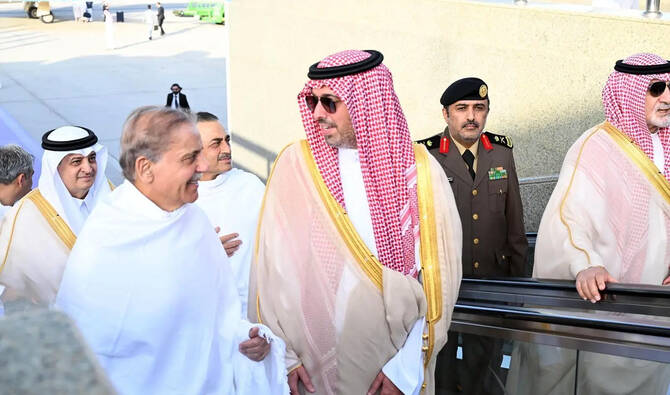
Pakistani PM in Saudi Arabia on two-day visit to bolster bilateral ties

Prime Minister of Pakistan, Shehbaz Sharif (second left), arrives in Jeddah, Saudi Arabia, on June 5, 2025. (SPA)
Short Url
Updated 06 June 2025
Follow

Pakistani PM in Saudi Arabia on two-day visit to bolster bilateral ties

  • During his stay on June 5 and 6, Sharif will celebrate Eid Al-Adha, hold bilateral meeting with Crown Prince Mohammed bin Salman
  • Discussions are expected to focus on enhancing cooperation in trade, investment and regional security, welfare of Muslim Ummah

ISLAMABAD: Pakistani Prime Minister Shehbaz Sharif arrived in Jeddah on Thursday on a two-day official visit to Saudi Arabia at the invitation of Crown Prince and Prime Minister Mohammed bin Salman, Sharif’s office said, to strengthen bilateral relations between the two longstanding allies.

Sharif’s office earlier on Wednesday said during his stay on June 5 and 6, the Pakistani prime minister will celebrate Eid Al-Adha in the Kingdom and hold a bilateral meeting with Crown Prince Mohammed bin Salman. The discussions are expected to focus on enhancing cooperation in trade, investment and regional security.

Upon arrival in Jeddah, Sharif was received by the Governor of Jeddah, Prince Saud bin Abdullah Jalawi, Saudi Arabia’s Ambassador to Pakistan Nawaf bin Saeed Al-Malki, Pakistan’s Ambassador to Saudi Arabia and senior diplomatic officials.

“The prime minister and the Pakistani delegation departed from Jeddah to Makkah to perform Umrah,” the Prime Minister’s Office (PMO) said.

In an earlier statement, the PMO said Sharif and the Saudi crown prince will discuss ways to further strengthen bilateral cooperation in various fields, including trade and investment, welfare of the Muslim Ummah, and regional peace and security.

Sharif is also expected to express gratitude to the Saudi leadership for their role in de-escalating recent tensions between Pakistan and India.

Last month, following the worst military confrontation between India and Pakistan in decades, Saudi Arabia, along with other Gulf nations, played a key role in mediating between the two nuclear-armed neighbors, helping to avert a potential war.

The visit also comes amid deepening economic ties between Pakistan and Saudi Arabia. In recent months, the two countries have signed multiple agreements aimed at boosting bilateral trade and investment. Notably, Saudi Arabia has committed to a $5 billion investment package to support Pakistan’s economy, which has been grappling with a balance of payments crisis.

Last year, Saudi and Pakistani businessmen signed 34 memorandums of understanding worth $2.8 billion, covering sectors such as industry, technology, and agriculture. Additionally, Saudi Arabia’s Manara Minerals is in talks to acquire a 10-20 percent stake in Pakistan’s $9 billion Reko Diq copper and gold mining project, one of the largest of its kind globally.

Defense cooperation is also a key component of the bilateral relationship. The two nations have a history of military collaboration, with Saudi Arabia providing support to Pakistan during times of regional tension and Pakistan training Saudi forces.

Pakistan has a 2.7 million-strong diaspora in Saudi Arabia, which accounts for the highest remittance inflow, a crucial lifeline for the country’s economy.


Pakistani, Bangladeshi officials discuss trade, investment and aviation as ties thaw

Updated 28 December 2025
Follow

Pakistani, Bangladeshi officials discuss trade, investment and aviation as ties thaw

  • Pakistan and Bangladesh were once one nation, but they split in 1971 as a result of a bloody civil war
  • Ties between Pakistan, Bangladesh have warmed up since last year and both nations have resumed sea trade

ISLAMABAD: Pakistan's High Commissioner to Bangladesh Imran Haider on Sunday met Chief Adviser Muhammad Yunus in Dhaka, the latter's office said on, with the two figures discussing trade, investment and aviation.

Pakistan and Bangladesh were once one nation, but they split in 1971 as a result of a bloody civil war, which saw the part previously referred to as East Pakistan seceding to form the independent nation of Bangladesh.

Ties between Pakistan and Bangladesh have warmed up since former prime minister Sheikh Hasina’s ouster as a result of a student-led uprising in August 2024. Relations remain frosty between Dhaka and New Delhi over India’s decision to grant asylum to Hasina.

Pakistan has attempted to forge closer ties with Bangladesh in recent months and both South Asian nations last year began sea trade, followed by efforts to expand government-to-government commerce.

"During the meeting, both sides discussed ways to expand cooperation in trade, investment, and aviation as well as scaling up cultural, educational and medical exchanges to further strengthen bilateral relations between the two South Asian nations," Yunus's office said in a statement on X.

In 2023-24 Pakistan exported goods worth $661 million to Bangladesh, while its imports were only $57 million, according to the Trade Development Authority of Pakistan. In Aug. this year, the Pakistani and Bangladeshi commerce ministries signed a memorandum of understanding to establish a Joint Working Group on Trade, aiming to raise their bilateral trade volume to $1 billion in the financial year that began in July.

The Pakistani high commissioner noted that bilateral trade has recorded a 20 percent growth compared to last year, with business communities from both countries actively exploring new investment opportunities, according to the statement.

He highlighted a significant increase in cultural exchanges, adding that Bangladeshi students have shown strong interest in higher education opportunities in Pakistan, particularly in medical sciences, nanotechnology, and artificial intelligence. Haider also said that Dhaka-Karachi direct flights are expected to start in January.

"Chief Adviser Professor Muhammad Yunus welcomed the growing interactions between the two countries and emphasized the importance of increased visits as well as cultural, educational and people-to-people exchanges among SAARC (South Asian Association for Regional Cooperation) member states," the statement read.

"Professor Yunus also underscored the need to further boost Bangladesh–Pakistan trade and expressed hope that during Mr. Haider’s tenure, both countries would explore new avenues for investment and joint venture businesses."