

Pakistani PM reiterates gratitude to Trump, Gulf nations for India ceasefire

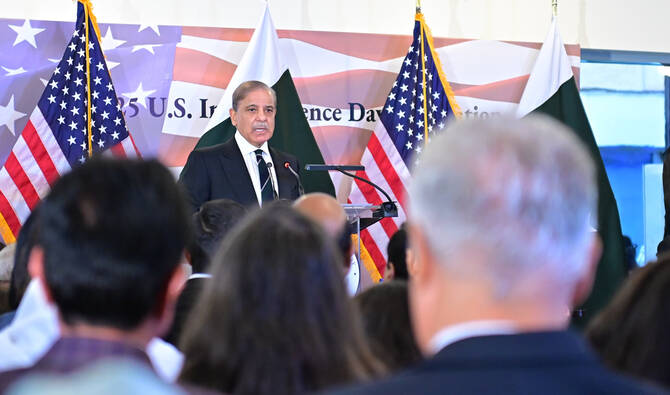
Pakistan Prime Minister Shehbaz Sharif addresses a ceremony organized on the eve of the 249th anniversary of Independence Day of the United States of America, at the US Embassy in Islamabad on June 4, 2025. (Photo courtesy: PMO)
Short Url
Updated 04 June 2025
Follow

Pakistani PM reiterates gratitude to Trump, Gulf nations for India ceasefire

  • US President Donald Trump brokered ceasefire between arch-rivals India and Pakistan on May 10
  • Shehbaz Sharif to visit Saudi Arabia on Thursday to thank Kingdom for support during India standoff

ISLAMABAD: Prime Minister Shehbaz Sharif on Wednesday thanked US President Donald Trump and Gulf countries for helping defuse Pakistan’s tensions with India following an armed conflict between the nuclear-armed nations last month.

Trump announced he had helped broker a ceasefire between India and Pakistan on May 10 after the worst fighting between the two countries since 1999. Following weeks of tensions, India and Pakistan pounded each other with artillery, fighter jets, missiles and drones in May before agreeing to cease hostilities.

Gulf countries, including Saudi Arabia and the United Arab Emirates (UAE) also engaged both Indian and Pakistani officials throughout the conflict to help defuse tensions.

“[US] President [Donald] Trump has shown, beyond a ray of doubt and imagination, that he is a man for peace,” Sharif said at a ceremony at the US embassy in connection with the upcoming American Independence Day.

“He is a man for promoting peace and beneficial business needs. He is a man who is against escalation,” he added.

Days after the ceasefire agreement was announced, Trump said he used trade to defuse tensions between India and Pakistan.
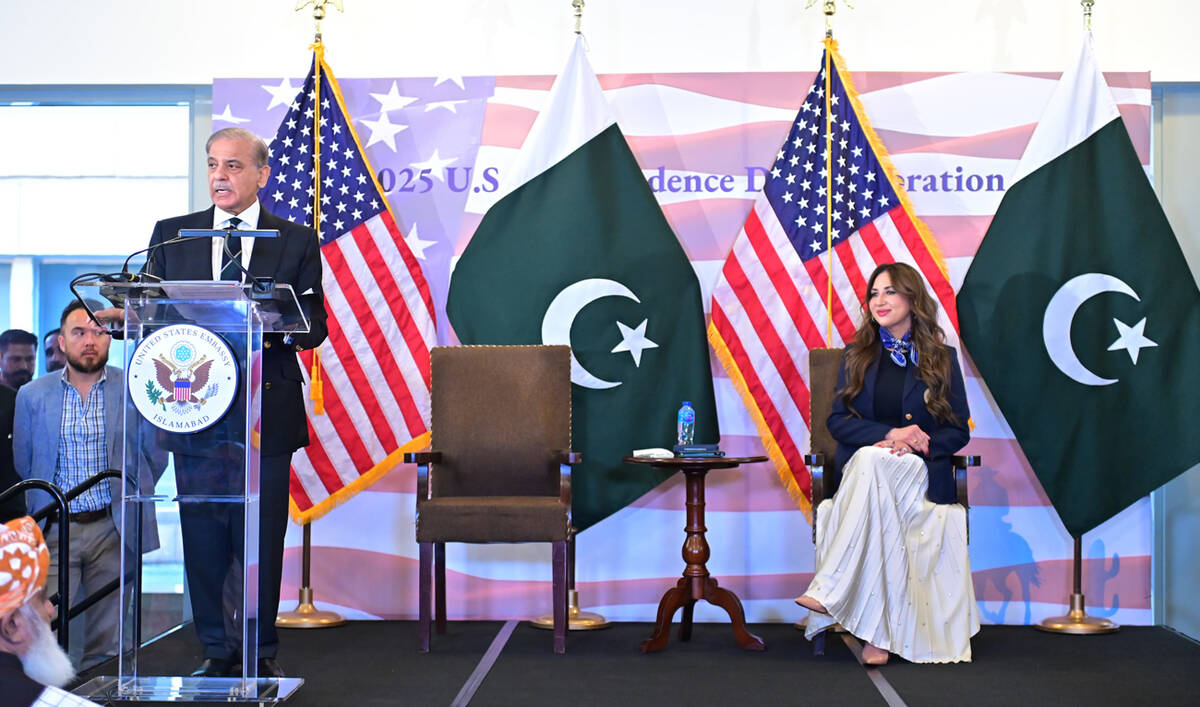


Pakistan Prime Minister Shehbaz Sharif speaks as the Acting US Ambassador Natalie Baker gestures during a ceremony organized on the eve of the 249th anniversary of Independence Day of the United States of America, at the US Embassy in Islamabad on June 4, 2025. (Photo courtesy: PMO)

Sharif noted Trump had advised both countries to promote trade and investments instead of fighting each other. The Pakistani premier appreciated Trump’s “outstanding contribution” to broker the ceasefire.

The Pakistani premier hoped the ceasefire would last between the two countries and lead to increased trade and investment.

“I hope and pray to God Almighty that this will become a long, lasting ceasefire on which we can build an edifice of investments, trade, pollution and so on so forth,” he said.

The Pakistani premier also appreciated the role played by Middle Eastern countries in resolving the dangerous conflict.

“And here, obviously, I’d like to mention the role of our friendly and brotherly countries in the Gulf, in the Middle East, who proactively coordinated with us and supported President Trump’s genuine efforts,” Sharif said.

Sharif will travel to Saudi Arabia on a day-long visit to the Kingdom on Thursday, Pakistan Deputy Prime Minister Ishaq Dar said.

The Pakistani premier will thank the Saudi leadership for its solidarity and support to Pakistan throughout the India standoff, Dar said.


Pakistan positions itself as ‘bridge builder’ to ease Middle East tensions as PM visits Saudi Arabia

Updated 5 sec ago
Follow

Pakistan positions itself as ‘bridge builder’ to ease Middle East tensions as PM visits Saudi Arabia

  • Islamabad says it is engaging regional capitals to keep diplomatic channels open amid Iran conflict
  • Foreign Office says Pakistan policy on Afghanistan unchanged amid cross-border militant attacks

ISLAMABAD: Pakistan is positioning itself as a bridge builder to help ease rising tensions in the Middle East, with Prime Minister Shehbaz Sharif traveling to Saudi Arabia for talks focused on regional peace and security, the Foreign Office said on Thursday.

Sharif left earlier in the day for what officials described as a brief visit to the Kingdom at a time when the region is facing heightened volatility after the United States and Israel launched airstrikes against Iran. Subsequently, Tehran said it was targeting American military bases in Gulf states, prompting condemnations from these countries, which said several strikes had hit civilian infrastructure.

The spillover of the conflict in the region has complicated diplomatic efforts aimed at calming the situation, but the Foreign Office spokesperson, Tahir Andrabi, said Pakistan had been in regular contact with capitals across the region since the crisis erupted and is trying to keep channels of communication open.

“And we are playing the role of a bridge builder in a sense that our principal position on issues with respect to sovereignty, international law and the UN Charter and with respect to dialogue and diplomacy is respected in all regional capitals,” Andrabi said during the weekly press briefing.

He said Prime Minister Sharif’s visit to Riyadh should be seen as part of ongoing coordination between Pakistan and Saudi Arabia on regional stability.

“The Prime Minister’s visit to Saudi Arabia is part of the coordination between Pakistan and Saudi Arabia on matters of regional peace and security and ending violence and hostilities,” he said.

“The Prime Minister’s visit should also be seen in the broader context of Pakistan’s efforts to advocate and facilitate an early cessation of hostilities and violence in the region, with the aim of paving the way for dialogue and diplomacy.”

Islamabad has condemned both the strikes on Iran and the retaliatory attacks launched from Iranian territory against Gulf states, urging all sides to show restraint and resolve their differences through diplomatic means.

“As you know, Pakistan had condemned the unwarranted attacks against the Islamic Republic of Iran,” Andrabi said, warning that such actions risk further destabilizing an already tense region. At the same time, he added, Pakistan had also condemned attacks carried out from Iran against Gulf states including Saudi Arabia, Bahrain, Jordan, Kuwait, Qatar and the United Arab Emirates, calling them violations of sovereignty.

He said Pakistan has remained diplomatically engaged since the crisis began. Deputy Prime Minister and Foreign Minister Ishaq Dar has spoken with his counterparts from several countries in the region to discuss the evolving situation.

The prime minister also held a telephone conversation on Wednesday with Iranian President Masoud Pezeshkian, during which the two leaders discussed regional developments.

Andrabi said Pakistan’s position was firmly rooted in international law and the principle that disputes should be resolved through dialogue.

PAK-AFGHAN CLASHES

Separately, the Foreign Office said Pakistan’s policy toward Afghanistan remains unchanged despite continued tensions over cross-border militant attacks.

“There is no qualitative change in our relations, in our way of how we engage with Afghanistan,” Andrabi said.

Pakistan has repeatedly accused the Afghan authorities of harboring militant groups and facilitating their cross-border attacks, an allegation denied by Kabul.

The two countries have witnessed fierce border clashes amid mounting tensions, with Pakistan saying it has targeted militant hideouts inside Afghanistan.

“We have emphatically communicated to the Afghan side and to our interlocutors that we need verifiable assurances from the Afghan side that their territory will not be used for terrorism against Pakistan,” Andrabi said.

“Since those assurances have not been received, we will continue with our existing policy with respect to that country.”

He said Pakistan reserved the right to respond to attacks originating from Afghan territory.

“We are under attack ... and in exercise of our right to self-defense, we do reserve the right to respond to these attacks.”