

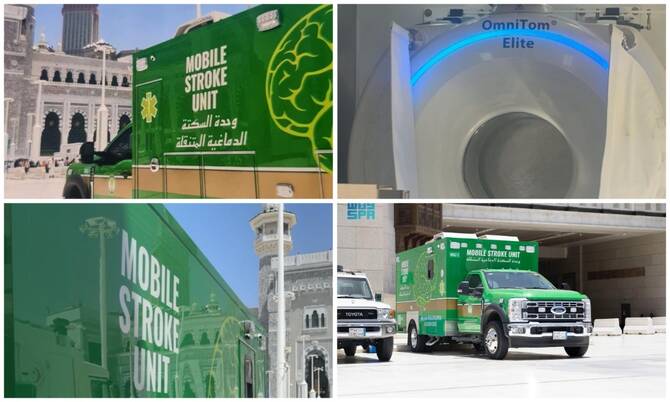

MAKKAH: In a healthcare milestone for pilgrims, Saudi Arabia has deployed a mobile stroke unit for the first time at the Grand Mosque in Makkah during this year’s Hajj.
Dr. Abdullah Al-Harthi, an emergency medicine consultant and executive director of Ajyad Hospital, told Arab News that the unit was a state-of-the-art ambulance designed specifically for stroke cases, aiming to reduce the time between symptom onset and treatment — without the need for hospital transport.
“The unit can quickly access difficult locations and provide immediate care on-site, improving recovery and saving lives,” he said.
It is equipped with a CT scanner, an intravenous contrast system and clot-dissolving medications. A remote communication system with high-speed internet and a 360-degree camera allows consultants to monitor patients in real time from anywhere.
The team at the mobile stroke unit comprises a neurologist, cardiologist, respiratory therapist, emergency nurse, radiologist and paramedic.
The unit is the result of a collaboration between Health Holding Co., via the Makkah Health Cluster, and King Faisal Specialist Hospital and Research Center, with support from the Ministry of Health.
Al-Harthi said that the unit was designed to treat one patient at a time, with diagnosis and treatment typically completed within 15 minutes. It has already proven effective in several cases.
He shared an example of a 60-year-old Ugandan pilgrim who recently arrived at Al-Haram Emergency Hospital with slurred speech and one-sided weakness. The pilgrim had collapsed inside the Grand Mosque due to a hemorrhage, prompting an immediate response.
The patient was transferred to the mobile unit, where imaging was done and clot-dissolving treatment was administered. His condition improved within minutes.
“The patient was later moved to King Abdulaziz Hospital for intensive care, and within two days he showed remarkable recovery and expressed a desire to continue his pilgrimage,” Al-Harthi said. “This highlights the importance of timely intervention in preserving brain function.”
He praised the Ministry of Health and the Makkah Health Cluster for introducing this advanced technology during Hajj, crediting its success to strong coordination among government agencies.
The unit was deployed to Jabal Al-Rahma Hospital on Tuesday as part of a broader strategy to ensure top-quality medical care for pilgrims, allowing them to complete their rituals safely and comfortably.
Every year, tens of thousands of Hajj pilgrims benefit from services provided by health centers and hospitals at the holy sites.
Saudi Arabia deploys about 50,000 healthcare and other professionals to work 24 hours a day during Islam’s most important gathering.


