Pakistan blockchain chief meets US counterpart amid digital assets adoption push

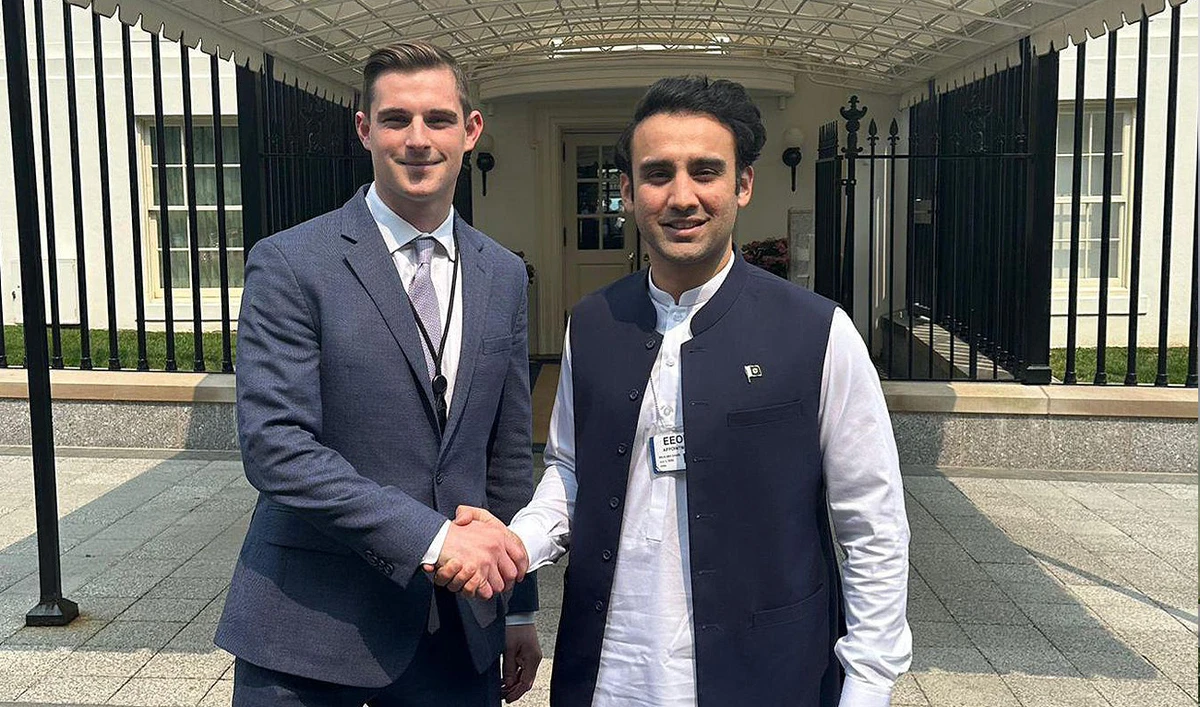
State Minister for Crypto and Blockchain, Bilal Bin Saqib (right) photographed with Trump Council’s Executive Director Bo Hines at White House, Washington DC, US, on June 4, 2025. (@cryptocouncilpk/X)
Short Url
Updated 04 June 2025
Follow

Pakistan blockchain chief meets US counterpart amid digital assets adoption push

  • Bilal Bin Saqib meets the director of Trump’s Council of Advisers for Digital Assets in Washington
  • He says Pakistan is building a real framework for digital asset adoption and economic modernization

KARACHI: Pakistan’s top blockchain policymaker on Wednesday expressed the country’s ambition to become the Global South’s leader in digital assets during a meeting with his American counterpart at the White House in Washington.

Bilal Bin Saqib, Pakistan’s Minister of State for Crypto & Blockchain and CEO of the Pakistan Crypto Council, met with Robert ‘Bo’ Hines, Executive Director of the US President’s Council of Advisers for Digital Assets. The meeting marked a deepening of bilateral engagement on cryptocurrency strategy and blockchain integration between the two countries.

In March, the administration in Islamabad established the Pakistan Crypto Council to help guide national policy on blockchain, digital currencies and crypto-related investments. This was followed by the government’s announcement of a Strategic Bitcoin Reserve (SBR) at the Bitcoin 2025 Conference in Las Vegas, making Pakistan one of the first Asian countries to integrate Bitcoin into its sovereign asset strategy.

The government also plans to establish an autonomous regulatory body to oversee the country’s digital finance and crypto ecosystem.

“I envision Pakistan to be a leader in the Global South for digital assets,” Saqib said according to a statement circulated after the meeting. “From launching our Strategic Bitcoin Reserve to unlocking national infrastructure for crypto mining and AI data zones, Pakistan is building a real framework for digital asset adoption and economic modernization.”

During the meeting, both officials discussed aligning national strategies on decentralized technologies, fostering regulatory coherence and building innovation ecosystems to promote youth engagement and financial inclusion.

Bo Hines, appointed in January by President Donald Trump, heads US policy development on digital assets and works alongside Council Chair David Sacks to position the United States as a global leader in the sector.

Saqib also held a separate meeting with officials from the White House Counsel’s Office to discuss legal frameworks around blockchain governance.

Pakistan’s broader digital asset strategy includes allocating 2,000 megawatts of surplus power to support Bitcoin mining and AI-driven data zones, aiming to turn untapped energy into economic productivity, job creation and digital infrastructure growth.

As regulatory frameworks continue to evolve globally, Pakistan says it is taking proactive steps to integrate private sector innovation with state policy and international partnerships, positioning itself as a key player in the next phase of the global digital economy.


12 killed, 20 injured in suicide blast outside Islamabad district court--official

Updated 8 sec ago
Follow

12 killed, 20 injured in suicide blast outside Islamabad district court--official

  • Security official says blast carried out by “Indian-sponsored” Pakistani Taliban militant group
  • Pakistan has seen resurgence in militant attacks since Afghan Taliban came to power in Afghanistan

ISLAMABAD: Twelve people were killed while 20 others were injured in a suicide blast outside a court in Islamabad on Tuesday, a security official confirmed. 

According to the official, the explosion took place outside a district court in Islamabad’s G-11 sector, saying the blast affected mostly passersby standing nearby at the time of the incident.

So far, no group has claimed responsibility for the attack. However, the official said the blast had been carried out by the Pakistani Taliban or Tehreek-e-Taliban Pakistan (TTP) outfit, which the military frequently describes as “Indian-sponsored” and “Fitna-ul-Khawarij.”

“The bodies of 12 people killed in the explosion have been shifted to Pakistan Institute of Medical Sciences (PIMS) Hospital,” the security official said on condition of anonymity. “Twenty injured have been shifted to emergency room at PIMS Hospital.”

The official said that more wounded persons were being brought into the hospital. 

“The alleged suicide bomber’s severed head was found on the road,” he added. 

Earlier Tuesday, Pakistani security forces said they foiled an attempt by militants to take cadets hostage at an army-run college overnight, when a suicide car bomber and five other Pakistani Taliban fighters targeted the facility in the northwestern Khyber Pakhtunkhwa (KP) province.

The attack started on Monday evening, when a bomber tried to storm the cadet college in Wana, a city in KP near the Afghan border. The area had until recent years served as a base for the Pakistani Taliban, Al-Qaeda and other foreign militants.

According to Alamgir Mahsud, the local police chief, two of the militants were quickly killed by troops while three militants managed to enter the compound before being cornered in an administrative block. The army’s commandoes were among the forces conducting a clearance operation and an intermittent exchange of fire went on into Tuesday, Mahsud said.

The administrative block is away from the building housing hundreds of cadets and other staff.

The Pakistani Taliban, or TTP, denied involvement in the college attack. The group has been emboldened since the Afghan Taliban seized power in Kabul in 2021, and many of its leaders and fighters are believed to have taken refuge in Afghanistan.

With additional input from AP News