

Pakistan blockchain chief meets US counterpart amid digital assets adoption push

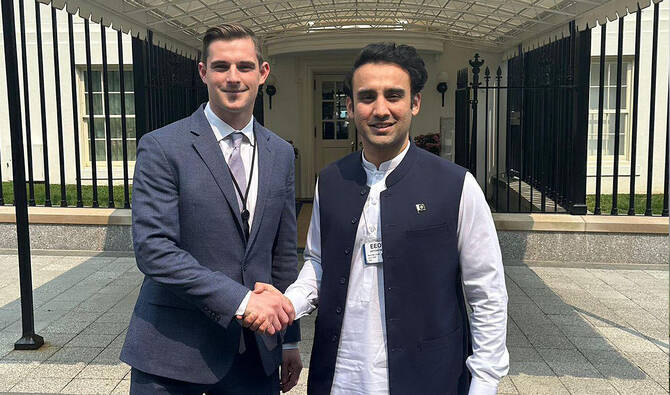
State Minister for Crypto and Blockchain, Bilal Bin Saqib (right) photographed with Trump Council’s Executive Director Bo Hines at White House, Washington DC, US, on June 4, 2025. (@cryptocouncilpk/X)
Short Url
Updated 04 June 2025
Follow

Pakistan blockchain chief meets US counterpart amid digital assets adoption push

  • Bilal Bin Saqib meets the director of Trump’s Council of Advisers for Digital Assets in Washington
  • He says Pakistan is building a real framework for digital asset adoption and economic modernization

KARACHI: Pakistan’s top blockchain policymaker on Wednesday expressed the country’s ambition to become the Global South’s leader in digital assets during a meeting with his American counterpart at the White House in Washington.

Bilal Bin Saqib, Pakistan’s Minister of State for Crypto & Blockchain and CEO of the Pakistan Crypto Council, met with Robert ‘Bo’ Hines, Executive Director of the US President’s Council of Advisers for Digital Assets. The meeting marked a deepening of bilateral engagement on cryptocurrency strategy and blockchain integration between the two countries.

In March, the administration in Islamabad established the Pakistan Crypto Council to help guide national policy on blockchain, digital currencies and crypto-related investments. This was followed by the government’s announcement of a Strategic Bitcoin Reserve (SBR) at the Bitcoin 2025 Conference in Las Vegas, making Pakistan one of the first Asian countries to integrate Bitcoin into its sovereign asset strategy.

The government also plans to establish an autonomous regulatory body to oversee the country’s digital finance and crypto ecosystem.

“I envision Pakistan to be a leader in the Global South for digital assets,” Saqib said according to a statement circulated after the meeting. “From launching our Strategic Bitcoin Reserve to unlocking national infrastructure for crypto mining and AI data zones, Pakistan is building a real framework for digital asset adoption and economic modernization.”

During the meeting, both officials discussed aligning national strategies on decentralized technologies, fostering regulatory coherence and building innovation ecosystems to promote youth engagement and financial inclusion.

Bo Hines, appointed in January by President Donald Trump, heads US policy development on digital assets and works alongside Council Chair David Sacks to position the United States as a global leader in the sector.

Saqib also held a separate meeting with officials from the White House Counsel’s Office to discuss legal frameworks around blockchain governance.

Pakistan’s broader digital asset strategy includes allocating 2,000 megawatts of surplus power to support Bitcoin mining and AI-driven data zones, aiming to turn untapped energy into economic productivity, job creation and digital infrastructure growth.

As regulatory frameworks continue to evolve globally, Pakistan says it is taking proactive steps to integrate private sector innovation with state policy and international partnerships, positioning itself as a key player in the next phase of the global digital economy.


Pakistan mulls 'Super App' for public services, document verification in major technology push

Updated 7 sec ago
Follow

Pakistan mulls 'Super App' for public services, document verification in major technology push

  • Pakistan has been urging technology adoption in public, private sectors as it seeks to become a key tech player globally
  • The country this month launched the Indus AI Week to harness technology for productivity, skills development and innovation

KARACHI: Pakistan is planning to launch a “Super App” to deliver public services and enable digital document verification, the country's information technology (IT) minister said on Sunday, amid a major push for technology adoption in public and private sectors.

Pakistan, a country of 240 million people, seeks to become a key participant in the global tech economy, amid growing interest from governments in the Global South to harness advanced technologies for productivity, skills development and innovation.

The country's information and communications technology (ICT) exports hit a record $437 million in Dec. last year, according to IT Minister Shaza Fatima Khawaja. This constituted a 23% increase month on month and a 26% increase year on year.

Pakistan's technology sector is also advancing in artificial intelligence (AI) and cloud computing, marked by the launch of Pakistan’s first sovereign AI cloud in November, designed to keep sensitive data domestic and support growth in the broader digital ecosystem.

“In developed countries, citizens can access all government services from a mobile phone,” Fatima said, announcing plans for the Super App at an event in Karachi where more than 7,000 students had gathered for an AI training entrance test as part of the ‘Indus AI Week.’

“We will strive to provide similar facilities in the coming years.”

Khawaja said the app will reduce the need for in-person visits to government offices such as the National Database and Registration Authority (NADRA) and the Higher Education Commission (HEC).

The Indus AI Week initiative, which ran from Feb. 9 till Feb. 15. was aimed at positioning Pakistan as a key future participant in the global AI revolution, according to the IT minister.

At the opening of the weeklong initiative, Prime Minister Shehbaz Sharif announced that Pakistan would invest $1 billion in AI by 2030 to modernize the South Asian nation’s digital economy.

“These initiatives aim to strengthen national AI infrastructure and make the best use of our human resource,” Khawaja said, urging young Pakistanis to become creators, inventors and innovators rather than just being the consumers of technology.