

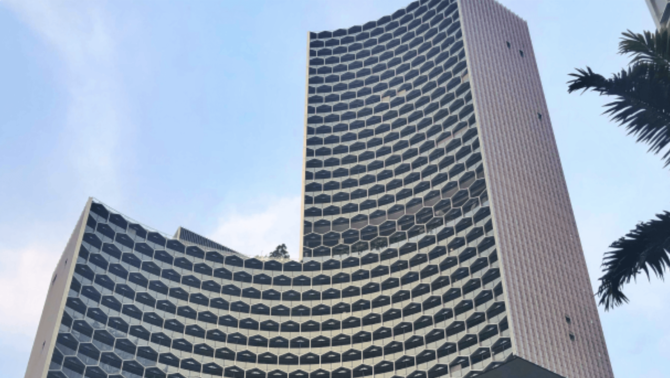
Hong Kong-based Gaw Capital plans to step up Middle East investments

Gaw Capital Partners has raised seven commingled funds targeting Asia Pacific regions since its inception in 2005. Gaw Capital
Short Url
Updated 04 June 2025
Follow

Hong Kong-based Gaw Capital plans to step up Middle East investments

  • Gaw Capital targets UAE, Saudi Arabia for investments
  • Firm plans separate investment vehicle for Middle East

HONG KONG: Gaw Capital plans to bolster investments in the Middle East, its top executive said, as the Hong Kong-based multi-asset investment manager looks to tap into the post-COVID boom in the region’s real estate and other industrial sectors.

Christina Gaw, Gaw’s managing principal and global head of capital markets, said the firm is looking at real estate and other businesses in the UAE and Saudi Arabia as their population has a large demand for real assets.

Gaw acquired a residential building in Abu Dhabi in May for more than $150 million, and signed a pact in November with Expo City Dubai and Lingang Group to explore creating the Expo Life Science Park in Dubai.

The firm, which had $34.4 billion of assets under management as of the end of 2024, expects to close another deal in the region in the second half of the year, said Gaw, whose two elder brothers founded the company in 2005.

Gaw’s interest in the Middle East comes against the backdrop of a post-pandemic property boom there, fueled by business demand and foreign investment.

“(The Middle East) is very wealthy, what can you bring to them? It’s the expertise ... they want to attract talents and different businesses,” Gaw said in an interview. “And we have tenants and business who want to expand there, so we act as a bridge ... to provide them funding and local connections.”

The firm plans to set up a separate vehicle to build an investment track record in the Middle East first before using its main funds in the future.

Gaw, whose main focus has been Greater China and in recent years in Japan and Australia, is also raising a $2 billion fund for private equity and private credit opportunities in Asia Pacific.

The fund is receiving interest from Middle Eastern and Asian investors, as well as in North America, who are looking to diversify amid changing geopolitics.

“Currently the US has many uncertainties. Investors who have been overweighting the US and have done well for many years now may say, ‘I need a little level play’,” Gaw said.

“Asia, on the other hand, has underperformed in the past five years, creating relative value, and people feel they need a repositioning and add some positions in Asia.”

Besides the Middle East, Gaw this year also made investments including more than $1 billion in the Tokyu Plaza Ginza mall in Tokyo with a joint venture partner, and a 45 percent stake in Agility Asset Advisers, a real estate manager in Japan.

In its home market, Gaw said that the firm was focusing on a private credit business linked to upper-middle class residential projects, and was in talks with developers with liquidity needs as well as banks that are selling their non-performing loans. 


Industry leaders highlight Riyadh’s Metro, infrastructure as investment catalysts

Updated 29 December 2025
Follow

Industry leaders highlight Riyadh’s Metro, infrastructure as investment catalysts

RIYADH: Saudi Arabia’s capital, Riyadh, is experiencing a transformative phase in its real estate sector, with the construction market projected to reach approximately $100 billion in 2025, accompanied by an anticipated annual growth rate of 5.4 percent through 2029.

The Kingdom is simultaneously advancing its data center capacity at an accelerated pace, with an impressive 2.7 GW currently in the pipeline. This expansion underscores the critical role of strategic land and power planning in establishing national infrastructure as a cornerstone of economic growth.

These insights were shared by leading industry experts during JLL’s recent client event in Riyadh, which focused on the city’s macroeconomic landscape and emerging trends across office, residential, retail, hospitality, and pioneering sectors, including AI infrastructure and Transit-Oriented Development.

Saud Al-Sulaimani, Country Lead and Head of Capital Markets at JLL Saudi Arabia, commented: “Riyadh is positioned at the forefront of Saudi Arabia’s Vision 2030, offering unparalleled opportunities for both investors and developers. National priorities are continuously recalibrated to ensure strategic alignment of projects and foster deeper collaboration with the private sector.”

He added: “Recent regulatory developments, including the introduction of the White Land Tax and the rent freeze, are designed to stabilize the market and are expected to drive renewed focus on delivering premium-quality assets. This dynamic environment, coupled with evolving construction cost considerations in select segments, is fundamentally reshaping the market landscape while accelerating progress toward our national objectives.”

The event further underscored the transformative impact of infrastructure initiatives. Mireille Azzam Vidjen, Head of Consulting for the Middle East and Africa at JLL, highlighted Riyadh’s transit revolution. She detailed the Riyadh Metro, a $22.5 billion investment encompassing 176 kilometers, six lines, and 84 stations, providing extensive geographic coverage, with a depth of 9.8 km per 100 sq. km. This strategic development generates significant TOD opportunities, with properties in proximity potentially commanding a 20-30 percent premium. JLL emphasized the importance of implementing climate-responsive last-mile solutions to enhance mobility and accessibility, particularly given Riyadh’s extreme temperatures.

Gaurav Mathur, Head of Data Centers at JLL, emphasized the rapid expansion of the Kingdom’s AI infrastructure, signaling a critical area for technological investment and innovation.

Focusing on the construction sector, Maroun Deeb, Head of Projects and Development Services, KSA at JLL, explained that the industry is actively navigating complexities such as skilled labor availability, material costs, and supply chain dynamics.

He highlighted the adoption of Building Information Modeling as a key driver for enhancing operational efficiency and project delivery.