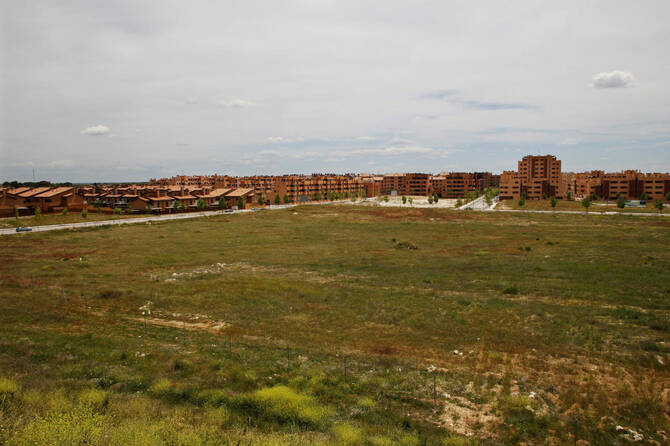
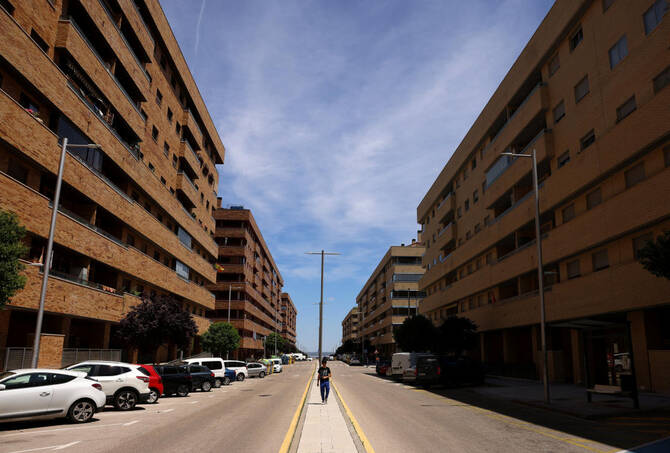

SESENA, Spain: The first call came two minutes after estate agent Segis Gomez posted a listing in Sesena, a development near Madrid that gained notoriety as one of the so-called “ghost towns” created when Spain’s property bubble burst in 2008.
Half-built and half-empty for more than a decade, these days the squatters have gone from this development 40 kilometers south of the capital and middle-class families, driven out of the city center by an acute housing crisis, are moving in. Construction, meanwhile, has restarted.
Demand is so strong in Sesena that Gomez has a waiting list of 70 people for each property. Property prices have recovered their original value after plunging to less than half during the crisis, he said.
As anger grows over the cost of housing in Spain, Prime Minister Pedro Sanchez has made providing affordable homes one of his main goals – even as he encourages population growth through immigration. The size of the challenge is clear in Madrid, which grew by 140,000 people in 2024, but only registered permits to build 20,000 new homes.
Short supply is being exacerbated by a boom in holiday lets, record migration and onerous planning laws.
“The problem is that we can’t match supply and demand quickly enough. So prices go up, or people have to trade price for distance,” said Carles Vergara, a real estate professor at IESE Business School in Madrid.
Sesena has been adopted as a commuter town as Madrid overflows, even though it is located in the neighboring Castile-La Mancha region and still lacks good transport links to the capital and public services, which caused homebuyers to reject it in the past.
Its founder and original developer, Francisco Hernando, had a vision of 13,000 affordable apartments with gardens and swimming pools on the Spanish plain where author Cervantes set his best-known work Don Quixote, but the project became a byword for speculative greed and corruption. Only 5,000 homes ended up being built. Hernando, who began his project in 2004, failed to tell homebuyers he hadn’t secured access to water or that the town had no public transport or schools. Hernando died in 2020.
When the market collapsed, initial investors saw the value of their property plummet, while many homes ended up in the hands of banks.
Madrid’s expansion
Today, Sesena teems with life as parents drop children at its three schools, drink coffee in its bars and visit recently-opened gyms and pharmacies. Impact Homes, a developer, is constructing 156 one-to-four bedroom apartments it expects to complete this year. Next door, another building has already pre-sold 49 percent of its units, it said in an email. “Sesena is at 100 percent,” said Jaime de Hita, the town’s mayor.
Nestor Delgado moved to Sesena in 2021 with his family from Carabanchel in south Madrid because an apartment cost 20 percent less to rent. In May, he bought a house with his wife for €240,000 ($272,808).
“We chose (Sesena) because we can afford it,” Delgado, 34, said.
The trade-off is rising before 5 a.m. (0300 GMT) to be among the first in the queue for the 6.30 a.m. bus to Madrid to arrive at his construction job by 8 a.m. or face an hour’s wait for the next bus.
Back to life
Other ghost towns are also coming back to life. Valdeluz, a development 75 km east of Madrid originally envisioned to house 30,000 people, was abandoned a quarter of the way through when the property bubble burst.
Mayor Enrique Quintana told Reuters the town’s 6,000-strong population is swelling with people from Madrid and could expand by 50 percent in the next four years.
A development on the edge of the village of Bernuy de Porreros, 100km north of Madrid, which as recently as six years ago was mostly abandoned, is now bustling with activity as handymen put the finishing touches on homes.
Lucia, a 37-year-old state employee, bought her house in April. Her daily commute to Madrid involves a 15-minute drive to the train station in Segovia and 28 minutes on the high-speed train, which costs her 48 euros for 30 trips thanks to a frequent traveler discount.
The development began to revive when Spain’s so-called bad bank Sareb, which was set up to take bad loans from the financial crisis, in 2021 began selling the homes for as little as €97,000. Four years later, one property was resold for double that, said resident Nuria Alvarez.
Until recently a relatively compact city, Madrid is on the way to becoming a metropolis like Paris or London, with commuter zones stretching beyond its administrative boundaries, said Jose Maria Garcia, the regional government’s deputy housing minister.
The metropolitan area’s population of 7 million will grow by a million in the next 15 years, the government estimates. Madrid has a deficit of 80,000-100,000 homes that’s growing by 15,000 homes a year and plans to build 110,000 homes by 2028, Garcia said.
Sesena, meanwhile, is once again dreaming big.
Its mayor, de Hita, said the town is securing permits for a new project dubbed Parquijote, with a proposed investment of €2.3 billion to build a logistics park that will create local jobs, along with 2,200 homes.
It’s no quixotic fantasy, de Hita said.
“This time we have learned from what happened,” he said. “It is fundamental that we look for growth by learning from the past.”