NATO’S Baltic drills are part of preparations for a potential clash with Russia, TASS reports

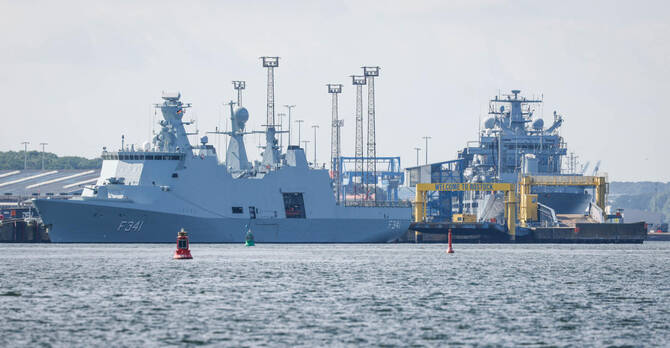
Above, the Danish frigate Absalon, left, and the German navy supply vessel Frankfurt am Main are moored at the Ubersee port in Rostock, northern Germany, on June 3, 2025 before they set sail on June 5 for the major NATO exercise BALTOPS. (AFP)
Short Url
Updated 04 June 2025
Follow

NATO’S Baltic drills are part of preparations for a potential clash with Russia, TASS reports

  • BALTOPS – NATO’s annual exercise in the Baltic Sea and the regions surrounding it – is being held this month

NATO’S Baltic drills are part of the alliance’s preparations for a potential military clash with Russia, TASS news agency cited Russia’s Deputy Foreign Minister Alexander Grushko as saying in remarks published on Wednesday.

“We assess NATO’s military activity as part of preparations for military clashes with Russia,” TASS cited Grushko as saying.

“If we look at the focus of these exercises, the concept, the structure of the deployment of forces, the forces themselves, their quality, the tasks that are formulated for these exercises, then this is a fight against a comparable adversary,” Grushko said according to TASS.

BALTOPS – NATO’s annual exercise in the Baltic Sea and the regions surrounding it – is being held this month.


Mali, Burkina say restricting entry for US nationals in reciprocal move

Updated 31 December 2025
Follow

Mali, Burkina say restricting entry for US nationals in reciprocal move

  • Both countries said they are applying the same measures on American nationals as imposed on them

ABIDJAN: Mali and Burkina Faso have announced travel restrictions on American nationals in a tit-for-tat move after the US included both African countries on a no-entry list.
In statements issued separately by both countries’ foreign ministries and seen Wednesday by AFP, they said they were imposing “equivalent measures” on US citizens, after President Donald Trump expanded a travel ban to nearly 40 countries this month, based solely on nationality.
That list included Syrian citizens, as well as Palestinian Authority passport holders, and nationals of some of Africa’s poorest countries including also Niger, Sierra Leone and South Sudan.
The White House said it was banning foreigners who “intend to threaten” Americans.
Burkina Faso’s foreign ministry said in the statement that it was applying “equivalent visa measures” on Americans, while Mali said it was, “with immediate effect,” applying “the same conditions and requirements on American nationals that the American authorities have imposed on Malian citizens entering the United States.”
It voiced its “regret” that the United States had made “such an important decision without the slightest prior consultation.”
The two sub-Saharan countries, both run by military juntas, are members of a confederation that also includes Niger.
Niger has not officially announced any counter-measures to the US travel ban, but the country’s news agency, citing a diplomatic source, said last week that such measures had been decided.
In his December 17 announcement, Trump also imposed partial travel restrictions on citizens of other African countries including the most populous, Nigeria, as well as Ivory Coast and Senegal, which qualified for the football World Cup to be played next year in the United States as well as Canada and Mexico.