Pakistan stock market hits record high on ADB funding boost, insurance sector buying

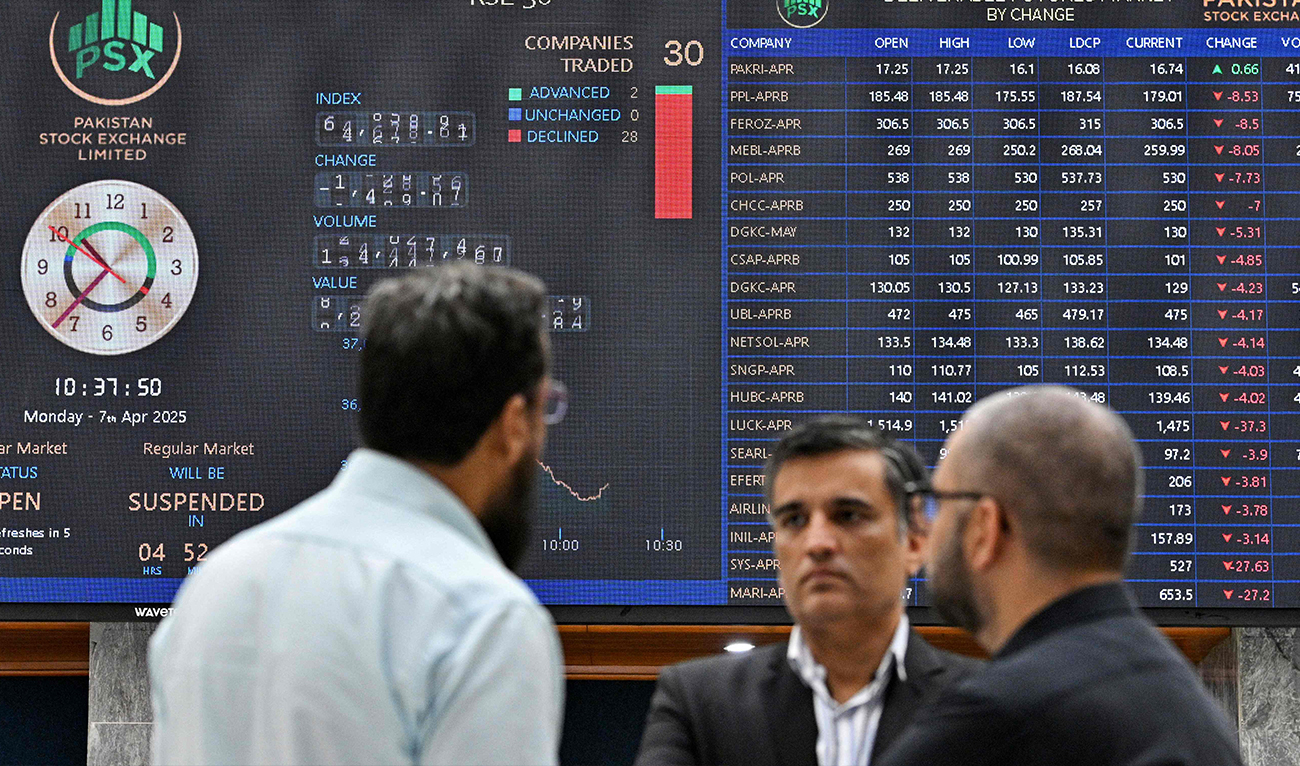
Stock brokers monitor share prices on a digital screen during a trading session at the Pakistan Stock Exchange (PSX) as index plummeted amid a global market crash, in Karachi on April 7, 2025. (AFP/File)
Short Url
Updated 03 June 2025
Follow

Pakistan stock market hits record high on ADB funding boost, insurance sector buying

  • The benchmark KSE-100 index gained 1,573.07 points, or 1.32 percent, during Tuesday’s trading
  • Anticipated relief for oil refineries, real estate and agri sectors played catalyst role, analysts say

ISLAMABAD: The Pakistan Stock Exchange (PSX) surged to an all-time high of more than 120,000 points on Tuesday, with analysts attributing the rally to the Asian Development Bank’s (ADB) financing package for Pakistan and strong buying by insurance companies in banking, fertilizer and power sectors.

The benchmark KSE-100 index closed at an unprecedented high of 120,450.87 points, marking a gain of 1,573.07 points, or 1.32 percent, from the previous day’s close of 118,877.80.

The development follows the ADB’s approval of an $800 million package to help Pakistan enhance fiscal reforms and economic stability, alongside the government’s approval of over Rs800 billion for public sector development projects in the upcoming budget.

“Stocks closed all time high led by scrips across the board after ADB approval of $800 million financing package,” Ahsan Mehanti, CEO of Arif Habib Commodities, told Arab News.

“Government set FY26 growth target at 4.2percent and government approval for Rs880 billion PSDP in the federal budget FY26 announcements next week.”

Mehanti said the anticipated budgetary relief for oil refineries, real estate and agriculture sectors, along with gains in rupee’s value, played a catalytic role in the bullish close at the PSX.

Raza Jafri, head of Intermarket Securities, said this was the first time the KSE-100 Index has ever closed above the 120,000-point mark.

“Strong buying by insurance companies in sectors such as banks, fertilizers and power led the market higher,” he said.

The budget for fiscal year 2025–26 is expected to be presented in Pakistan’s lower house of parliament on June 10, following the Eid Al-Adha holidays.

Pakistan’s annual inflation rate rose to 3.5 percent in May, though the country’s macroeconomic outlook has improved in recent months, supported by a stronger current account balance, increased remittances and declining inflation.

Authorities remain cautious as they aim to build on recent economic stabilization, guide the country toward gradual growth, and reaffirm their commitment to ongoing economic reforms.
Pakistani, Bangladeshi officials discuss trade, investment and aviation as ties thaw

Updated 28 December 2025
Follow

Pakistani, Bangladeshi officials discuss trade, investment and aviation as ties thaw

  • Pakistan and Bangladesh were once one nation, but they split in 1971 as a result of a bloody civil war
  • Ties between Pakistan, Bangladesh have warmed up since last year and both nations have resumed sea trade

ISLAMABAD: Pakistan's High Commissioner to Bangladesh Imran Haider on Sunday met Chief Adviser Muhammad Yunus in Dhaka, the latter's office said on, with the two figures discussing trade, investment and aviation.

Pakistan and Bangladesh were once one nation, but they split in 1971 as a result of a bloody civil war, which saw the part previously referred to as East Pakistan seceding to form the independent nation of Bangladesh.

Ties between Pakistan and Bangladesh have warmed up since former prime minister Sheikh Hasina’s ouster as a result of a student-led uprising in August 2024. Relations remain frosty between Dhaka and New Delhi over India’s decision to grant asylum to Hasina.

Pakistan has attempted to forge closer ties with Bangladesh in recent months and both South Asian nations last year began sea trade, followed by efforts to expand government-to-government commerce.

"During the meeting, both sides discussed ways to expand cooperation in trade, investment, and aviation as well as scaling up cultural, educational and medical exchanges to further strengthen bilateral relations between the two South Asian nations," Yunus's office said in a statement on X.

In 2023-24 Pakistan exported goods worth $661 million to Bangladesh, while its imports were only $57 million, according to the Trade Development Authority of Pakistan. In Aug. this year, the Pakistani and Bangladeshi commerce ministries signed a memorandum of understanding to establish a Joint Working Group on Trade, aiming to raise their bilateral trade volume to $1 billion in the financial year that began in July.

The Pakistani high commissioner noted that bilateral trade has recorded a 20 percent growth compared to last year, with business communities from both countries actively exploring new investment opportunities, according to the statement.

He highlighted a significant increase in cultural exchanges, adding that Bangladeshi students have shown strong interest in higher education opportunities in Pakistan, particularly in medical sciences, nanotechnology, and artificial intelligence. Haider also said that Dhaka-Karachi direct flights are expected to start in January.

"Chief Adviser Professor Muhammad Yunus welcomed the growing interactions between the two countries and emphasized the importance of increased visits as well as cultural, educational and people-to-people exchanges among SAARC (South Asian Association for Regional Cooperation) member states," the statement read.

"Professor Yunus also underscored the need to further boost Bangladesh–Pakistan trade and expressed hope that during Mr. Haider’s tenure, both countries would explore new avenues for investment and joint venture businesses."