

Russia urges normal India-Pakistan ties, eyes deeper counterterrorism cooperation with Islamabad

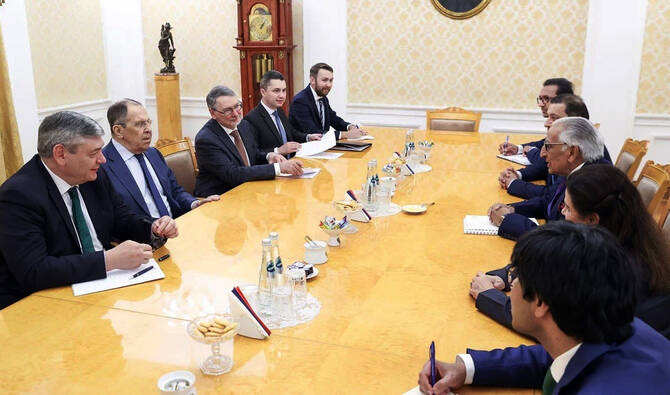
Special Assistant to the Prime Minister of Pakistan, Syed Tariq Fatemi (third right), meets Russian Foreign Minister, Sergey Lavrov (second left) in Moscow, Russia, on June 3, 2025. (Photo Courtesy: Ministry of Foreign Affairs of Russia)
Short Url
Updated 03 June 2025
Follow

Russia urges normal India-Pakistan ties, eyes deeper counterterrorism cooperation with Islamabad

  • Senior Pakistani official Syed Tariq Fatemi briefs Russia’s Sergey Lavrov on India standoff during Moscow visit
  • The Russian foreign minister expressed satisfaction over growing ties, including cooperation on new steel mills

ISLAMABAD: Russian Foreign Minister Sergey Lavrov on Tuesday called for normal relations between India and Pakistan and expressed interest in closer counterterrorism cooperation with Islamabad during a meeting with a senior aide of Pakistan’s Prime Minister Shehbaz Sharif in Moscow.

The meeting came as Syed Tariq Fatemi, special assistant to the prime minister, began a visit to Russia weeks after India and Pakistan exchanged missiles, drones and artillery fire, following heightened tensions that ended with a US-brokered ceasefire on May 10.

Pakistan has since call for a “composite dialogue” with India to discuss all outstanding issues, though New Delhi has rejected direct talks after Washington said the two countries had agreed to meet at a neutral venue to defuse tensions.

Both sides have also formed delegations to present their respective positions over the conflict to the international community.

“At the outset of his visit to the Russian Federation, Syed Tariq Fatemi, Special Assistant to the Prime Minister (SAPM) called on Sergey Lavrov, Russian Foreign Minister, this afternoon,” Pakistan’s embassy in Moscow said in a statement. “He also briefed the Russian Foreign Minister, in detail, about the recent developments in South Asia, conveying Pakistan’s perspective on the dangers of escalation as well as the dire consequences of India’s threat to reduce the flow of the Indus Waters Treaty, by holding the Treaty in a so-called ‘abeyance.’”

“Foreign Minister Lavrov stressed Russia’s support for promotion of normal relations between the two countries and its positive effect in the region,” the statement added.

Fatemi also delivered a letter from Prime Minister Sharif to President Vladimir Putin and conveyed Pakistan’s desire to expand cooperation with Russia in areas including energy, trade and connectivity.

Lavrov, for his part, expressed satisfaction over the “steadily growing bilateral cooperation” and cited specific initiatives, including new steel mills and connectivity projects.

“He [Lavrov] also stated that Russia looked forward to working closely with Pakistan, within the framework of the Shanghai Cooperation Organization (SCO), especially in the field of counter-terrorism,” the embassy said.

Russia and Pakistan have strengthened ties in recent years through growing bilateral cooperation, particularly in energy, and by working together on regional platforms such as the SCO, where both are full members.


Curfew extended in Gilgit-Baltistan, probe ordered after deadly Khamenei protests

Updated 03 March 2026
Follow

Curfew extended in Gilgit-Baltistan, probe ordered after deadly Khamenei protests

  • At least 15 people were killed in clashes with law enforcement agencies over the weekend in Gilgit-Baltistan
  • Government also announces a de-weaponization campaign, crackdown on hate speech and cybercrime in region

ISLAMABAD: The government in Pakistan’s Gilgit-Baltistan (GB) region on Tuesday extended a curfew in Gilgit district and ordered a judicial probe into violent protests over the killing of Iranian Supreme Leader Ali Khamenei in US-Israeli strikes last week, an official said.

At least 15 people were killed in clashes with law enforcement agencies over the weekend in GB, where protesters torched and vandalized several buildings, including United Nations regional offices, an army-run school, software technology park and a local charity building.

The violence prompted regional authorities to impose curfew in Gilgit and Skardu districts on March 2-4 as officials urged people to stay indoors and cooperate with law enforcers, amid widespread anger in Pakistan, particularly among members of the Shiite minority, over Khamenei’s killing.

On Tuesday, the GB government convened to review the situation and announced the extension of curfew in Gilgit among a number of security measures as well as ordered the establishment of a judicial commission to investigate the weekend violence in the region.

“The government has made it clear that the law will strictly take its course against elements involved in vandalism at government institutions, private properties and incidents of vandalism in Gilgit and Skardu and no kind of mischief will be tolerated,” Shabbir Mir, a GB government spokesperson, said in a statement.

“In view of the security situation, curfew will remain in force in Gilgit, while the decision to extend the curfew in Skardu will be taken keeping the ground realities and the changing situation in view.”

The statement did not specify how long the curfew will remain in place in Gilgit.

Besides the formation of the judicial commission to investigate the violent clashes, the government also decided to launch a large-scale de-weaponization campaign in the entire Gilgit district, for which relevant institutions have been directed to immediately complete all necessary arrangements, according to Mir.

In addition, a crackdown has been ordered on hate speech, spread of fake news and cybercrime.

“The aim of these decisions is to ensure the rule of law, protect the lives and property of citizens and crack down on miscreants,” he said. “Approval has also been given to immediately survey the affected infrastructure and start their restoration work on priority basis.”

Demonstrators in Pakistan’s southern port city of Karachi also stormed the US Consulate on Sunday, smashing windows and attempting to burn the building. Police responded with batons, tear gas, and gunfire, leaving 10 people dead and more than 50 injured.

Pakistani authorities have since beefed up security at US diplomatic missions across the country, including around the US consulate building in Peshawar, to avoid any further violence.