



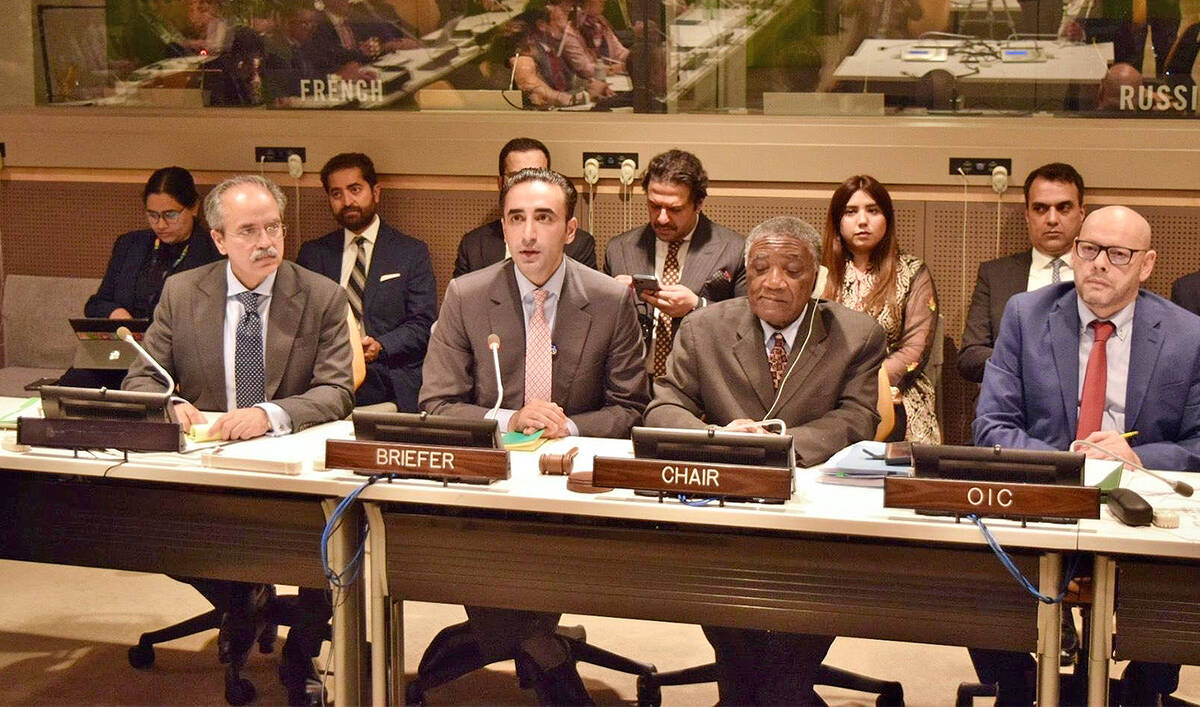
ISLAMABAD: A high-level Pakistani delegation set up by Prime Minister Shehbaz Sharif this week briefed members of the Organization of Islamic Cooperation (OIC) at the United Nations, calling for the resumption of a “comprehensive dialogue” with India to resolve the Kashmir dispute and other issues, Pakistan’s mission to the UN said.
Led by former foreign minister Bilawal Bhutto Zardari, the nine-member parliamentary delegation arrived in New York on Monday as the first stop in a diplomatic mission to present Pakistan’s position in world capitals following Islamabad’s recent military conflict with India. The group headed by Bhutto Zardari will visit New York, Washington DC, London and Brussels. Another delegation, led by Special Assistant to the Prime Minister Syed Tariq Fatemi, will also visit Moscow.
Tensions between Pakistan and India are high after they struck a ceasefire on May 10 following the most intense military confrontation between the nuclear-armed neighbors in decades. Both countries accuse the other of supporting militancy on each other’s soil — a charge both capitals deny.
The latest escalation last month took place following weeks of tensions after India blamed Pakistan for supporting an April 22 attack on the Kashmir territory it governs that killed 26 tourists. Pakistan denied involvement in the incident and called for an international probe. Both countries traded missiles, artillery fire and drone strikes before Washington brokered a ceasefire on May 10.
“He [Bhutto Zardari] reaffirmed Pakistan’s commitment to peace, restraint, and diplomacy, and called for the restoration of the Indus Waters Treaty, full respect for the ceasefire, and the resumption of a comprehensive dialogue with India, with the resolution of the Jammu and Kashmir dispute at its core,” Pakistan’s Permanent Mission to the United Nations said in a statement on Monday.
Members of a high-level Pakistani parliamentary delegation, led by former foreign minister Bilawal Bhutto-Zardari (fifth from right), pose for a picture in New York, US, on June 2, 2025. (Ministry of Foreign Affairs)
Following the attack at the Pahalgam tourist resort in April, India suspended the decades-old Indus Waters Treaty with Pakistan. The move drew a sharp response from Islamabad, which said any attempts to divert or stop the flow of its waters by India would be considered an “act of war.”
About 80 percent of Pakistani farms depend on the Indus system, as do nearly all hydropower projects serving the country of some 250 million.
“Mr. Bhutto expressed grave concern at the unilateral suspension of the Indus Waters Treaty — a move that Pakistan considers a blatant act of weaponizing water and a violation of international and treaty obligations,” the statement said.
The former Pakistani foreign minister thanked OIC countries for their efforts and role aimed at de-escalation, mediation and ceasefire during the conflict. He highlighted that the only path to peace was in dialogue, engagement and diplomacy.
“Mr. Bilawal Bhutto underlined that OIC has emerged as the moral conscience of the world in these difficult times and thanked the OIC member states for their steadfast support for the people of Jammu and Kashmir,” the statement said.
The statement said that the OIC’s permanent representatives appreciated Pakistan’s briefing and reaffirmed their solidarity with the country.
“They reiterated their concern over the worsening security situation in South Asia and stressed the importance of upholding the principles of the UN Charter and international law and in this regard, the sanctity of treaties, including the Indus Waters Treaty,” Pakistan’s permanent mission to the UN said.
Separately, the delegation also met Ambassador Carolyn Rodrigues-Birkett, president of the UN Security Council for June, according to a press release issued by
Bhutto Zardari’s residence, Bilawal House.
“The Pakistani delegation stressed that in the face of a growing trend of unilateralism and escalation, the Security Council must play its crucial role to ensure peace and conflict resolution,” it said.
The delegation urged the Security Council to play a “proactive role” in promoting de-escalation, ensuring respect for international law and treaties and facilitating peaceful resolution of disputes.
The statement said Birkett reaffirmed the Security Council’s commitment to upholding international peace and security in line with its mandate.


