

Unseeded Frenchwoman Boisson stuns Pegula and joins No. 2 Gauff in the quarterfinals

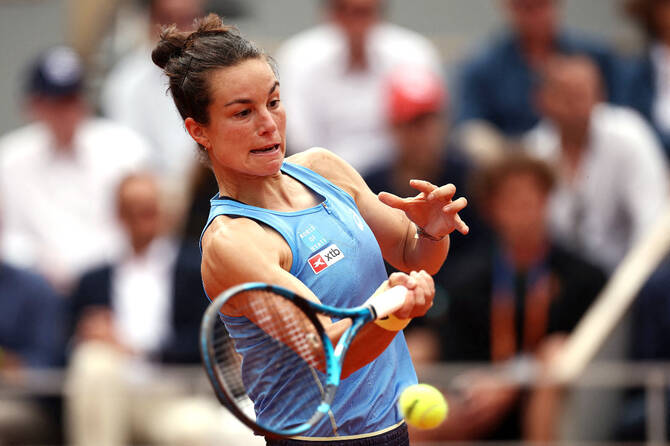
France’s Lois Boisson plays a shot against Jessica Pegula of the US during their women’s singles match in the French Open tennis tournament on Court Philippe-Chatrier at Roland-Garros Complex in Paris on Monday. (AFP)
Short Url
Updated 02 June 2025
Follow

Unseeded Frenchwoman Boisson stuns Pegula and joins No. 2 Gauff in the quarterfinals

  • Boisson, a wild card entry ranked 361st, threw her head back and roared after beating third-seeded American Jessica Pegula 3-6, 6-4, 6-4 on Court Philippe-Chatrier in Monday’s fourth-round play

PARIS: Lois Boisson had never even played at the French Open before, let alone in the biggest arena at Roland-Garros, and now the unseeded 21-year-old Frenchwoman is through to the quarterfinals.

Boisson, a wild card entry ranked 361st, threw her head back and roared after beating third-seeded American Jessica Pegula 3-6, 6-4, 6-4 on Court Philippe-Chatrier in Monday’s fourth-round play.

Quite some victory, considering Pegula was the US Open runner-up last year. Understandably, Boisson was nervous as she served for the match and saved three break points.

After Pegula missed an easy-looking winner at the net, and then clutched her head in her hands, Boisson had her first match point, and the biggest point of her career so far.

Pegula returned a strong serve to the back of the court, where Boisson unleashed a brilliant forehand winner down the line. She then raised her arms in the air, realizing the enormity of her win.

“I really don’t know what to say, but ‘Thank you to all of you’” Boisson told the crowd in her post-match interview. “Playing on this court with such an atmosphere was really incredible.”

Boisson made the notoriously hard-to-please crowd laugh when she added: “I’m really happy on here. I can stay a long time if you like.”

The crowd broke into chants of “Lois, Lois” and she waved back to them.

She was in the news last month. British player Harriet Dart apologized to Boisson after asking the chair umpire to tell her to put some deodorant on. Now she’s the only French player — male or female — left at Roland-Garros.

Asked what her ambitions were for the rest of the tournament — she plays sixth-seeded Mirra Andreeva on Wednesday in the quarterfinals — she replied, “I hope to win, right?”

That prompted more laughter from the crowd at Court Philippe-Chatrier, which included tournament director Amelie Mauresmo, who has been criticized in some quarters for the lack of women playing in the night session.

Top-ranked Jannik Sinner was playing his fourth-round match later Monday in the night session against No. 17 Andrey Rublev, following 24-time Grand Slam winner Novak Djokovic’s match against Britain’s Cameron Norrie.

What else happened at the French Open on Monday?

In other women’s fourth-round play, second-seeded Coco Gauff, the 2023 US Open champion, won 6-0, 7-5 against No. 20 Ekaterina Alexandrova.

Over on Court Suzanne-Lenglen, the 18-year-old Andreeva, who reached the semifinals at Roland-Garros last year for her best performance at a major, won 7-5, 6-3 against No. 17 Daria Kasatkina. She playfully threw her wristband at Andreeva when they came to the net and Andreeva joked she would keep it.

No. 7 Madison Keys also advanced on Court Suzanne-Lenglen after beating Hailey Baptiste 6-3, 7-5 in an all-American contest. There’s another one coming up for Keys against Gauff.

In remaining men’s fourth-round play, No. 3 Alexander Zverev, last year’s runner-up, was leading 6-4, 3-0 against Tallon Griekspoor when the unseeded Dutch player retired from the match. He later said it was due to an abdominal strain.

Who is playing Tuesday at Roland-Garros?

The quarterfinals are underway, with two men’s matches and two women’s matches, all on Court Philippe-Chatrier.

Top-ranked Aryna Sabalenka faces Olympic champion Qinwen Zheng followed by defending women’s champ Iga Swiatek against No. 13 Elina Svitolina.

The first men’s contest sees eighth-seeded Italian Lorenzo Musetti take on No. 15-seeded American Frances Tiafoe, before defending champion Carlos Alcaraz plays 12th-seeded American Tommy Paul. 


MESIF 2026 wraps up in Riyadh with spotlight on legacy, fans and sustainable sports growth

Updated 28 January 2026
Follow

MESIF 2026 wraps up in Riyadh with spotlight on legacy, fans and sustainable sports growth

  • A recurring theme in panel discussions was the importance of moving beyond siloed planning toward connected strategies
  • Abdullah Aldrees: I believe Saudi is a sleeping giant within the football ecosystem because of the high demand that exists

RIYADH: The sixth edition of the Middle East Sports Investment Forum concluded on Jan. 28 in Riyadh, reinforcing the need for long-term legacy planning, integrated infrastructure development and fan-centric strategies as the region’s sports ecosystem continues to mature.

Held over two days — Jan. 27-28 — at the ministry of investment headquarters and the Kingdom Arena, the forum brought together senior government officials, global sports executives, investors and technology leaders to assess how the Middle East — and Saudi Arabia in particular — can translate major event hosting and increased investment into sustainable impact.

A recurring theme in panel discussions was the importance of moving beyond siloed planning toward connected strategies that link infrastructure, finance, fan engagement and legacy from the earliest stages of project development.

Dr. Sakis Batsilas, deputy CEO of FIFA World Cup Qatar 2022, stressed that while international expertise has played a key role in the region’s rapid progress, long-term success depends on knowledge transfer and talent development.

“Yes, we do need experts and consultants and expatriates to help,” he said. “But the main, I would say, focus, is how we ensure that we transfer this knowledge and we build talent … to make sure we have the right talent.”

Drawing on his experience delivering major global events, Batsilas highlighted the need to embed legacy considerations during the bidding phase.

“Talking now from an operational point of view … I think everything starts with a bidding phase,” he said, adding that stronger legacy metrics would encourage greater long-term planning from host nations and rights holders alike.

Fan experience and commercialization also featured prominently, particularly as Saudi Arabia continues to expand its domestic leagues and host major international competitions. David Davies, chief experience officer of Catapult, said the Kingdom’s challenge lies in converting strong digital fandom into sustained in-stadium engagement.

“Saudi Arabia is … ranked consistently in the highest in the world” in terms of football fandom, Davies said. “However, attendance in-stadium is still developing.” He noted that younger, digitally native audiences require tailored engagement strategies. “The days of being able to ask them to come to you have gone,” he said.

From a government and delivery perspective, Abdullah Aldrees, chief of staff at the vice minister’s executive office at the ministry of sport, said MESIF highlighted the scale of opportunity ahead — and the importance of a joined-up approach.

“I believe Saudi is a sleeping giant within the football ecosystem because of the high demand that exists, the government support and the anchor IPs that we’re hosting,” Aldrees said. “So all of this can create a lot of opportunities for football to grow in Saudi.”

He said the Kingdom has entered a critical preparation phase as it gears up for a packed calendar of major events. “We are now living in the preparation phase. We’re preparing for all these IPs, we’re preparing for all these big events coming up,” Aldrees said. “So how do you make sure that you really reap the right benefit from them and have the right legacy?”

Pointing to upcoming milestones such as the AFC Asian Cup Saudi Arabia 2027 and the FIFA World Cup 2034, Aldrees emphasized the need to think beyond hosting.

“Yes, we’re hosting World Cup. We’re hosting Asia 2027, but how do you make sure that they have a long, lasting impact on the ecosystem?” he said.

Echoing a key message from the forum, Aldrees concluded: “The effective strategy is to be looking at these things together. We no longer can be looking at them as silos and test cycles.”

The transformation of Saudi football was also highlighted as a reflection of broader cultural and structural change. Juan Esteban Gomez, a football expert specializing in digitalization and artificial intelligence, said the shift has been tangible in recent years. “The people here are breathing football,” he said, describing the Saudi league as “one of the most enjoyable competitions in the world.”

As MESIF 2026 drew to a close, participants agreed that the next phase of sports investment in the Middle East will be defined by execution — ensuring that capital, policy and innovation align to deliver measurable legacy, deeper fan engagement and resilient ecosystems capable of sustaining growth well beyond headline events.