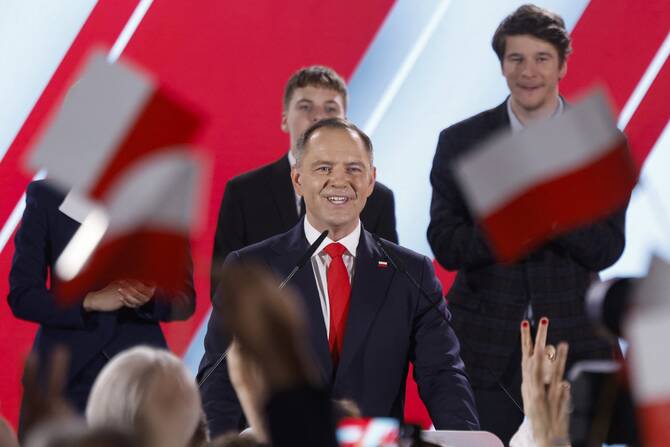
WARSAW: The victory of nationalist Karol Nawrocki in Poland’s presidential election looks set to strain relations with Ukraine and embolden Donald Trump-inspired conservatives in central Europe, analysts and diplomats said on Monday.
Nawrocki won a knife-edge vote that pitted him against Warsaw Mayor Rafal Trzaskowski, who was supported by the ruling centrists Civic Coalition (KO), dealing a major blow to the pro-European government of Prime Minister Donald Tusk.
While remaining committed to helping Ukraine’s effort to fend off Russian’s invasion, Nawrocki opposes Kyiv joining Western alliances such as NATO.
Nawrocki rejects suggestions that his stance is pro-Russian. But his campaign, backed by the nationalist opposition party Law and Justice (PiS), tapped into a mix of weariness with Ukrainian refugees and worries Poland could be drawn into the war over the border that many Polish voters feel.
All parties in Poland have ruled out sending troops to Ukraine.
Although real executive power lies with the government, the Polish president has veto powers, meaning he can stymie the government’s agenda. The head of state can also propose laws.
Nawrocki signed a declaration saying he would not ratify Ukraine’s accession to NATO, as it could result in the alliance being drawn into a conflict with Russia, a move that was sharply criticized by Kyiv’s ambassador to Warsaw and which marked a departure from previous Polish policy under both PiS and KO.
Ukrainian President Volodymyr Zelensky congratulated Nawrocki on Monday and said he looked forward to future “fruitful cooperation” with Poland.
But elsewhere in Ukraine, the mood was less positive.
“The choice of the Poles will most likely complicate the dialogue within the EU and our European integration,” Ukrainian lawmaker Ivanna Klympush-Tsintsadze was quoted as saying by Interfax-Ukraine.
A European diplomat based in Warsaw said that while policy on Ukraine’s future in the EU and NATO would continue to be set by Tusk’s government, Nawrocki could create “a shift in tone that’s not going to be helpful.”
In his role as head of Poland’s Institute of National Remembrance, Nawrocki has been a harsh critic of what he said was Ukraine’s reluctance to exhume the remains of Polish victims killed by Ukrainian nationalists during World War Two.
Euroskeptic politicians
Nawrocki’s campaign echoed the language of other euroskeptic politicians in central Europe, lambasting a perceived over-reach of Brussels into areas that they consider should be the domain of individual countries.
“Yes, we want a common market, we want development, we want to be a strong voice in the European Union, but we do not want our freedom in the entire scope of social life to be decided by the Brussels elites,” Nawrocki told a campaign rally in March.
The election of Tusk, a former European Council president, as prime minister in 2023 catapulted Poland back to the heart of European decision-making.
He succeeded in unblocking billions in EU funds that had been held back over rule-of-law concerns, even as critics said Warsaw had not actually implemented the necessary court reforms as a result of PiS-ally President Andrzej Duda’s veto.
“Of course it (the election result) will mean a lot to the prime minister of Poland, who now instead of being a very strong force in the EU will be more marginalized,” said a second European diplomat.
Hungarian Prime Minister Viktor Orban, himself facing a tough election battle in 2026, hailed Nawrocki’s “fantastic victory” on Monday.
“This is definitely emboldening for... all pro-Trumpist or pro-MAGA euroskeptics,” said Botond Feledy, a geopolitical analyst at Red Snow Consulting, adding that in Hungary it could add strength to Orban’s argument that protecting national identity is more important than EU money.
With the ‘co-habitation’ of a government and president from different political camps looking likely to continue at least until parliamentary elections in 2027, a third diplomat said that they hoped “they will not be spending more energy on fighting each other than they will... (on) Poland’s leadership in Europe.”
Stanley Bill, Professor of Polish Studies at the University of Cambridge said that Tusk’s pro-European government would set foreign policy, but that if Nawrocki uses “an even more aggressive rhetoric against the European Union than Duda has... that’s clearly going to create a greater impression of chaos.”


![]()

Poland’s new president poses challenge for EU, Ukraine ties
Short Url
https://arab.news/r3697
Poland’s new president poses challenge for EU, Ukraine ties
- Karol Nawrocki opposes Ukraine’s NATO accession, criticized by Kyiv ambassador
- His euroskeptic stance echoes central European conservatives


Latest updates





Recommended


© 2026 SAUDI RESEARCH & PUBLISHING COMPANY, All Rights Reserved And subject to Terms of Use Agreement.