

Pakistan to play in Colombo when India hosts women’s World Cup

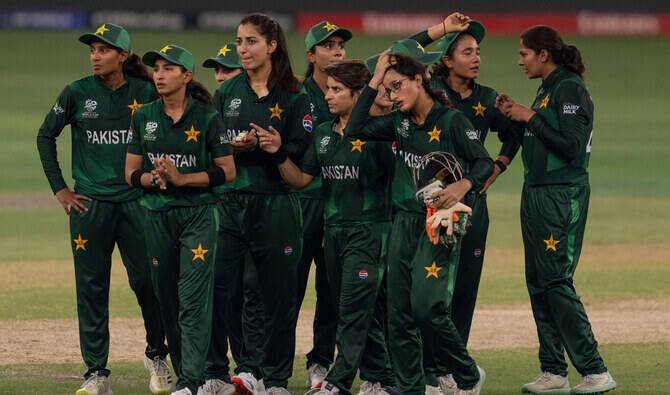
Pakistan players gather after loss against Australia during the ICC Women’s T20 World Cup 2024 match between Pakistan and Australia at Dubai International Stadium, United Arab Emirates on October 11, 2024. (AP/File)
Short Url
Updated 02 June 2025
Follow

Pakistan to play in Colombo when India hosts women’s World Cup

  • India and Pakistan have not played a bilateral series since 2013 and play their matches in neutral venues when either country hosts an ICC event
  • Neutral venue arrangement between the countries will also be in place for the men’s T20 World Cup in 2026, which India will co-host with Sri Lanka

Pakistan will play all their women’s 50-over World Cup matches in Sri Lanka’s capital Colombo when India hosts this year’s tournament, the International Cricket Council (ICC) said on Monday.

Politically-estranged India and Pakistan, who have not played a bilateral series since 2013, will play their matches in neutral venues when either country hosts an ICC event, the sport’s global governing body announced in December.

“The venues for the knockouts are dependent on Pakistan qualifying as two alternative venues have been identified for one semifinal and the final,” the ICC said.

“Colombo will be the venue for the first semifinal and the final only if Pakistan qualify for those stages.”

Bengaluru, where the tournament will start with India playing in the opening match, will host the final on November 2 if Pakistan are knocked out earlier in the tournament, the ICC added.

Bengaluru will also stage the second semifinal on October 30, a day after the first semifinal in Colombo or Guwahati. Visakhapatnam and Indore are the two other host cities for the eight-team tournament.

India played all their matches in Dubai when Pakistan hosted the men’s Champions Trophy this year, including the final which they won.

Both the Indian Premier League (IPL) and the Pakistan Super League were suspended last month amid clashes between the two countries following an attack targeting tourists that killed 26 people in disputed Kashmir region in April. Matches resumed after a ceasefire was announced.

The neutral venue arrangement between the countries will also be in place for the men’s T20 World Cup in 2026, which India will co-host with Sri Lanka, and the women’s T20 World Cup in 2028 in Pakistan.


Pakistan improves water management but remains highly vulnerable to floods, shortages — report

Updated 9 sec ago
Follow

Pakistan improves water management but remains highly vulnerable to floods, shortages — report

  • Asian Water Development Outlook says national water security score up 6.4 points since 2013 but service delivery still weak
  • ADB-linked report warns that groundwater dependence, urban demand and ecosystem decline remain critical risks

ISLAMABAD: Pakistan has strengthened its water governance and planning capacity over the past decade but continues to face serious risk from climate shocks, declining freshwater availability and weak service provision, according to the Asian Water Development Outlook 2025.

The regional water security assessment linked to the Asian Development Bank evaluates countries across Asia on water supply, governance, climate resilience, urban systems and environmental health. 

The study found that Pakistan has made policy progress since 2013, yet implementation remains inconsistent and the country is still exposed to extreme weather events, rapid population growth and stressed aquifers. The assessment warns that improvement has not kept pace with risk.

“Pakistan’s national water security score improved moderately from 2013 to 2025 by 6.4 points. At the same time, water governance performance, measured through SDG 6.5.1, rose from 50 percent in 2017 to 63 percent in 2023,” the report said. 

Despite these gains, rural supply and service reliability remain uneven. 

“Pakistan’s rural household water security remains under pressure due to ineffective service models, limited surveillance, and persistent contamination,” while economic performance is hampered by “falling per capita water availability, insufficient storage, and heavy reliance on poorly monitored groundwater resources for industrial activity,” according to the report.

Pakistan’s cities remain under pressure, with infrastructure struggling to match population growth and demand: 

“Urban water security has shown only modest gains, with rising demand, untreated wastewater and urban flooding straining infrastructure and service delivery.”

Environmental conditions have also deteriorated, driven by unchecked industrial discharge and limited regulatory enforcement. 

“Environmental water security has declined slightly, as rapid population growth, industrial activity, and untreated wastewater continue to degrade aquatic ecosystems,” the report added. 

Pakistan remains highly exposed to disasters including major floods, droughts and glacial lake outburst floods (GLOFs). The report cites the 2022 monsoon crisis, noting that it “affected over 24 million people.” 

While early-warning systems are improving, infrastructure investment and coordinated management remain inadequate.

The document concludes that Pakistan must convert policy gains into ground-level delivery by expanding financing, strengthening provincial coordination and scaling ecosystem protection to stabilize long-term water security.