

Islamabad mulls new regulator to oversee digital finance and crypto ecosystem

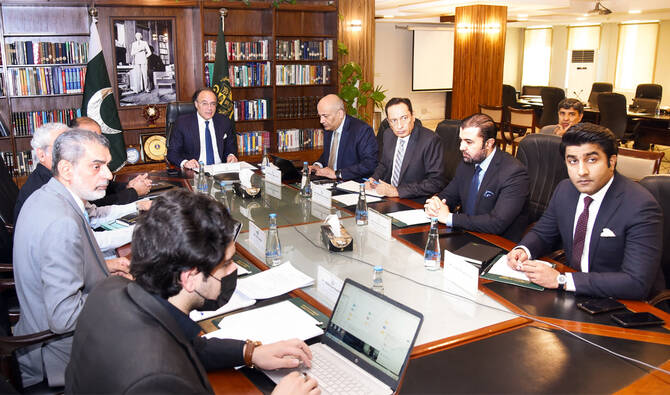
Federal Minister for Finance and Revenue Muhammad Aurangzeb (center) chairs a meeting of the Pakistan Crypto Council to discuss the draft regulatory framework for digital and virtual assets, in Islamabad on June 2, 2025. (Ministry of Finance, Pakistan)
Short Url
Updated 02 June 2025
Follow

Islamabad mulls new regulator to oversee digital finance and crypto ecosystem

  • The development comes months after Islamabad set up a crypto council to formulate legal framework for cryptocurrency trading
  • In April, Pakistan introduced its first-ever policy framework on how cryptocurrencies and the firms dealing in it will operate

KARACHI: Pakistan is mulling a new virtual asset regulator to oversee digital finance and cryptocurrency ecosystem in the country, it emerged on Monday, following a meeting of the Pakistan Crypto Council (PCC).

Pakistan set up the PCC in March to create a legal framework for cryptocurrency trading in a bid to lure international investment. In April, Pakistan introduced its first-ever policy framework to set rules for how digital money like cryptocurrencies and the companies that deal in it should operate in Pakistan. The policy has been formulated to align with compliance and financial integrity guidelines of the global Financial Action Task Force (FATF).

Last month, the government also approved setting up the Pakistan Virtual Assets Regulatory Authority (PVARA), a specialized regulatory body to oversee blockchain-based financial infrastructure.

On Monday, Finance Minister Muhammad Aurangzeb presided over a PCC meeting on the draft regulatory framework for digital and virtual assets in Pakistan, aiming to align with international standards and evolving technological trends.

“Participants also discussed various options around the establishment of an autonomous regulatory authority to oversee and regulate the digital finance and crypto ecosystem in the country,” the Pakistani finance ministry said after the meeting.

“It was agreed to constitute a technical committee comprising representatives from SBP (State Bank of Pakistan), SECP (Securities and Exchange Commission of Pakistan), Law Division, and IT & Telecom Division. The committee will review the draft laws and propose a robust framework and governance structure to be reviewed by the Pakistan Crypto Council in its next meeting.”

During the meeting, the ministry said, the PCC members provided valuable input to ensure a secure, transparent, and innovation-friendly regulatory environment, with the goal of promoting responsible blockchain adoption, safeguarding investors and advancing financial inclusion.

Finance Minister Aurangzeb, who is also the PCC chairman, appreciated the contributions of all stakeholders and reaffirmed the government’s commitment to building a future-ready financial infrastructure that supports innovation while maintaining financial stability and regulatory compliance.

Late last month, Pakistan announced the allocation of 2,000 megawatts (MW) of electricity in the first phase of a national initiative to power bitcoin mining and artificial intelligence data centers. The allocation is the first phase of a broader, multi-stage digital infrastructure roll-out.

Bilal Bin Saqib, the CEO of the Pakistan Crypto Council, last week unveiled the country’s first government-led strategic bitcoin reserve at the Bitcoin 2025 conference in Las Vegas.

However, the central bank said it had not declared virtual assets illegal but had in 2018 advised regulated entities to avoid dealing in virtual currency “due to the absence of any legal and regulatory framework.”

“This was done to protect its regulated entities and their customers from the risks emanating due to the absence of legal and regulatory framework for VAs in the country,” the central bank said in a statement last week.

“The SBP and Finance Division are currently engaged with the Pakistan Crypto Council established by the Federal Government for, among others, developing an appropriate legal and regulatory framework for VAs in Pakistan. We understand that the legal and regulatory framework would provide the requisite clarity and legal coverage about the VAs ensuring consumer and investor protection.”


Pakistan’s president defends ongoing strikes in Afghanistan, urges Kabul to dismantle militants

Updated 02 March 2026
Follow

Pakistan’s president defends ongoing strikes in Afghanistan, urges Kabul to dismantle militants

  • Afghanistan on Thursday launched attacks in retaliation for Pakistani airstrikes the previous Sunday
  • Pakistan’s military says it is only targeting Afghan military installations to avoid civilian casualties

ISLAMABAD: Pakistan’s president on Monday defended his country’s ongoing military strikes in neighboring Afghanistan, saying Islamabad tried all forms of diplomacy before targeting militants operating from Afghan territory, and called on the Taliban government in Kabul to disarm groups responsible for attacks in Pakistan.

Pakistan earlier said it is in “open war” with Afghanistan, alarming the international community. The border area remains a stronghold for militant organizations including Al-Qaeda and the Daesh (Islamic State) group.

“(The Afghan Taliban) must choose to dismantle the terror groups that survive on conflict and its war economy,” Asif Ali Zardari said during a speech to lawmakers, adding that “no state accepts serial attacks on its soil.”

Afghanistan on Thursday launched attacks in retaliation for Pakistani airstrikes the previous Sunday. Since then, Pakistan has carried out operations along the border, with Information Minister Attaullah Tarar claiming the killing of 435 Afghan forces and the capture of 31 Afghan positions.

Kabul has denied such claims.

In Afghanistan, the deputy government spokesman Hamdullah Fitrat said Pakistan’s military fired mortar shells at a refugee camp in eastern Kunar province, killing three children and injuring three others.

Afghanistan’s defense ministry said Afghan forces carried out strikes targeting a Pakistani military facility near Paktia province, causing “substantial losses and heavy casualties.”

Pakistan’s military did not respond to questions. It has said Pakistan is only targeting Afghan military installations to avoid civilian casualties.

Pakistan has witnessed a surge of violence in recent months and blames it on the outlawed Pakistani Taliban, known as Tehreek-e-Taliban Pakistan or TTP. It operates both inside Pakistan and from Afghan territory.
Islamabad accuses Afghanistan’s Taliban government of providing safe havens for the TTP, which Kabul denies.

The latest cross-border fighting ended a ceasefire brokered by Qatar and Turkiye in October. The two sides failed to reach a permanent agreement during talks in Istanbul.

Zardari reiterated Pakistan’s call for talks, saying, “We have never walked away from dialogue.”

The Pakistani leader again accused Afghanistan of acting as a proxy for India by sheltering militant groups.

“Stop being used by another country as a battlefield for their ambitions,” he said.

Zardari cited a recent report from the United Nations Security Council’s monitoring team that described the presence of militant groups in Afghanistan as an extra-regional threat.