

Militants free two customs officials months after abduction in Pakistan’s northwest

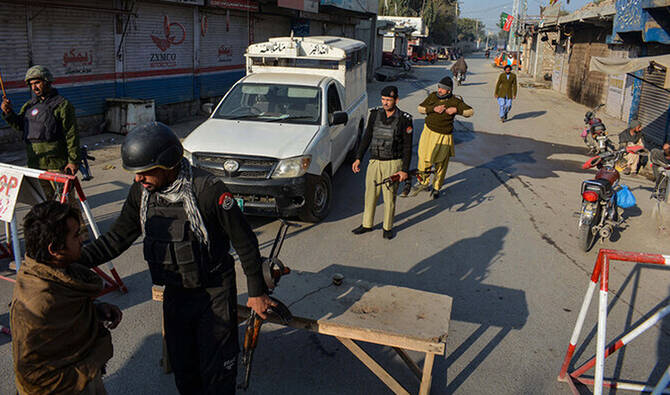
Police stand guard along a road they blocked after militants seized a police station in Bannu, Pakistan, on December 19, 2022. (AFP/File)
Short Url
Updated 02 June 2025
Follow

Militants free two customs officials months after abduction in Pakistan’s northwest

  • The incident highlights persistent security challenges in Pakistan’s northwestern tribal districts that border Afghanistan
  • The development comes amid a thaw in Pakistan-Afghanistan relations which were strained by a surge in militancy in Pakistan

ISLAMABAD: Pakistani Taliban militants have freed two customs officials months after they were abducted in Pakistan’s northwestern Khyber Pakhtunkhwa (KP) province, police and local officials said on Sunday.

Pakistan Customs Superintendent Nisar Abbasi, Inspector Khushal Khan and Saif-ur-Rehman, president of a local chambers of commerce, were abducted in KP’s South Waziristan district in Feb. this year, according to Deputy Commissioner Nasir Khan.

While the kidnappers released Rehman the same day, the two customs officials remained in captivity and it took months of efforts by tribal elders and members of the Lower South Waziristan Chambers of Commerce to negotiate their release.

“The officers have returned safely after their captors let them go,” Habib Islam, a police spokesperson in South Waziristan district that borders Afghanistan, told Arab News.

“Their release was made possible through extensive negotiations involving multiple stakeholders.”

The development highlights persistent security challenges in Pakistan’s northwestern tribal districts where militant groups, particularly the Pakistani Taliban, have mounted their attacks against security forces, besides targeted killings and kidnappings of law enforcers and government officials.

It also comes amid a thaw in Pakistan-Afghanistan relations which were strained by a surge in militancy in Pakistan’s western regions that border Afghanistan. Islamabad frequently blamed Afghanistan for the surge in militant activities, an allegation denied by Kabul.

However, both countries have sought to mend ties in recent months and last week announced to upgrade their diplomatic missions in Islamabad and Kabul to the ambassadorial rank.

Rehman, president of the Lower South Waziristan Chambers of Commerce and Industry who was released shortly after his kidnapping along with the two customs officials, said the kidnappers had initially demanded the government free their detained associates in return for the release of the two customs officials.

“When it became clear that the government would not meet their demands even after several months, the abductors eventually relented to tribal mediation and agreed to release the officials,” he told Arab News, adding that both officials were in good health and no ransom was paid against their release. 

On Jan. 9, the Pakistani Taliban kidnapped more than a dozen workers of the Pakistan Atomic Energy Commission (PAEC), which is responsible for nuclear energy projects, from the volatile Lakki Marwat district, according to Lakki Marwat police.

Eight of the abductees were released shortly after the kidnapping, while the militants released one more and body of another hostage on Jan. 25. The fate of the remaining captives remains unknown.

Last year, the militant group had kidnapped District and Sessions Judge Shakirullah Marwat near KP’s Dera Ismail Khan district who was later recovered in a joint operation by police and security forces, officials said.


Pakistan issues over $7 billion sukuk in 2025, nears 20 percent Shariah-compliant debt target

Updated 11 sec ago
Follow

Pakistan issues over $7 billion sukuk in 2025, nears 20 percent Shariah-compliant debt target

  • Finance Adviser Khurram Schehzad says this was the highest-ever Sukuk issuance in a single calendar year since 2008
  • Pakistan’s Federal Shariat Court ordered in 2022 the entire banking system to transition to Islamic principles by 2027

ISLAMABAD: Pakistan’s Finance Adviser Khurram Schehzad on Monday said the country achieved a landmark breakthrough in Islamic finance by issuing over Rs2 trillion ($7 billion) sukuk this year, bringing it closer to its 20 percent Shariah-compliant debt target by Fiscal Year 2027-28.

A sukuk is an Islamic financial certificate, similar to a bond, but it complies with Shariah law, which forbids interest. Pakistan’s Federal Shariat Court (FSC) had directed the government in April 2022 to eliminate interest and align the country’s entire banking system with Islamic principles by 2027.

Following the ruling, the government and the State Bank of Pakistan (SBP) have undertaken a series of measures, including legal reforms and the issuance of sukuk to replace interest-based treasury bills and investment bonds.

“In 2025, the Ministry of Finance (MoF) through its Debt Management Office, together with its Joint Financial Advisers (JFAs), successfully issued over PKR 2 trillion in Sukuk,” Schehzad said on X, describing it as “the highest-ever Sukuk issuance in a single calendar year since 2008 by Pakistan.”

Pakistan made a total of 61 issuances across one-, three-, five- and 10-year tenors, according to the finance adviser. The country also successfully launched its first Green Sukuk, a Shariah-compliant bond designed to fund environment-friendly projects.

He said the Green Sukuk was 5.4 times oversubscribed, indicating investor demand was more than five times higher than the amount the government planned to raise, which showed strong market confidence.

“The rising share of Islamic instruments in the government’s domestic securities portfolio (domestic debt) underscores strong momentum, growing from 12.6 percent in June 2025 to around 14.5 percent by December 2025, clearly positioning the MoF to achieve its 20 percent Shariah-compliant debt target by FY28,” Schehzad said.

“This milestone also reflects the structural deepening of Pakistan’s Islamic capital market, sustained investor confidence, and the strengthening of sovereign debt management.”

He said Pakistan was strengthening its government securities market by making it more resilient, diversified, and future-ready, supported by a stabilizing macroeconomic environment, a disciplined debt strategy, and a clear roadmap for Islamic finance.