

Explosions caused 2 bridges in western Russia to collapse, officials say

1 / 2
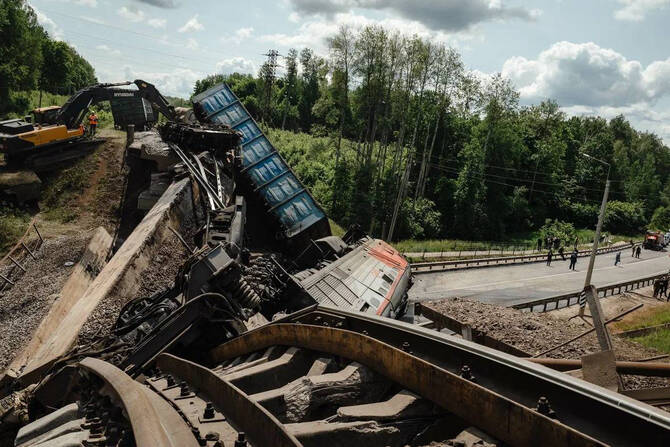
This handout photograph posted on the Telegram account of Kursk region acting governor Alexander Khinshtein on June 1, 2025 shows a damaged freight train at the site of a railway bridge collapse in the Kursk region. (Telegram/@Hinshtein)
2 / 2
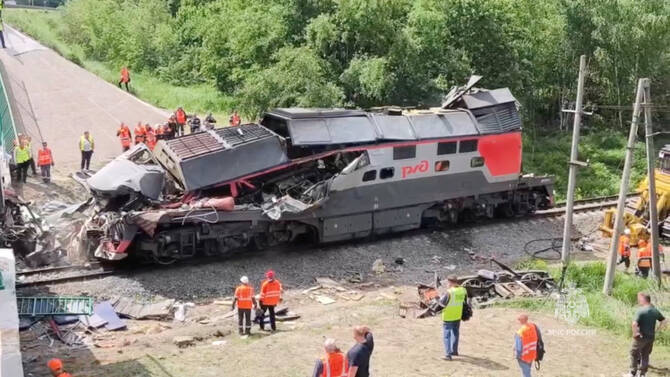
​ Specialists of emergency services work at the scene, after a road bridge collapsed onto railway tracks derailing an approaching train in the Bryansk region, Russia, on June 1. (Russian Emergencies Ministry/Handout via REUTERS) ​
Short Url
Updated 02 June 2025
Follow

Explosions caused 2 bridges in western Russia to collapse, officials say

  • 7 people were killed in the first incident, in which a bridge in Bryansk region collapsed on top of a passenger train
  • Hours later, officials said a second train derailed when the bridge beneath it collapsed in nearby Kursk region

Explosions caused two bridges to collapse and derailed two trains in western Russia overnight, officials said Sunday, without saying what had caused the blasts. In one of the incidents, seven people were killed and dozens were injured.
The first bridge, in the Bryansk region on the border with Ukraine, collapsed on top of a passenger train on Saturday, causing the casualties. The train’s driver was among those killed, state-run Russian Railways said.

In that collapse, a freight train was thrown off its rails onto the road below as the explosion collapsed the bridge, local acting Gov. Alexander Khinshtein said Sunday. The crash sparked a fire, but there were no casualties, he said.

Russia’s Investigative Committee, the country’s top criminal investigation agency, said in a statement that explosions had caused the two bridges to collapse, but did not give further details. Several hours later, it edited the statement, which was posted on social media, to remove the words “explosions” but did not provide an explanation.
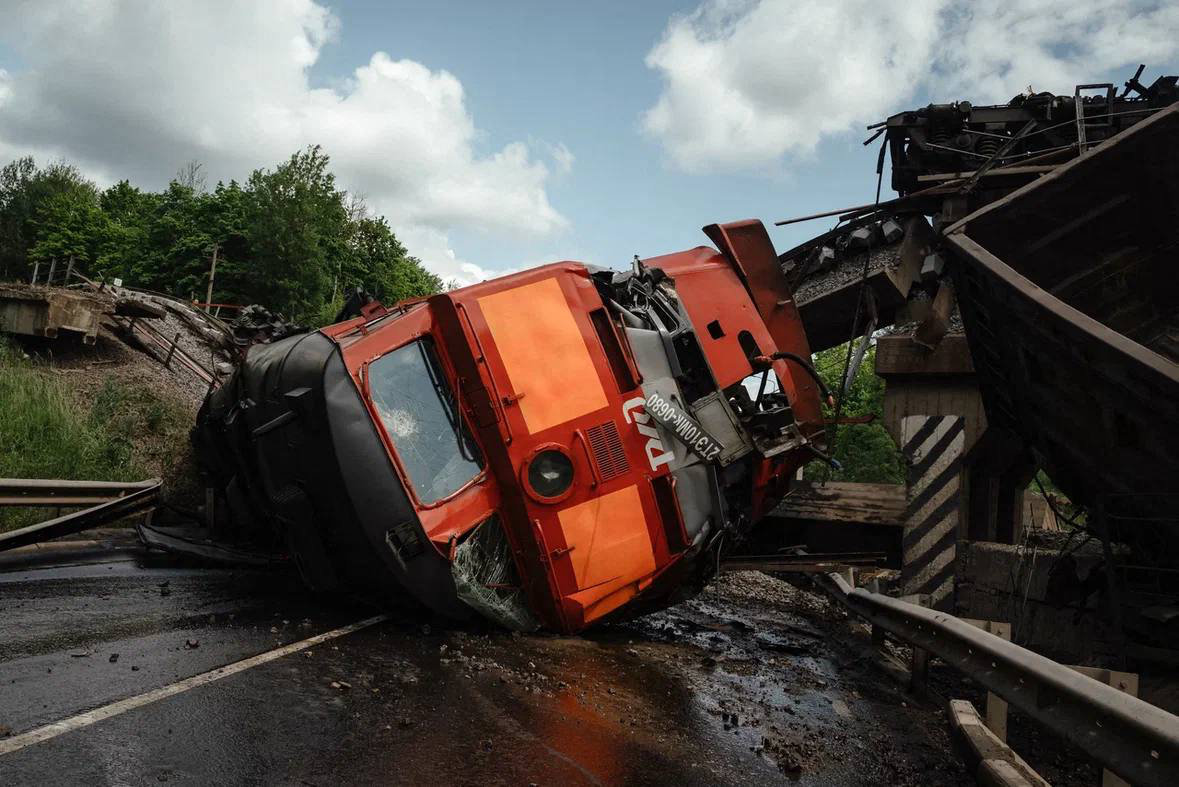


This handout photograph posted on the Telegram account of Kursk region acting governor Alexander Khinshtein on June 1, 2025 shows a damaged freight train at the site of a railway bridge collapse in the Kursk region. (Telegram/@Hinshtein)

The committee said that it would be investigating the incidents as potential acts of terrorism.
Rescue workers cleared debris from both sites, while some of those injured were transported to Moscow for treatment. Photos posted by government agencies in Bryansk appeared to show train carriages ripped apart and lying amid fallen concrete from the collapsed bridge. Other footage on social media was apparently taken from inside vehicles on the road that had managed to avoid driving onto the bridge before it collapsed.
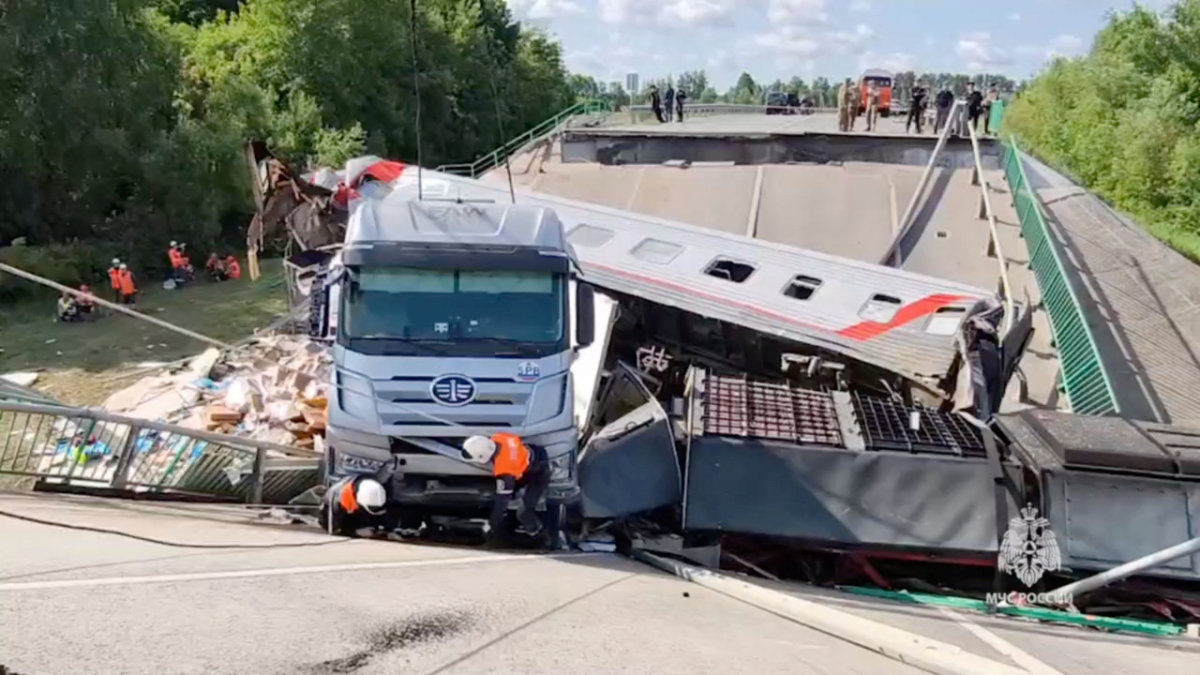


Specialists of emergency services work at the scene, after a road bridge collapsed onto railway tracks derailing an approaching train in the Bryansk region, Russia, on June 1. (Russian Emergencies Ministry/Handout via REUTERS)

Bryansk regional Gov. Alexander Bogomaz announced three days of mourning for the victims, starting Monday.
Damage to railway tracks was also found Sunday by inspectors working on the line elsewhere in the Bryansk region, Moscow Railway said in a statement. It did not say whether the damage was linked to the collapsed bridges.
In the past, some officials have accused pro-Ukrainian saboteurs of attacking Russia’s railway infrastructure. The details surrounding such incidents, however, are limited and cannot be independently verified.
Ukraine’s military intelligence, known by the Ukrainian abbreviation GUR, said Sunday that a Russian military freight train carrying food and fuel had been blown up on its way to Crimea. It did not claim the attack was carried out by GUR or mention the bridge collapses.
The statement said Moscow’s key artery with the Russian-occupied Zaporizhzhia region and Crimea has been destroyed.
Russia forces have been pushing into the region of Zaporizhzhia in eastern Ukraine since Moscow’s full-scale invasion in February 2022. Russia took Crimea and annexed it in 2014.


Treason trial of South Sudan’s suspended VP is further eroding peace deal, UN experts say

Updated 5 sec ago
Follow

Treason trial of South Sudan’s suspended VP is further eroding peace deal, UN experts say

  • The experts said forces from both sides are continuing to confront each other across much of the country
  • “Years of neglect have fragmented government and opposition forces alike,” the experts said

UNITED NATIONS: The treason trial of South Sudan’s suspended vice president is further eroding a 2018 peace agreement he signed with President Salva Kiir, UN experts warned in a new report.
As Riek Machar’s trial is taking place in the capital, Juba, the experts said forces from both sides are continuing to confront each other across much of the country and there is a threat of renewed major conflict.
UN peacekeeping chief Jean-Pierre Lacroix told the UN Security Council last month that the crisis in South Sudan is escalating, “a breaking point” has become visible, and time is running “dangerously short” to bring the peace process back on track.
There were high hopes when oil-rich South Sudan gained independence from Sudan in 2011 after a long conflict, but the country slid into a civil war in December 2013 largely based on ethnic divisions, when forces loyal to Kiir, an ethnic Dinka, battled those loyal to Machar, an ethnic Nuer.
More than 400,000 people were killed in the war, which ended with the 2018 peace agreement that brought Kiir and Machar together in a government of national unity. But implementation has been slow, and a long-delayed presidential election is now scheduled for December 2026.
The panel of UN experts stressed in a report this week that the political and security landscape in South Sudan looks very different today than it did in 2018 and that “the conflict that now threatens looks much different to those that came before.”
“Years of neglect have fragmented government and opposition forces alike,” the experts said, “resulting in a patchwork of uniformed soldiers, defectors and armed community defense groups that are increasingly preoccupied by local struggles and often unenthused by the prospect of a national confrontation. ”
With limited supplies and low morale, South Sudan’s military has relied increasingly on aerial bombings that are “relatively indiscriminate” to disrupt the opposition, the experts said.
In a major escalation of tensions in March, a Nuer militia seized an army garrison. Kiir’s government responded, charging Machar and seven other opposition figures with treason, murder, terrorism and other crimes.
The UN experts said Kiir and his allies insist that, despite having dismissed Machar, implementation of the peace agreement is unaffected, pointing to a faction of the opposition led by Stephen Par Kuol that is still engaged in the peace process.
Those who refused to join Kuol and sided with Machar’s former deputy, Natheniel Oyet, “have largely been removed from their positions, forcing many to flee the country,” the experts said in the report.
The African Union, regional countries and the Intergovernmental Authority on Development, or IGAD, have all called for Machar’s release and stressed their strong support for implementation of the 2018 agreement, the panel said.
According to the latest international assessment, 7.7 million people — 57 percent of the population — face “crisis” levels of food insecurity, with pockets of famine in some communities most affected by renewed fighting, the panel said.
