

Pakistan raises alarm over risks to Asia-Pacific stability amid India tensions

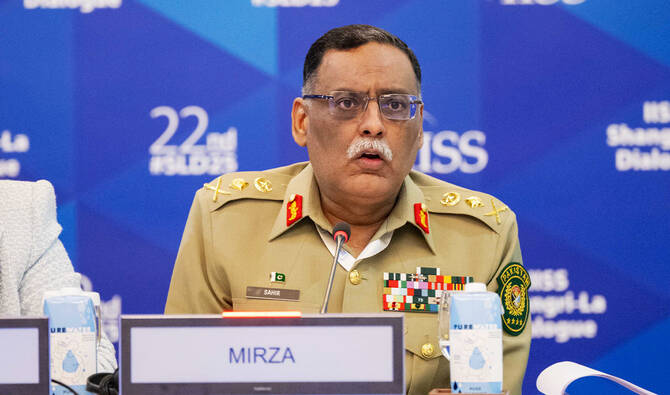
Pakistan Armed Forces Chairman of the Joint Chiefs of Staff, General Sahir Shamshad Mirza, addresses the Shangri-La Dialogue Summit in Singapore on May 31, 2025. (Photo Courtesy: The International Institute for Strategic Studies)
Short Url
Updated 01 June 2025
Follow

Pakistan raises alarm over risks to Asia-Pacific stability amid India tensions

  • Pakistan, India last month engaged in a worst standoff between them in decades that killed 70 people on both sides
  • The conflict raised fears that it could spiral into a full-blown war and bring nuclear arsenals of the archrivals into play

ISLAMABAD: A top Pakistani general on Sunday raised alarmed over risks to Asia-Pacific stability in the absence of regional crisis management frameworks, amid prevailing tensions between Pakistan and India.

Pakistan and India last month engaged in a worst standoff between them in decades that saw the neighbors attack each other with jets, missiles, drones and artillery, killing around 70 people on both sides before the United States brokered a ceasefire on May 10.

The conflict, triggered by an attack on tourists in Indian-administered Kashmir’s Pahalgam town that New Delhi blamed on Pakistan, alarmed the world powers and raised fears that it could spiral into a full-blown war and bring the archfoes’ nuclear arsenals into play.

Speaking at the Shangri-La Dialogue security meeting in Singapore, General Sahir Shamshad Mirza, Pakistan’s Joint Chiefs of Staff Committee chairman, said the recent India-Pakistan conflict underscored how crisis management frameworks remained “hostage to countries’ belligerence.”

“The recent standoff amply underlines significance of maintaining open channels of communications to avert crises as and when they erupt. Post-Pahalgam [attack], the threshold of an escalatory war has come dangerously low, implying greater risk on both sides, just not in the disputed territory, but all of India and all of Pakistan,” he said.

“In future, given the Indian policies and polities’ extremist mindset, absence of a crisis management mechanism may not give enough time to the global powers to intervene and effect cessation of hostilities.”

Bitter rivals India and Pakistan have fought three wars, including two over the disputed region of Kashmir, since gaining independence from British rule in 1947.

Before the conflict, both nations unleashed a raft of punitive measures against each other, with India suspending the 1960 Indus Waters Treaty that ensures water for 80 percent of Pakistani farms and Pakistan closing its airspace to Indian airlines. India has said the treaty would remain in abeyance.

Gen Mirza said New Delhi’s move to suspend the treaty is in “total defiance of the international laws, since it is an existential threat for the people of Pakistan.”

“If there is any effort to stop, divert or delay Pakistan’s share of water, as clearly spelt out by our National Security Committee, it could be considered as an act of war,” he added.


Excavations resume at Mohenjo-Daro to study early Harappan city wall

Updated 6 sec ago
Follow

Excavations resume at Mohenjo-Daro to study early Harappan city wall

  • A joint Pakistani-US team probes multi-phase wall dating to around 2800 BC
  • Research remains limited despite Mohenjo-Daro’s archaeological importance

ISLAMABAD: Archaeologists working at the ancient site of Mohenjo-Daro have resumed excavations aimed at better understanding the city’s early development, including the structure and chronology of a massive perimeter wall first identified more than seven decades ago, officials said on Saturday.

The latest excavation season, launched in late December, is part of a joint Pakistani-US research effort approved by the Technical Consultative Committee of the National Fund for Mohenjo-Daro, which met at the site this week to review conservation and research priorities. The work focuses on reassessing the city’s defensive architecture and early occupation layers through controlled excavation and carbon dating.

Jonathan Mark Kenoyer, a senior archaeologist involved in the project, told the committee that the excavation targets a section of the city wall originally uncovered by British archaeologist Mortimer Wheeler in 1950.

“This wall was over seven meters wide and built in multiple phases, reaching a height of approximately seven meters,” Kenoyer said, according to an official statement circulated after the meeting. “The lowest part of the wall appears to have been constructed during the early Harappan period, around 2800 BC.”

Organic material recovered from different excavation levels is being analyzed for carbon dating to establish a clearer timeline of the site’s development, the statement continued, adding that the findings would be published after detailed study.

The committee noted that despite Mohenjo-Daro’s status as one of the world’s earliest and largest urban centers, systematic research at the site has remained limited in recent decades. Its members agreed to expand archaeological studies and invited new research proposals to help formulate a long-term strategy for the site.

The committee also approved the continuation of conservation work on previously excavated material, including dry core drilling data, and reviewed progress on preserving a coin hoard discovered at the site in 2023, the results of which are expected to be published after conservation is completed.

Mohenjo-Daro, a UNESCO World Heritage site in Pakistan’s Sindh province, was a major center of the Indus Valley Civilization, which flourished more than 4,000 years ago.