

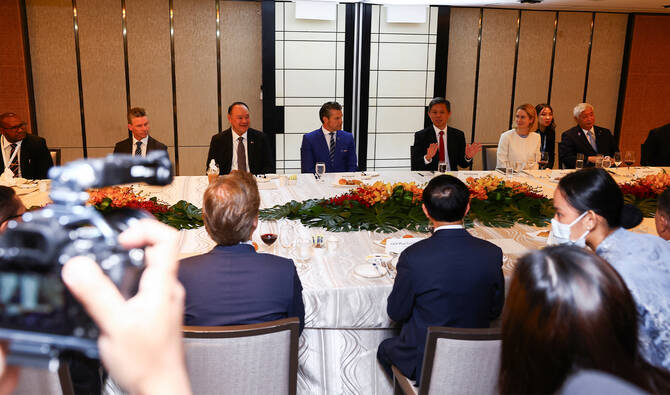

SINGAPORE: The Shangri-La Dialogue security meeting in Singapore has long been marked by US-China rivalry but Beijing’s relative retreat at the weekend exposed a new faultline — tensions between the US and Europe over Asia.
Even as he warned in a speech on Saturday that China posed an “imminent” threat, US Defense Secretary Pete Hegseth made clear he wanted Europeans to concentrate on European security as they boosted military budgets.
“We would much prefer that the overwhelming balance of European investment be on that continent...so that as we partner there, which we will continue to do, we’re able to use our comparative advantage as an Indo-Pacific nation to support our partners here,” he said.
Hegseth also noted the absence of his Chinese counterpart Dong Jun, as Beijing instead dispatched a low-level team of military scholars to the annual event, which attracts top defense officials, diplomats, spies and arms dealers from across the world.
The other highlight of the event was the presence of high-powered military delegations from India and Pakistan after four days of intense clashes between the nuclear-armed neighbors that were halted by a ceasefire on May 10.
The delegations, in full uniform and bristling with medal and service ribbons, were led by India’s highest-ranking military officer and Pakistan’s chairman of the joint chiefs of staff. They pointedly kept out of each other’s way in the corridors and meeting halls of the sprawling Shangri-La hotel.
On engaging in Asia, at least some European nations signaled they would not be swayed by the US exhortations.
They insisted they would try to stay in both the Asian and European theaters, noting their deep links and vital trade flows as well as the global nature of conflict.
“It is a good thing we are doing more (in Europe), but what I want to stress is that the security of Europe and the security of the Pacific is very much interlinked,” said Europe’s top diplomat Kaja Kallas.
“If you are worried about China, you should be worried about Russia,” Kallas said, underlining the importance of Chinese assistance to the Russian war effort in Ukraine and Moscow’s deployment of North Korean soldiers.
FRANCE’S ASIAN TIES
French President Emmanuel Macron insisted that his nation remains an Indo-Pacific power, alluding to its enduring colonial presence in New Caledonia and French Polynesia and the basing of over 8,000 soldiers across the region.
“We are neither China nor the US, we don’t want to depend on either of them,” Macron said at a press conference on Friday, outlining a “third path” coalition between Europe and Asia that avoided having to choose between Beijing and Washington.
“We want to cooperate with both as far as we can, and we can cooperate for growth and prosperity and stability for our people and the world order, and I think this is exactly the same view of a lot of countries and a lot of people of this region,” he said.
Beyond the rhetoric, regional military attaches and analysts say the European regional presence — and ambitions — may not be easy to shift.
Military deployments are mapped out over decades rather than months, and both commercial and defense relationships go back decades, some of them only rarely publicly acknowledged.
The visit of a British aircraft carrier to Singapore later this month is part of a program first mentioned by then-Foreign Secretary Boris Johnson in 2017 to stress British support for freedom of navigation in the South China Sea.
The carrier visit in part reflects Britain’s commitments under the 54-year-old Five-Power Defense Arrangement that links its military with counterparts in Singapore, Malaysia, Australia and New Zealand.
British ties with Australia have been bolstered with the recent three-way AUKUS submarine and advanced technology sharing agreement struck with the US — a move that could see British submarines visiting Western Australia.
Singapore meanwhile keeps 200 personnel in France operating 12 of its light combat aircraft while Britain also has a jungle training camp and helicopters in Brunei and a 1,200-strong Gurkha battalion, according to International Institute of Strategic Studies data.
A report last month by the London-based IISS highlighted European defense firms’ long-standing and expanding defense ties to Asia, even in the face of competition, particularly from Saudi Arabia and the United Arab Emirates as regional budgets rise.
“European companies, including Airbus, Damen, Naval Group and Thales, have a long-standing presence in Southeast Asia, and other European actors have established themselves in the market in the last decade, including Italy’s Fincantieri and Sweden’s Saab,” the IISS study said.
Saab is close to securing a deal with US ally Thailand to supply its Gripen fighters, beating out Lockheed Martin’s F-16s.
The Stockholm International Peace Research Institute has reported that Asian defense spending rose 46 percent in the decade to 2024, reaching $629 billion.
For Finnish officials at least, Hegseth’s remarks resonated — it is Moscow rather than the Indo-Pacific that looms large for Helsinki given the country’s long Russian border.
“When Europe’s defense is in a good shape, then you will have resources to do something more,” Finnish Defense Minister Antti Hakkanen told Reuters.
“But now all the European countries must do their main focus on European defense so that the United States can do a bigger share in the Indo-Pacific area,” Hakkanen said.


