

Pakistan weekly inflation down by 0.81% as prices of essential items remain largely stable

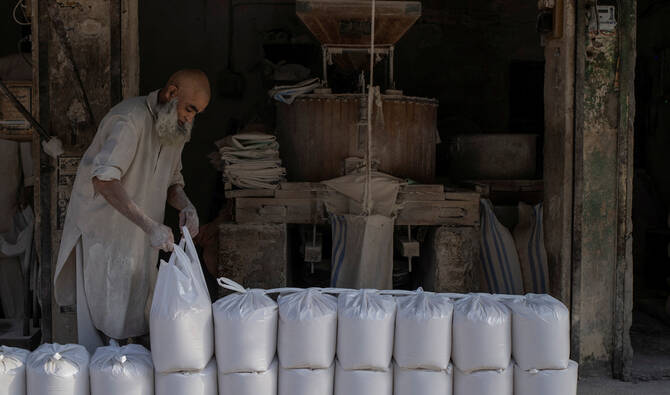
A shopkeeper arranges bags of milled whole grain flour for sale in Rawalpindi, Pakistan on May 20, 2025. (REUTERS)
Short Url
Updated 31 May 2025
Follow

Pakistan weekly inflation down by 0.81% as prices of essential items remain largely stable

  • Annual inflation rate fell to 0.3% in April, well below the finance ministry’s estimate of 1.5-2%
  • The Pakistan Stock Exchange also recorded a 7.5% gain in May on a month-on-month basis

ISLAMABAD: Short-term inflation, measured by the Sensitive Price Index (SPI), lowered by 0.81% in Pakistan, the country’s statistics bureau said this week, as prices of most essential items remained stable.

The SPI, which comprises 51 essential items collected from 50 markets in 17 cities, is computed on a weekly basis to assess the price movement of essential commodities at a shorter interval of time to review the price situation in the country.

While the SPI for the week ending on May 29 decreased 0.81% on a week-on-week basis, it recorded an increase of 0.41% when compared to the same week last year, according to the Pakistan Bureau of Statistics (PBS).

“During the week, out of 51 items, prices of 14 (27.45%) items increased, 10 (19.61%) items decreased and 27 (52.94%) items remained stable,” the PBS said.

A decrease was observed in the prices of electricity charges for Q1 (10.10%), chicken (8.51%), LPG (2.67%), sugar (0.25%), powdered milk (0.20%), vegetable ghee 2.5Kg (0.17%), wheat flour (0.09%), rice (0.07%), garlic (0.05%) and pulse moong (0.01%).

The items whose prices increased during the week included tomatoes (4.54%), potatoes (2.94%), eggs (2.19%), onions (2.17%), gur (0.77%), bananas (0.73%), mustard oil (0.34%), pulse mash (0.22%), pulse gram (0.17%), pulse masoor (0.14%) and basmati rice (0.12%).

Pakistan’s annual inflation rate fell to 0.3% in April, well below the Ministry of Finance estimate of 1.5% to 2%. The central bank forecasts average inflation to be in the range of 5.5% to 7.5% for the fiscal year ending June.

Also, the Pakistan Stock Exchange (PSX) recorded a 7.5% gain in May on a month-on-month basis, according to the Karachi-based Topline Securities.

“This gain can be attributed to cut in policy rate by 100bps by SBP,” it said in its monthly review, citing improvement in inflation outlook and approval of first review of Pakistan’s $7 billion International Monetary Fund (IMF) program as well as the approval of another $1.4 billion under the IMF’s Resilience and Sustainability Facility.

“Average daily traded volume and value during the month stood at 566 million shares and PKR28 billion.”


Pakistan urges pilgrims to complete Saudi biometrics as Hajj preparations gain pace

Updated 30 January 2026
Follow

Pakistan urges pilgrims to complete Saudi biometrics as Hajj preparations gain pace

  • Government warns pilgrims biometric verification is required for Hajj visas
  • Step follows tighter oversight after last year’s Hajj travel disruptions

ISLAMABAD: Pakistan’s government on Friday urged aspiring pilgrims to complete mandatory Saudi biometric verification for Hajj visas, as preparations for the 2026 pilgrimage gather pace following stricter oversight of the Hajj process.

The announcement comes only a day after Pakistan’s Religious Affairs Minister Sardar Muhammad Yousuf said regulations for private Hajj operators had been tightened, reducing their quota following widespread complaints last year, when tens of thousands of pilgrims were unable to travel under the private Hajj scheme.

“Saudi biometric verification is mandatory for the issuance of Hajj visas,” the Ministry of Religious Affairs said in a statement, urging pilgrims to complete the process promptly to avoid delays.

“Hajj pilgrims should complete their biometric verification at home using the ‘Saudi Visa Bio’ app as soon as possible,” it added.

The statement said the pilgrims who were unable to complete biometric verification through the mobile application should visit designated Saudi Tasheer centers before Feb. 8, adding that details of the centers were available on Pakistan’s official Hajj mobile application.

Pakistan has been steadily implementing digital and procedural requirements for pilgrims ahead of Hajj 2026, including mandatory training sessions, biometric checks and greater use of mobile applications, as part of efforts to reduce mismanagement.

Saudi Arabia has allocated Pakistan a quota of 179,210 pilgrims for Hajj 2026, with the majority of seats reserved under the government scheme and the remainder allocated to private tour operators.