

Pakistan weekly inflation down by 0.81% as prices of essential items remain largely stable

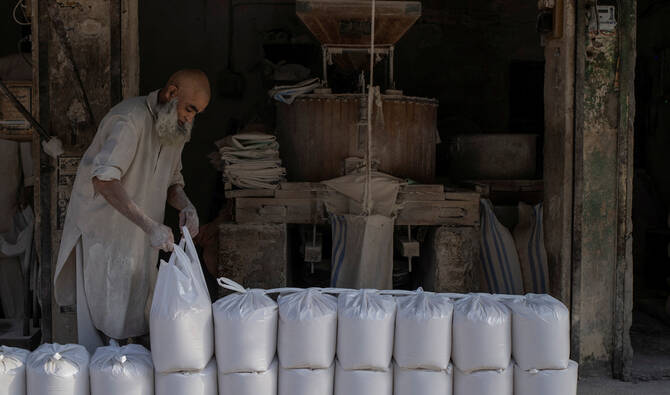
A shopkeeper arranges bags of milled whole grain flour for sale in Rawalpindi, Pakistan on May 20, 2025. (REUTERS)
Short Url
Updated 31 May 2025
Follow

Pakistan weekly inflation down by 0.81% as prices of essential items remain largely stable

  • Annual inflation rate fell to 0.3% in April, well below the finance ministry’s estimate of 1.5-2%
  • The Pakistan Stock Exchange also recorded a 7.5% gain in May on a month-on-month basis

ISLAMABAD: Short-term inflation, measured by the Sensitive Price Index (SPI), lowered by 0.81% in Pakistan, the country’s statistics bureau said this week, as prices of most essential items remained stable.

The SPI, which comprises 51 essential items collected from 50 markets in 17 cities, is computed on a weekly basis to assess the price movement of essential commodities at a shorter interval of time to review the price situation in the country.

While the SPI for the week ending on May 29 decreased 0.81% on a week-on-week basis, it recorded an increase of 0.41% when compared to the same week last year, according to the Pakistan Bureau of Statistics (PBS).

“During the week, out of 51 items, prices of 14 (27.45%) items increased, 10 (19.61%) items decreased and 27 (52.94%) items remained stable,” the PBS said.

A decrease was observed in the prices of electricity charges for Q1 (10.10%), chicken (8.51%), LPG (2.67%), sugar (0.25%), powdered milk (0.20%), vegetable ghee 2.5Kg (0.17%), wheat flour (0.09%), rice (0.07%), garlic (0.05%) and pulse moong (0.01%).

The items whose prices increased during the week included tomatoes (4.54%), potatoes (2.94%), eggs (2.19%), onions (2.17%), gur (0.77%), bananas (0.73%), mustard oil (0.34%), pulse mash (0.22%), pulse gram (0.17%), pulse masoor (0.14%) and basmati rice (0.12%).

Pakistan’s annual inflation rate fell to 0.3% in April, well below the Ministry of Finance estimate of 1.5% to 2%. The central bank forecasts average inflation to be in the range of 5.5% to 7.5% for the fiscal year ending June.

Also, the Pakistan Stock Exchange (PSX) recorded a 7.5% gain in May on a month-on-month basis, according to the Karachi-based Topline Securities.

“This gain can be attributed to cut in policy rate by 100bps by SBP,” it said in its monthly review, citing improvement in inflation outlook and approval of first review of Pakistan’s $7 billion International Monetary Fund (IMF) program as well as the approval of another $1.4 billion under the IMF’s Resilience and Sustainability Facility.

“Average daily traded volume and value during the month stood at 566 million shares and PKR28 billion.”


Security forces kill four militants in Pakistan’s volatile southwest, military says

Updated 5 sec ago
Follow

Security forces kill four militants in Pakistan’s volatile southwest, military says

  • Balochistan, Pakistan’s largest province by land area bordering Iran and Afghanistan, has long been the site of a low-level insurgency
  • The Balochistan government has recently established a threat assessment center to strengthen early warning, prevent ‘terrorism’ incidents

ISLAMABAD: Pakistani security forces gunned down four militants in an intelligence-based operation in the southwestern Balochistan province, the military said on Tuesday.

The operation was conducted in Balochistan’s Kalat district on reports about the presence of militants, according to the Inter-Services Public Relations (ISPR), the Pakistani military’s media wing.

The “Indian-sponsored militants” were killed in an exchange of fire during the operation, while weapons and ammunition were also recovered from the deceased, who remained actively involved in numerous militant activities.

“Sanitization operations are being conducted to eliminate any other Indian-sponsored terrorist found in the area,” the ISPR said in a statement.

There was no immediate response from New Delhi to the statement.

Balochistan, Pakistan’s largest province by land area bordering Iran and Afghanistan, has long been the site of a low-level insurgency involving Baloch separatist groups, including the Balochistan Liberation Army (BLA) and the Balochistan Liberation Front (BLF).

Pakistan accuses India of supporting these separatist militant groups and describes them as “Fitna Al-Hindustan.” New Delhi denies the allegation.

The government in Balochistan has also established a state-of-the-art threat assessment center to strengthen early warning and prevention against “terrorism” incidents, a senior official said this week.

“Information that was once scattered is now shared and acted upon in time, allowing the state to move from reacting after incidents to preventing them before they occur,” Balochistan Additional Chief Secretary Hamza Shafqaat wrote on X.

The development follows a steep rise in militancy-related deaths in Pakistan in 2025. According to statistics released by the Pakistan Institute for Conflict and Security Studies (PICSS) last month, combat-related deaths in 2025 rose 73 percent to 3,387.

These included 2,115 militants, 664 security forces personnel, 580 civilians and 28 members of pro-government peace committees, the think tank said.