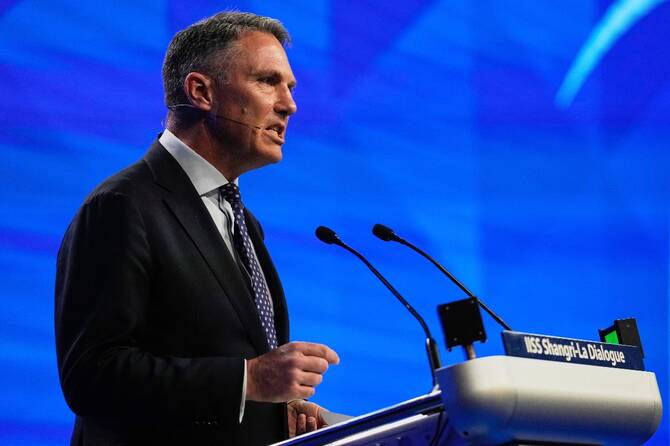
SINGAPORE: Australian Defense Minister Richard Marles on Saturday urged greater transparency from China over its military modernization and deployments as Pacific nations brace for a more assertive Chinese presence.
Speaking to Reuters on the sidelines of the Shangri-La Dialogue defense meeting in Singapore, Marles said that while China remains an important strategic partner to Australia, more open communication between the two nations is key for a “productive” relationship.
“When you look at the growth in the Chinese military that has happened without a strategic reassurance, or a strategic transparency....we would like to have a greater transparency in what China is seeking to do in not only its build up, but in the exercises that it undertakes,” said Marles.
“We want to have the most productive relationship with China that we can have ... we hope that in the context of that productive relationship, we can see greater transparency and greater communication between our two countries in respect of our defense.”
Both Australia and New Zealand raised concerns in February after three Chinese warships conducted unprecedented live-fire drills in the Tasman Sea.
Both nations complained of late notice over the drills by China, which led to the diversion of 49 commercial flights.
Marles said that while the drills were in accordance with international law, China should have been less disruptive.
He also said Australia was able to closely scrutinize the Chinese task-force.
“It’s fair to say that this was done in a bigger way than they have done before, but equally, that was meant from our point of view, by a much greater degree of surveillance than we’ve ever done,” he said.
“From the moment that Chinese warships came within the vicinity of Australia, they were being tailed and tracked by Australian assets ... we were very clear about what exercises China was undertaking and what capability they were seeking to exercise and to build.”
Chinese officials have signalled that more such exercises could be expected as it was routine naval activity in international waters. Defense analysts say the exercises underscore Beijing’s ambition to develop a global navy that will be able to project power into the region more frequently.
Australia has in recent times pledged to boost its missile defense capability amid China’s nuclear weapons buildup and its blue-water naval expansion, as the country targets to increase its defense spending from roughly 2 percent of GDP currently to 2.4 percent by the early 2030s.
The nation is scheduled to pay the United States $2 billion by the end of 2025 to assist its submarine shipyards, in order to buy three Virginia-class nuclear-powered submarines starting in 2032 — its biggest ever defense project.


Australia’s defense minister urges greater military openness from China
https://arab.news/juyxs
Australia’s defense minister urges greater military openness from China

- Richard Marles says that while China remains an important strategic partner to Australia, more open communication between the two nations is key for a "productive" relationship


Mali, Burkina say restricting entry for US nationals in reciprocal move
- Both countries said they are applying the same measures on American nationals as imposed on them
ABIDJAN: Mali and Burkina Faso have announced travel restrictions on American nationals in a tit-for-tat move after the US included both African countries on a no-entry list.
In statements issued separately by both countries’ foreign ministries and seen Wednesday by AFP, they said they were imposing “equivalent measures” on US citizens, after President Donald Trump expanded a travel ban to nearly 40 countries this month, based solely on nationality.
That list included Syrian citizens, as well as Palestinian Authority passport holders, and nationals of some of Africa’s poorest countries including also Niger, Sierra Leone and South Sudan.
The White House said it was banning foreigners who “intend to threaten” Americans.
Burkina Faso’s foreign ministry said in the statement that it was applying “equivalent visa measures” on Americans, while Mali said it was, “with immediate effect,” applying “the same conditions and requirements on American nationals that the American authorities have imposed on Malian citizens entering the United States.”
It voiced its “regret” that the United States had made “such an important decision without the slightest prior consultation.”
The two sub-Saharan countries, both run by military juntas, are members of a confederation that also includes Niger.
Niger has not officially announced any counter-measures to the US travel ban, but the country’s news agency, citing a diplomatic source, said last week that such measures had been decided.
In his December 17 announcement, Trump also imposed partial travel restrictions on citizens of other African countries including the most populous, Nigeria, as well as Ivory Coast and Senegal, which qualified for the football World Cup to be played next year in the United States as well as Canada and Mexico.


