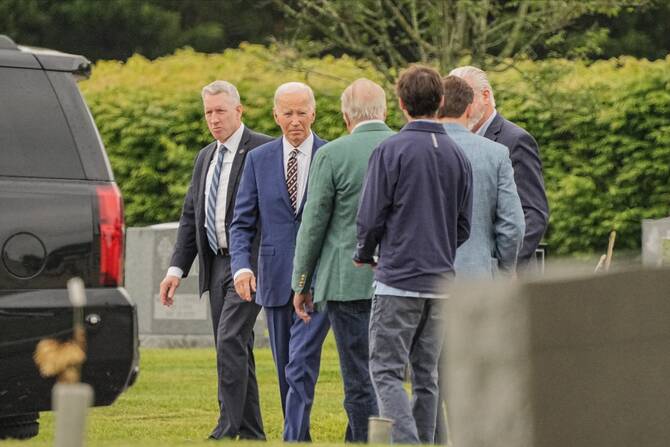
WILMINGTON, US: Former US President Joe Biden told reporters Friday he was feeling “optimistic” about the future after delivering his first public remarks since revealing he had an aggressive form of prostate cancer.
“Well, the prognosis is good. You know, we’re working on everything. It’s moving along. So, I feel good,” Biden, 82, said after an event in Delaware belatedly marking Monday’s Memorial Day federal holiday.
Biden’s office announced earlier this month he is battling prostate cancer with a Gleason score of nine, which places him in the most severe category.
The veteran Democrat told reporters he had decided on a treatment regime, adding that “the expectation is, we’re going to be able to beat this.”
“It’s not in any organ, my bones are strong, it hasn’t penetrated. So I’m feeling good,” he said.
The mental and physical health of the former president, the oldest person ever to hold the office, was a dominant issue in the 2024 election.
After a disastrous debate performance against Trump, Biden ended his campaign for a second term.
When Biden’s office announced his diagnosis, they said the cancer had spread to his bones.
But Biden told reporters: “We’re all optimistic about the diagnosis. As a matter of fact, one of the leading surgeons in the world is working with me.”
The political row over Biden’s aborted candidacy has become a major scandal since the release of the book “Original Sin” — which alleges that Biden’s White House covered up his cognitive decline while he was in office.
The ex-president was asked about the controversy and responded with sarcasm, joking that “I’m mentally incompetent and I can’t walk.”
He said he had no regrets about initially running for a second term, and that his Democratic critics could have challenged him but chose not to “because I’d have beaten them.”
In earlier formal remarks in New Castle, Delaware, Biden spoke of his presidency as his greatest honor, and called for better treatment of veterans.
But he saved his most poignant comments to mark the 10th anniversary on May 30 of his son, National Guard veteran Beau Biden, dying of brain cancer at the age of 46.
“For the Bidens, this day is the 10th anniversary, the loss of my son Beau, who spent a year in Iraq,” said Biden, who had attended a memorial service for his son earlier in the day.
“And, to be honest, it’s a hard day.”


Biden says ‘I’m feeling good’ after cancer diagnosis
https://arab.news/chfet
Biden says ‘I’m feeling good’ after cancer diagnosis

- The veteran Democrat told reporters he had decided on a treatment regime


Canadian police investigate reports of gunfire at US consulate in Toronto
- Police said they were at the scene near University Avenue and Queen Street West
- “Evidence of a firearm discharge has been located,” police said in the post
TORONTO: Canadian police are investigating reports that the United States consulate in downtown Toronto was hit by gunfire early on Tuesday morning.
No injuries have been reported.
Toronto police said Tuesday they responded to reports at around 5:30 a.m. that someone shot a gun at the US consulate.
In a post on social media, police said they were at the scene near University Avenue and Queen Street West.
“Evidence of a firearm discharge has been located,” police said in the post.
No suspect information has been released.
“The shooting that took place at the US consulate early this morning is an absolutely unacceptable act of violence and intimidation aimed at our American friends and neighbors,” Ontario Premier Doug Ford said in a statement.
“Everyone at all levels of government and across Canada needs to make clear that there is zero tolerance for this sort of intimidating and dangerous behavior.”
The reported shooting comes after two Toronto-area synagogues were struck by gunfire last weekend.
“The US consulate was shot at. This comes after shootings at synagogues,” Toronto Mayor Olivia Chow said. “This cannot stand. Toronto’s Jewish community has the right to practice their faith and culture and to live their day-to-day lives without fear, intimidation or violence. As we have seen too many times, antisemitic incidents spike when international incidents rise. It is never acceptable to target the Jewish community.”
Chow said there is heavy police presence on Tuesday at both the US and Israeli consulates in Toronto.
The war in Iran has prompted large demonstrations outside the US consulate, both in support and in protest.