Senior Pakistani official killed in Balochistan as government blames ‘Indian-backed’ militants

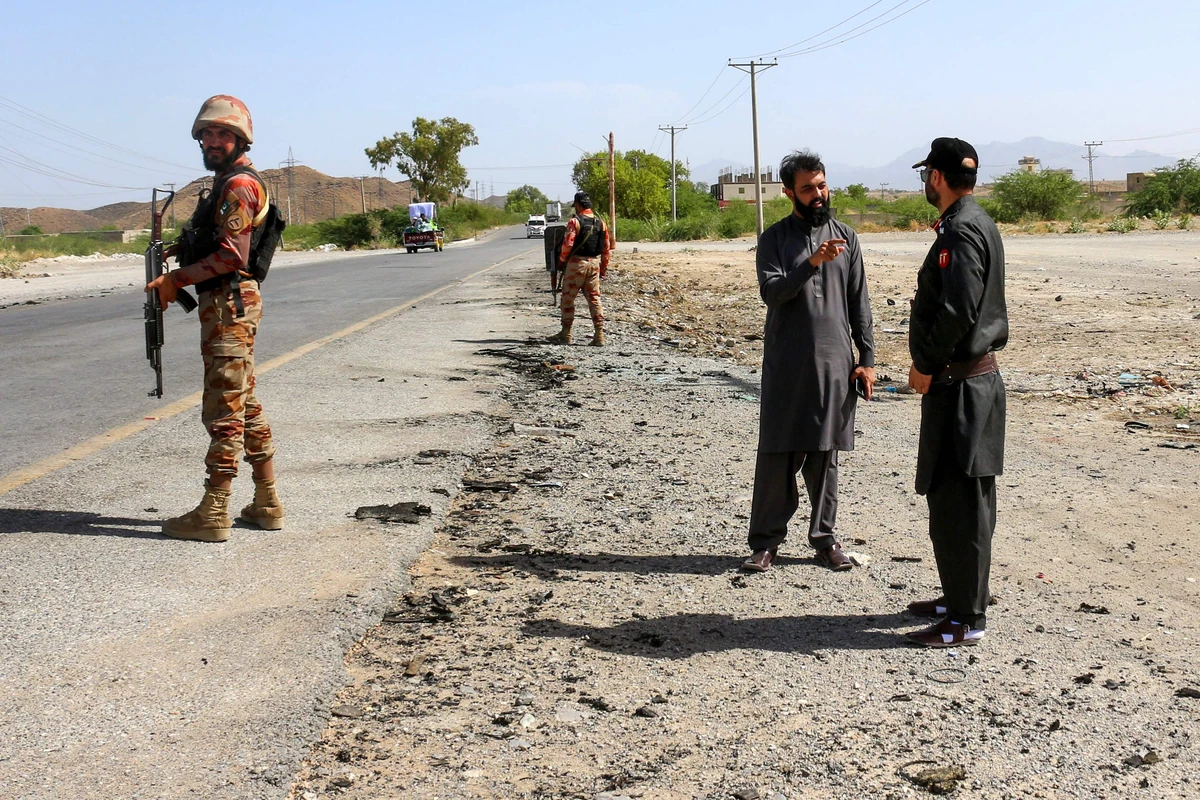
Security personnel stand guard at the site of a school bus bombing in Khuzdar district of Balochistan province on May 21, 2025. (AFP/File)
Short Url
Updated 30 May 2025
Follow

Senior Pakistani official killed in Balochistan as government blames ‘Indian-backed’ militants

  • Balochistan CM says Hidayatullah Buledi was shot dead when he tried to protect civilians in a local market
  • Pakistan’s PM and army chief say the country’s war will continue until militant violence is fully eradicated

KARACHI: The Pakistani government on Friday condemned the killing of a senior administration official in a gun attack in the volatile southwestern Balochistan province, with top officials attributing the assault to what they described as “Fitna Al-Hind” — or Indian-sponsored proxies — fueling unrest in the region.

Additional Deputy Commissioner (ADC) Hidayatullah Buledi was shot dead by armed militants in the Sorab area as he reportedly intervened to protect civilians, including women and children, during an armed assault in a local market.

In a post on social media platform X, the province’s chief minister, Sardar Sarfraz Bugti, said the attack was carried out by militants affiliated with the Baloch Liberation Army (BLA), a separatist group banned in Pakistan, which he said was backed by the neighboring Indian state.

“Despite holding the office of ADC Revenue, when terrorists of Fitna Al-Hind BLA opened fire on women and children in Sorab today, Hidayatullah Buledi honored the traditions of Baloch valor and sacrificed his life in defense of the Pakistani state,” he said in the post while praying for the deceased officer and his family.

Prime Minister Shehbaz Sharif also issued a statement, condemning the “cowardly attack” on a local bank, civilians and public officials in Sorab and paying tribute to Buledi for defending his community.

“The entire nation stands with the family of Shaheed [martyr] Hidayatullah Buledi,” he said, vowing to bring the perpetrators to justice.

“Their attack reflects a mindset that is openly hostile to Pakistan’s progress and stability in Balochistan,” he added.

The prime minister also praised the efforts of the Pakistani armed forces and reiterated the government’s commitment to eradicating militant violence from the country.

Pakistan’s army chief, Field Marshal Asim Munir, who was in Quetta during the day to address officers at the Command and Staff College, also promised to take Pakistan’s war against militancy to its “logical conclusion.”

“The nation’s fight against terrorism will be driven to a logical conclusion — success against all forms and manifestations of terrorism,” the military’s media wing, Inter-Services Public Relations, quoted him as saying in a statement.

Balochistan, Pakistan’s largest but least developed province, has long been the site of a separatist insurgency, with militants blaming the state for exploiting the mineral resources of the region without doing much for the local population.

The government has repeatedly denied the allegation, pointing to the infrastructure and livelihood projects it has been carrying out in the area for years.

Pakistan has also frequently accused India of funding and arming militant groups, a charge New Delhi denies.
Punjab expands Pakistan-India Wagah border arena with museum, partition-themed park

Updated 4 sec ago
Follow

Punjab expands Pakistan-India Wagah border arena with museum, partition-themed park

  • The border crossing, near eastern city of Lahore, is the primary land route between Pakistan and India and one of the most recognizable symbols of their often-tense relations
  • The site is best known for its daily flag-lowering ceremony, a choreographed military ritual performed by border forces from both countries that draws thousands of spectators

ISLAMABAD: Maryam Nawaz, chief minister of Pakistan’s Punjab province, on Thursday inaugurated the newly constructed arena at Wagah border cross between Pakistan and India, which includes a museum and a partition themed park.

The Wagah border crossing, located near the eastern city of Lahore, is the primary land route between Pakistan and India and one of the most recognizable symbols of the often-tense relationship between the two neighbors. It serves as a key point for prisoner exchanges and limited movement of travelers, while remaining tightly regulated due to security considerations.

The site is best known for its daily flag-lowering ceremony, a choreographed military ritual performed by border forces from both countries that draws thousands of spectators. Over the years, the ceremony has evolved into a popular tourist attraction, blending displays of nationalism with public spectacle and making it one of Pakistan’s most visited landmarks, which connects with India’s Attari.

Flanked by military officials, CM Nawaz visited the crossing and inaugurated the new arena, with its seating capacity increased from 7,500 to 25,000 spectators, the state-run Radio Pakistan broadcaster reported. The chief minister also visited the martyrs’ monument and offered her respects.

“In addition to the arena’s expansion, several new constructions have been added at the Joint Check Post Wagah. These new developments include a theme park depicting the partition of the Subcontinent, featuring models of a railway station, military equipment and a Martyrs’ Memorial,” the broadcaster reported.

“A Pakistan Museum has also been established within the arena, showcasing the country’s history and culture from the Freedom Movement to the present day.”

In August 1947, Britain divided the Indian Sub-continent, its former colony, into two countries — Hindu-majority India and Muslim-majority Pakistan.

Excitement over independence was quickly overshadowed by some of the worst bloodletting that left up to 1 million people dead as gangs of Hindus and Muslims slaughtered each other.

Creating two independent nations also tore apart millions of Hindu and Muslim families in one of the world’s largest peacetime migrations, which displaced at least 15 million people.

The fate of Kashmir, then a princely state, was left undecided. The Himalayan territory continues to remain a flashpoint in relations between the neighbors, who have fought multiple wars over it.