

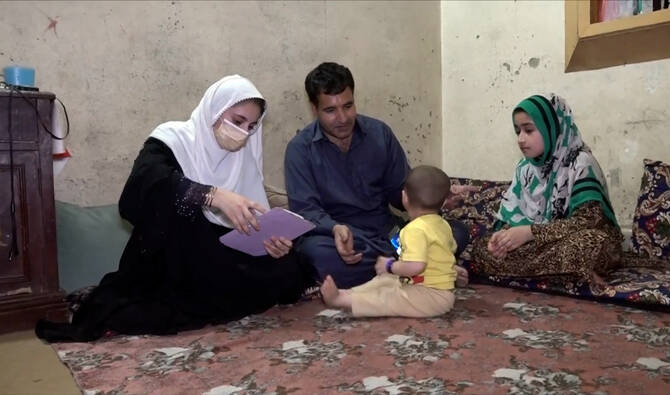

PESHAWAR: Muhammad Alam, 40, wakes up daily to the laughter and noise of his seven children as they begin their day at the family’s rented home in the northwestern Pakistani city of Peshawar while their mother prepares breakfast in a small kitchen.
These days, Alam’s heart is full of dread, and he is having frequent arguments with his wife over whether she and the children, six daughters and one son, will accompany him to Afghanistan if he has to leave.
Alam is an Afghan refugee who is married to a Pakistani woman. Under an ongoing repatriation drive targeting "illegal" foreigners that was launched by the Pakistan government in November 2023, Alam may have to leave the country soon. If that happens, he will be separated from his family, all of whom are Pakistani nationals and are refusing to accompany him.
Around 1.3 million Afghans have left Pakistan since the expulsion drive was started.
“We are in trouble because of the deportation drive,” Alam told Arab News at his home in Peshawar, the capital of the northwestern Khyber Pakhtunkhwa province.
“I can’t refuse to leave but who will convince my family? Just for me, these seven children will not go to Afghanistan and I can’t leave these seven behind.”
Alam holds a Proof of Registration (PoR) card, a document issued by the National Database and Registration Authority that provides temporary legal status and freedom of movement for registered Afghan refugees. It serves as an identification document, allowing Afghan refugees to legally reside in Pakistan. The PoR card was initially issued in 2007 and has been extended multiple times, currently valid until June 30, 2025.
Alam is unsure what will happen after that deadline passes next month: “If the government arrests and deports me, who will take care of my family?”
When he spoke to his children about going to Afghanistan with him, one of them replied: “You are an Afghan, you should go.”
Alam’s wife holds a Pakistani Computerized National Identity Card (CNIC) and his children all have the Form-B, an important document for children under 18 years old in Pakistan, serving as a child's identification document and necessary for various purposes like school admissions, passports, and international travel.
One of Alam’s daughters Laiba, 14, said the government should make a special case for her father as he had a Pakistani family.
“We and our mother have Pakistani identification documents, only he doesn’t have it. He should be given the [CNIC] card, the whole fight will end,” she said.
“What will we do in Afghanistan? We have neither seen nor gone there.”
Troubles have already begun for the family.
Laiba said she was refused enrollment in the 8th standard after she failed to present a Pakistani CNIC for her father.
“They asked for my mother’s [CNIC] card, I produced it. Then they asked for my father’s card. My father didn’t have a [CNIC] card, from where should I have produced it? So, they expelled me from the school,” the teenager said.
“Our school is gone already. What should we do?”
Qudratullah, 38, another Afghan refugee from Jalalabad who is married to a Pakistani women, is facing the same issue, saying his children and wife were refusing to accompany him to Afghanistan.
While he has an Afghan passport, his Pakistan visa had expired, after which he was deported to Afghanistan in October 2024. It took him nearly four months to get a new visa from Afghanistan and return to Pakistan in February this year, with a multiple-entry family visit visa that expires in February 2026.
“I have married a Pakistani woman but my wife doesn’t want to go with me to [Afghanistan],” Qudratullah told Arab News. “When I tell her to go, she starts fighting with me. She doesn’t want to go with me at any cost.”
Qudratullah's wife Nasreen Bibi described the situation as “too difficult.”
“Sometimes he [my husband] gets a visa and sometimes the visa is rejected, and he sometimes gets stuck there [in Afghanistan] and we are left alone,” she said at the couple’s home in Peshawar.
“We have children who are studying here, we have a house. We can’t go with him there, our children can’t live in that country.”
“HOSPITALITY”
Nauman Mohib Kakakhel, a Peshawar High Court advocate, has fought cases for families, where a Pakistani is married to an Afghan with Proof of Registration (POR) or Afghan Citizen Cards (ACC). The ACC is a document issued by the Pakistan government to undocumented Afghan nationals, allowing them to legally reside in Pakistan for a limited time and provides temporary protection from deportation.
“We filed a case for hundreds of families, and it was decided by the Peshawar High Court that since NADRA already has records of these families in the shape of Afghan Citizen Cards or Proof of Registration cards, as they enjoy refugees’ status in Pakistan and that’s a legal status,” Kakakhel said.
“And now they have got married to a Pakistani citizen, so this should be sufficient for them to get permanent residency in Pakistan.”
As per the law, children born to a couple where one partner is Pakistani and the other is Afghan, will automatically be entitled to the citizenship of Pakistan by descent when they turn 21, the lawyer explained.
After they turn 21, they must opt for the nationality of one country while Pakistani women married to an Afghan can hold the citizenship of both countries under Pakistani law.
Speaking to Arab News, Qaisar Afridi, a spokesperson for UNHCR in Pakistan, said Afghans, including human rights activists, journalists and others married to Pakistani nationals, were facing challenges in Pakistan:
“As the Pakistani government and the people of Pakistan have hosted Afghans for the past 40-45 years, we request the government of Pakistan that this hospitality should be continued until the situation in Afghanistan improves.”


