

Pakistan formally initiates talks with US on ‘reciprocal tariffs’ amid export concerns

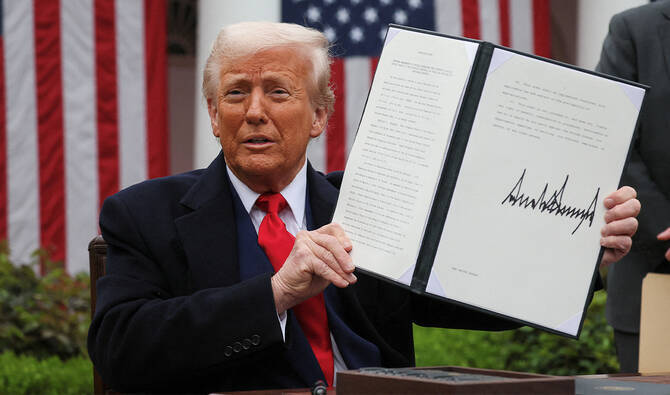
US President Donald Trump holds a signed executive order on tariffs, in the Rose Garden at the White House in Washington, DC, US, April 2, 2025. (REUTERS/File)
Short Url
Updated 30 May 2025
Follow

Pakistan formally initiates talks with US on ‘reciprocal tariffs’ amid export concerns

  • US imposed a 29% tariff on Pakistani goods as Islamabad pushes for export-led growth
  • Pakistan says it sees the move as both a challenge and an opportunity to reset trade ties

KARACHI: Pakistan has formally begun negotiations with the United States over newly imposed “reciprocal tariffs,” an official statement said on Friday, with Finance Minister Muhammad Aurangzeb holding a conference call with US Trade Representative Ambassador Jamieson Greer to launch the process.

The talks come after US President Donald Trump imposed steep tariffs on a number of countries earlier this year, a move widely viewed as a setback for the global economy still recovering from the coronavirus pandemic. Defending the action, Trump said the tariffs were necessary to correct trade imbalances and counter what he described as unfair treatment of American goods abroad.

Pakistan was among the countries affected, with a 29 percent tariff placed on its goods at a time when Islamabad is pushing for export-driven growth.

Aurangzeb called the development both a challenge and an opportunity to reset trade ties in April, adding that a high-level delegation would soon travel to Washington to pursue the matter further.

“Pakistan’s formal negotiations on US reciprocal tariffs kick-started between Mr. Muhammad Aurangzeb, Pakistan’s Finance Minister and Ambassador Jamieson Greer, United States Trade Representative through a telephonic/conference call on 30th May, 2025,” the finance ministry said.

“The two sides exchanged their viewpoint through a constructive engagement with the understanding that technical level detailed discussions would follow in the coming few weeks,” it added.

The ministry said both sides expressed confidence in advancing the negotiations toward a successful conclusion at the earliest.

The US is Pakistan’s largest export destination, and the newly imposed duties threaten to undermine Islamabad’s fragile economic recovery.

According to Pakistan’s central bank, the country exported $5.44 billion worth of goods to the US in 2024. From July to February of the current fiscal year, exports to the US reached $4 billion, up 10 percent from the same period last year.

Nearly 90 percent of those exports are textiles, which analysts say will be hardest hit.

Experts have also warned previously the tariffs could reduce Pakistan’s competitiveness, especially if regional exporters such as China, Bangladesh and Vietnam redirect more goods to Europe, intensifying competition in alternative markets.


Pakistan regulator amends law to facilitate capital raising by listed companies

Updated 19 January 2026
Follow

Pakistan regulator amends law to facilitate capital raising by listed companies

  • The amendments address challenges faced by listed companies when raising further capital from existing shareholders through a rights issue
  • Previously, listed companies were prohibited from announcing a rights issue if the company, officials or shareholders had any overdue amounts

KARACHI: The Securities and Exchange Commission of Pakistan (SECP) has notified amendments to the Companies (Further Issue of Shares) Regulations 2020 to facilitate capital raising by listed companies while maintaining adequate disclosure requirements for investors, it announced on Monday,

The amendments address challenges faced by listed companies when raising further capital from existing shareholders through a rights issue. Previously, listed companies were prohibited from announcing a rights issue if the company, its sponsors, promoters, substantial shareholders, or directors had any overdue amounts or defaults appearing in their Credit Information Bureau (CIB) report.

This restriction constrained financially stressed yet viable companies from raising capital, even in circumstances where existing shareholders were willing to support revival, restructuring, or continuation of operations, according to the SECP.

“Under the amended framework, the requirement for a clean CIB report will not apply if the relevant persons provide a No Objection Certificate (NOC) regarding the proposed rights issue from the concerned financial institution(s),” the regulator said.

The notification of the amendments follows a consultative process in which the SECP sought feedback from market stakeholders, including listed companies, issue consultants, professional bodies, industry associations, law firms, and capital market institutions.

The amendments are expected to enhance market confidence, improve access to capital for listed companies, and strengthen transparency within the rights issue framework, according to the SECP.

“To ensure transparency and protect investors’ interests, companies in such cases must make comprehensive disclosures in the rights offer document,” the regulator said.

“These disclosures must include details of any defaults or overdue amounts, ongoing recovery proceedings, and the status of any debt restructuring.”

The revised regulations strike an “appropriate balance” between facilitating corporate rehabilitation and enabling investors to make informed investment decisions, the SECP added.