
ISLAMABAD: Prime Minister Shehbaz Sharif on Friday drew the world’s attention to India’s “weaponization” of water by suspending Indus Waters Treaty (IWT) with Pakistan, urging the world to not let millions of lives to be held “hostage.”
India announced on April 23 that it was putting the 1960 World Bank-mediated treaty in abeyance after it accused Pakistan of backing an attack on tourists in Indian-administered Kashmir. Islamabad has denied complicity and called for a credible, international probe into it.
The IWT grants Pakistan rights to the Indus basin’s western rivers — Indus, Jhelum, and Chenab — for irrigation, drinking, and non-consumptive uses like hydropower, while India controls the eastern rivers — Ravi, Beas, and Sutlej — for unrestricted use but must not significantly alter their flow. India can use the western rivers for limited purposes such as power generation and irrigation, without storing or diverting large volumes, according to the agreement.
Speaking at the International Conference on Glaciers’ Preservation in Dushanbe, Sharif said the world must recognize that water transcends political boundaries, connects communities and sustains ecosystems and cultures, demanding world action over New Delhi’s move to suspend the IWT.
“We are now witnessing an alarming new low, the weaponization of water, India’s unilateral and illegal decision to hold in abeyance the Indus Water Treaty which governs the sharing of the Indus basin’s water is deeply regrettable,” he said, urging that lives of millions of Pakistanis must not be held hostage to “narrow political gains.”

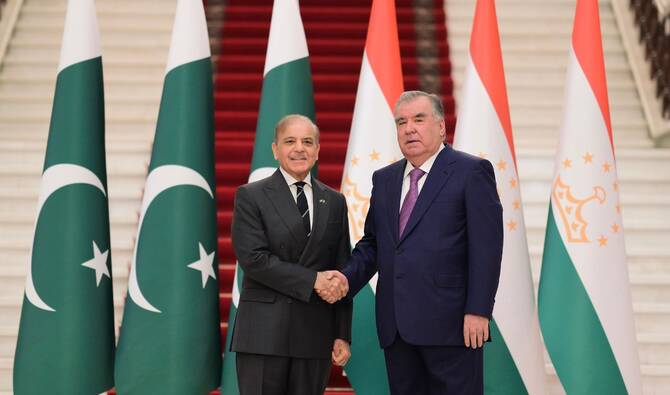
Prime Minister Shehbaz Sharif speaking at the International Conference on Glaciers’ Preservation in Dushanbe, Tajikistan, on MAy 30, 2025. (PMO)
“Our waters and our glaciers... bind us in a shared destiny. Let us protect and preserve nature’s precious bounties for our planet and our peoples.”
The IWT suspension was among a series of punitive measures India announced against Pakistan over the Kashmir attack that killed 26 people. The archfoes this month traded missile, drone and artillery fire in their worst fighting since 1999 Kargil War before agreeing to a ceasefire on May 10.
India has maintained its decision to keep the treaty, which ensures water for 80 percent of Pakistani farms, in abeyance, while Islamabad has said it will contest the move at every forum.
Sharif also urged the world to expedite its climate action to protect glacial systems, which were the lifeline of their civilization, culture and economy.
He said his country witnessed firsthand the peril of glacial melt in 2022, when devastating floods submerged Pakistan, washing away standing crops over millions of acres, affecting over 30 million people and causing more billions of dollars in damages.
“We only contribute less than half percent of the total world emissions, and yet we are one of those 10 most vulnerable countries facing this menace [of climate change],” he said.
“I pray to Allah Almighty that other countries do not face this kind of devastation which we faced back in 2022, but it will not be protected through words and speeches, it requires comprehensive, a plan, and immediate implementation.”
Pakistan believes in shared responsibility and collective action, according to Sharif. There is an urgent need for an enhanced global climate action to mitigate the negative impacts of climate change.
“The developed countries must meet their climate financial commitments without any delay and with a balanced focus on adaptation and mitigation as well as loss and damage,” he said.
“Adequate funding for climate resilient infrastructure and overcoming financing gap remains critical for climate vulnerable countries.”
Islamabad has been urging the international community to ensure faster and simpler disbursements from the global fund to help vulnerable countries respond to climate-related losses.
The Fund for Responding to Loss and Damage (FRLD) was established at the COP27 climate summit in Egypt in 2022 and a year later, nearly 200 nations agreed to the operationalization of $575 million as part of it. However, disbursements under the program have since been slow, hampering climate adaptation efforts in developing countries.