Witnesses in Gaza describe more chaos at food distribution sites

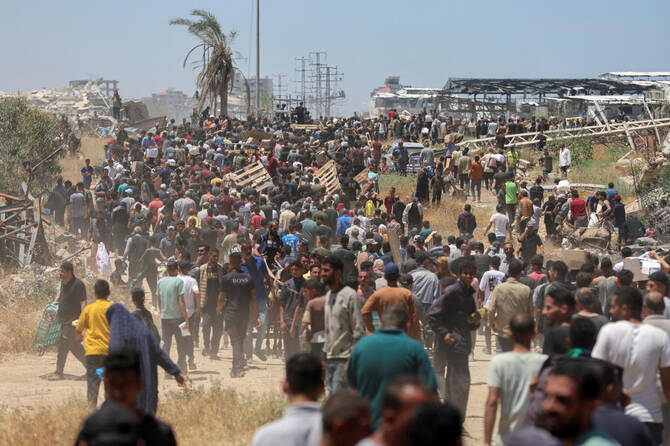
People walk as Palestinians receive aid supplies from the US-backed Gaza Humanitarian Foundation, in the central Gaza Strip, May 29, 2025. (REUTERS)
Short Url
Updated 30 May 2025
Follow

Witnesses in Gaza describe more chaos at food distribution sites

  • Multiple witnesses on Thursday reported a free-for-all of people grabbing aid, and they said Israeli troops opened fire to control crowds.
  • Witnesses said it was Israeli troops who fired the projectiles to clear large crowds of Palestinians after the center ran out of supplies

NUSEIRAT: Chaos erupted again Thursday as tens of thousands of desperate Palestinians in the Gaza Strip tried to collect food from distribution sites run by a new US- and Israeli-backed foundation. Multiple witnesses reported a free-for-all of people grabbing aid, and they said Israeli troops opened fire to control crowds.
In central Gaza, Associated Press video showed smoke bombs arching through the air around a distribution center, and gunfire was audible as an Israeli tank moved nearby. Witnesses said it was Israeli troops who fired the projectiles to clear large crowds of Palestinians after the center ran out of supplies Thursday.
“I came to get a sack of flour … a sardine tin or anything,” said Mahmoud Ismael, a man on crutches from an earlier leg injury who said he walked for miles to get to the center, only to leave empty-handed.
“There is no food in my house, and I can’t get food for my children,” he said.
Turmoil has plagued the aid system launched this week by the Gaza Humanitarian Foundation, which runs three distribution centers in the territory. Israel has slated GHF to take over food distribution in Gaza despite opposition from the United Nations and most humanitarian groups.
Over the past three days, there have been reports of gunfire at GHF centers, and Gaza health officials have said at least one person has been killed and dozens wounded.
The Israeli military said it has facilitated the entry of nearly 1,000 truckloads of supplies into Gaza recently and accused the UN of failing to distribute the goods. It claimed Hamas was responsible for the crisis by stealing aid and refusing to release the remaining hostages.
The military’s spokesman, Brig. Gen. Effei Defrin, said the army will continue “to provide for the humanitarian needs of the civilian population while taking necessary steps to ensure that the aid does not reach the hands of Hamas.”
With media not allowed to access the centers, the circumstances remain unclear. The distribution points are guarded by armed private contractors, and Israeli forces are positioned in the vicinity. On Tuesday, the Israeli military said it fired warning shots to control a crowd outside one center.
Dr. Khaled Elserr, a surgeon at Nasser Hospital in the southern city of Khan Younis, told the AP he treated two people wounded at distribution centers on Thursday — a 17-year-old girl and a man in his 20s. Both had gunshot wounds in the chest and stomach, he said, adding that other casualties had come in from the centers but that he did not have an exact number.
In a statement Thursday, GHF said no shots had been fired at any of its distribution centers the past three days and there have been no casualties, saying reports of deaths “originated from Hamas.”
Separately on Thursday, Israeli strikes in Gaza killed at least 34 people, according to local health officials. Israel said it would establish 22 more Jewish settlements in the occupied West Bank. Most of the international community views settlements as illegal and an obstacle to resolving the decades-old conflict.
Turmoil at aid distribution sites
Hunger and malnutrition have mounted among Gaza’s 2.3 million Palestinians since Israel barred entry of food, fuel, medicine and other supplies nearly three months ago, allowing a trickle of aid in only the past two weeks.
GHF has opened hubs in three locations – two in the far south around the city of Rafah, and the other in central Gaza near the Netzarim corridor, a strip of territory controlled by Israeli forces. The large crowds have to walk miles to reach the locations.
More than a dozen Palestinians described chaos at all three Thursday.
At one of the Rafah sites near the Morag Corridor, another Israeli-held strip, one man told the AP he and his cousin arrived at 5:30 a.m., and found thousands of people massed outside, waiting to be let in. When it was opened, the crowd flowed into an outdoor area ringed by barbed wire and earth berms, where pallets of food boxes had been left.
Armed contractors stood on the berms watching, and beyond them Israeli troops and tanks were visible, said the 41-year-old man, who spoke on condition he be identified only by his first name, Shehada, for fear of reprisals. The crowd descended on the food boxes, and pushing and shoving got out of control, he said.
Shehada said the contractors pulled back and Israeli troops shot at people’s feet. His cousin was wounded in the left foot, he said. “The gunfire was very intense,” he said. “The sand was jumping all around us.”
At the other Rafah site, several people told AP of a similar scene of pallets of food boxes left on the ground for the crowds to take whatever they could with no control by staff. Mohammad Abu-Elinin, said “gangs” carried off cartloads of flour bags and multiple aid boxes.
Samira Z’urob said by the time she arrived at 6.a.m, “the thieves had stolen people’s aid.” When she begged, one person gave her a bag of pasta and a can of beans. “I said, Thank God, and took it to my children,” she said. “I haven’t had flour for more than a week.”
Another woman, Heba Joda, said people tore down metal fences and took wooden pallets. When the food boxes ran out, staff told people to leave, then fired sound grenades to disperse them, she said.
As people fled through a nearby roundabout outside the center, Israeli troops fired gunshots, causing a panic, she said. Abu-Elinin said he saw one man wounded by shrapnel.
At the center in central Gaza, witnesses told the AP that Israeli troops fired tear gas and smoke grenades to disperse the crowds when aid ran out. AP video showed crowds of people returning from the site, some with carts full of boxes and many with nothing.
Aisha Na’na said all she managed to grab were some sticks to use as firewood. “We had come to get food for our children, but it was all in vain — we returned with nothing,” she said.
Israel says the GHF system will replace the massive aid operation that the UN and other aid groups have carried out throughout the war. It says the new mechanism is necessary, accusing Hamas of siphoning off large amounts of aid. The UN denies that significant diversion takes place.
In its statement Thursday, GHF said it has distributed more than 32,200 boxes of food since Monday. It says each box, which contains basics like sugar, lentils, pasta and rice, can make 58 meals. It said it will scale up to start operations at a fourth center and will build additional hubs in the weeks ahead.
The UN and other aid groups have refused to participate in the mechanism, saying it violates humanitarian principles. They say it allows Israel to use food as a weapon, forcing people to move to the hubs, potentially emptying large swaths of Gaza. They also say it cannot meet the massive needs of the population.
Israel has allowed in some trucks of aid for the UN to distribute, but the UN has struggled to deliver the material amid looting and Israeli military restrictions.
UN spokesman Stephane Dujarric told reporters Thursday that Israeli authorities hadn’t given permission for UN trucks to move to the border to retrieve the arriving supplies for the previous three days.


Israel’s Somaliland gambit: what’s at risk for the region?

Updated 28 December 2025
Follow

Israel’s Somaliland gambit: what’s at risk for the region?

  • Somaliland’s strategic location near the Bab Al-Mandab raises fears an Israeli security presence could turn the Red Sea into a powder keg
  • Critics argue the decision revives Israel’s “periphery” strategy, encouraging fragmentation of Arab and Muslim states for strategic advantage

RIYADH: It perhaps comes as no surprise to seasoned regional observers that Israel has become the first and only UN member state to formally recognize the Republic of Somaliland as an independent and sovereign nation.

On Dec. 26, Israel’s Prime Minister Benjamin Netanyahu and Foreign Minister Gideon Sa’ar signed a joint declaration of mutual recognition alongside Somaliland’s President Abdirahman Mohamed Abdullahi.

For a region that has existed in a state of diplomatic limbo since declaring independence from Somalia in 1991, this development is, as Abdullahi described it, “a historic moment.” But beneath the surface lies a calculated and high-stakes geopolitical gamble.

While several nations, including the UK, Ethiopia, Turkiye, and the UAE, have maintained liaison offices in the capital of Hargeisa, none had been willing to cross the Rubicon of formal state recognition.

Israel’s Prime Minister Benjamin Netanyahu, assisted by Foreign Minister Gideon Sa’ar, signs the document formally recognizing Somalia's breakaway Somaliland region on Dec. 26, 2025. (AFP)

Israel’s decision to break this decades-long international consensus is a deliberate departure from the status quo.

By taking this step, Israel has positioned itself as the primary benefactor of a state that has long sought a seat at the international table. As Dya-Eddine Said Bamakhrama, the ambassador of Djibouti to Saudi Arabia, told Arab News, such a move is deeply disruptive.

“A unilateral declaration of separation is neither a purely legal nor an isolated political act. Rather, it carries profound structural consequences, foremost among them the deepening of internal divisions and rivalries among citizens of the same nation, the erosion of the social and political fabric of the state, and the opening of the door to protracted conflicts,” he said.

Critics argue that Israel has long lobbied for the further carving up of the region under various guises.

This recognition of Somaliland is seen by many in the Arab world as a continuation of a strategy aimed at weakening centralized Arab and Muslim states by encouraging peripheral secessionist movements.

Somaliland’s President Abdirahman Mohamed Abdullahi. (AFP file photo)

In the Somali context, this path is perceived not as a humanitarian gesture, but as a method to undermine the national understandings reached within the framework of a federal Somalia.

According to Ambassador Bamakhrama, the international community has historically resisted such moves to prioritize regional stability over “separatist tendencies whose dangers and high costs history has repeatedly demonstrated.”

By ignoring this precedent, Israel is accused of using recognition as a tool to fragment regional cohesion.

In the past, Israel has often framed its support for non-state actors or separatist groups under the pretext of protecting vulnerable minorities — such as the Druze in the Levant or Maronites in Lebanon.

This “Periphery Doctrine” served a dual purpose: it created regional allies and supported Israel’s own claim of being a Jewish state by validating the idea of ethnic or religious self-determination.

However, in the case of Somaliland, the gloves are off completely. The argument here is not about protecting a religious minority, as Somaliland is a staunchly Muslim-majority territory. Instead, the rationale is nakedly geopolitical.

Israel appears to be seeking strategic depth in a region where it has historically been isolated. Netanyahu explicitly linked the move to “the spirit of the Abraham Accords,” signaling that the primary drivers are security, maritime control, and intelligence gathering rather than the internal demographics of the Horn of Africa.

The first major win for Israel in this maneuver is the expansion of its diplomatic orbit. It could be argued that the refusal of the federal government in Mogadishu to join the Abraham Accords was an artificial barrier.

The evidence for this claim, from the Israeli perspective, is that Somaliland — a territory with a population of nearly six million and its own functioning democratic institutions — was eager to join.

Abdullahi said Somaliland would join the Abraham Accords as a “step toward regional and global peace.” Yet, this peace comes with a clear quid pro quo — formal recognition.

Residents wave Somaliland flags as they gather in downtown Hargeisa on December 26, 2025, to celebrate Israel's announcement recognizing Somaliland's statehood. (AFP)

Israel can now argue that the “Somaliland model” proves that many other Arab and Muslim entities are willing to normalize relations if their specific political or territorial interests are met.

This challenges the unified stance of the Arab League and the Organization of Islamic Cooperation, which maintain that normalization must be tied to the resolution of the Palestinian conflict.

The second major gain for Israel is the potential for a military presence in the Horn of Africa. Somaliland’s strategic position on the Gulf of Aden, near the Bab Al-Mandab Strait, makes it a prime location for monitoring maritime traffic.

This is a ticking time bomb given that just across the narrow sea lies Yemen, where the Houthi movement — whose slogan includes “Death to Israel” — controls significant territory.

Israel may claim that a military or intelligence presence in Somaliland will boost regional security by countering Houthi threats to shipping. However, regional neighbors fear it will likely inflame tensions.

Ambassador Bamakhrama warned that an Israeli military presence would “effectively turn the region into a powder keg.”

Ambassador Dya-Eddine Said Bamakhrama, Djibouti's envoy to Saudi Arabia. (Supplied)

“Should Israel proceed with establishing a military base in a geopolitically sensitive location... such a move would be perceived in Tel Aviv as a strategic gain directed against the Arab states bordering the Red Sea — namely Egypt, Saudi Arabia, Somalia, Yemen, Sudan, and Djibouti,” he said.

The Red Sea is a “vital international maritime corridor,” and any shift in its geopolitical balance would have “repercussions extending far beyond the region,” he added.

The recognition is also a clear violation of international law and the principle of territorial integrity as enshrined in the UN Charter.

While proponents point to exceptions like South Sudan or Kosovo, those cases involved vastly different circumstances, including prolonged genocidal conflicts and extensive UN-led transitions.

In contrast, the African Union has been firm that Somaliland remains an integral part of Somalia.

The backlash has been swift and severe. The Arab League, the Gulf Cooperation Council, and the OIC have all decried the move. Even US President Donald Trump, despite his role in the original Abraham Accords, has not endorsed Israel’s decision.

When asked whether Washington would follow suit, Trump replied with a blunt “no,” adding, “Does anyone know what Somaliland is, really?”

This lack of support from Washington highlights the isolation of Israel’s position. The OIC and the foreign ministers of 21 countries have issued a joint statement warning of “serious repercussions” and rejecting any potential link between this recognition and reported plans to displace Palestinians from Gaza to the African region.

Israel’s recognition of Somaliland appears to be a calculated gamble to trade diplomatic norms for strategic advantage.

While Hargeisa celebrates a long-awaited milestone, the rest of the world sees a dangerous precedent that threatens to destabilize one of the world’s most volatile corridors.

As Ambassador Bamakhrama says, the establishment of such ties “would render (Israel) the first and only state to break with the international consensus” — a move that prioritizes “narrow strategic calculations” over the stability of the international system.