

Pakistani high court to hear Imran Khan’s appeal in Al-Qadir land bribe case on June 5

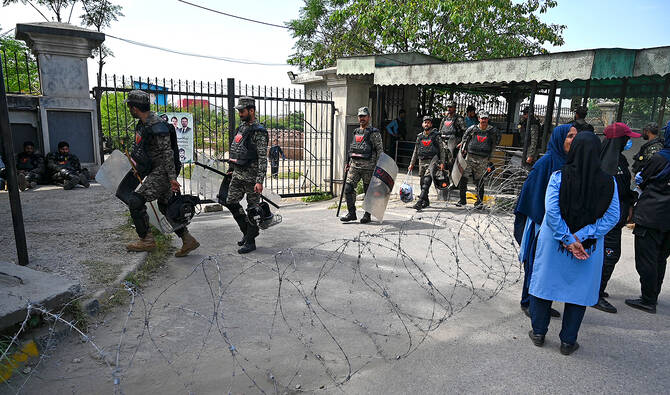
Rangers stand guard at the High Court for the arrival of Pakistan’s former Prime Minister Imran Khan in Islamabad on May 12, 2023. (AFP/File)
Short Url
Updated 29 May 2025
Follow

Pakistani high court to hear Imran Khan’s appeal in Al-Qadir land bribe case on June 5

  • Khan and his wife Bushra were sentenced four months ago, call the case politically motivated
  • Authorities say they used Al-Qadir trust to receive land as a bribe from a real estate developer

ISLAMABAD: The Islamabad High Court (IHC) will take up the Al-Qadir Trust case involving former Prime Minister Imran Khan and his wife on June 5, marking the first hearing since the couple was sentenced over four months ago, the opposition Pakistan Tehreek-e-Insaf (PTI) party said Thursday.

A Pakistani court sentenced Khan to 14 years and his wife, Bushra Bibi, to seven years in prison last January. The centers on allegations that they received land as a bribe from real estate tycoon Malik Riaz Hussain through their charitable foundation, the Al-Qadir Trust.

The trust, founded in 2018 while Khan was still in office, is accused by authorities of being used as a front for illegal benefits.

The PTI has long maintained the case lacks merit and repeatedly requested the high court to hear their petition to suspend the convictions. This is the first time the IHC has scheduled proceedings since the lower court verdict in January, which was delayed at least three times before being delivered.

“Al-Qadir Trust case is scheduled for hearing on June 5,” the PTI said in a statement during the day.

The hearing will be conducted by a two-member IHC bench led by acting Chief Justice Sardar Muhammad Sarfraz Dogar and Justice Muhammad Asif, according to the court’s cause list.

PTI Chairman Barrister Gohar Khan, speaking to reporters outside the Supreme Court earlier this week, said the party had met with the chief justice to press for the case to be listed.

“Release [of Khan and his wife] will take place once the case is heard,” Gohar told reporters. “We still hope the case will be heard on June 5.”

The Al-Qadir case stems from £190 million that the UK repatriated to Pakistan in 2019 after the Pakistani real estate tycoon settled a British investigation into suspected criminal assets.

Authorities allege that instead of depositing the funds in Pakistan’s national treasury, Khan’s government used the money to help Hussain pay court-imposed fines in a separate case related to land acquired illegally in Karachi at below-market rates.

Khan, who has been in jail since August 2023 and is facing a slew of legal cases, says all charges against him are politically motivated.

He accuses Prime Minister Shehbaz Sharif and the country’s powerful military of orchestrating the crackdown to sideline him, a claim both Sharif and military officials deny.


Pakistan to launch AI screening in January to target fake visas, agent networks

Updated 5 sec ago
Follow

Pakistan to launch AI screening in January to target fake visas, agent networks

  • New system to flag forged-document travelers before boarding and pre-verify eligibility
  • Move comes amid increasing concern over fake visas, fraudulent agents, forged papers

ISLAMABAD: Pakistan will roll out an AI-based immigration screening system in Islamabad from January to detect forged documents and prevent illegal overseas travel, the government said on Thursday. 

The move comes amid increasing concern over fake visas, fraudulent agents and forged papers, with officials warning that such activity has contributed to deportations, human smuggling and reputational damage abroad. Pakistan has also faced scrutiny over irregular migration flows and labor-market vulnerability, particularly in the Gulf region, prompting calls for more reliable pre-departure checks and digital verification.

The reforms include plans to make the protector-stamp system — the clearance required for Pakistani citizens seeking overseas employment — “foolproof”, tighten labor-visa documentation, and cancel the passports of deportees to prevent them from securing visas again. The government has sought final recommendations within seven days, signalling a rapid enforcement timeline.

“To stop illegal immigration, an AI-based app pilot project is being launched in Islamabad from January,” Interior Minister Mohsin Naqvi said following a high-level meeting chaired by him and Minister for Overseas Pakistanis Chaudhry Salik Hussain.

Naqvi said the new screening technology is intended to determine travelers’ eligibility in advance, reducing airport off-loads and closing loopholes exploited by traffickers and unregistered agents.

The interior minister added that Pakistan remains in contact with foreign governments to improve the global perception and ranking of the green passport, while a uniform international driving license will be issued through the National Police Bureau.

The meeting also approved zero-tolerance measures against fraudulent visa brokers, while the Overseas Pakistanis Ministry pledged full cooperation to streamline the emigration workflow. Minister Hussain said transparency in the protector process has become a “basic requirement,” particularly for labor-migration cases.

Pakistan’s current immigration system has long struggled with document fraud, with repeated cases of passengers grounded at airports due to forged papers or agent-facilitated travel. The launch of an AI screening layer, if implemented effectively, could shift the burden from manual counters to pre-flight verification, allowing authorities to identify risk profiles before departure rather than after arrival abroad.

The reforms also come at a moment when labor mobility is tightening globally. Gulf states have begun demanding greater documentation assurance for imported labor, while European and Asian destinations have increased scrutiny following trafficking arrests and irregular-entry routes from South Asia. For Pakistan, preventing fraudulent departures is increasingly linked to protecting genuine workers, reducing deportation cycles and stabilizing the country’s overseas employment footprint.