

Pakistan army launches teachers’ awareness program on online ‘anti-state’ propaganda

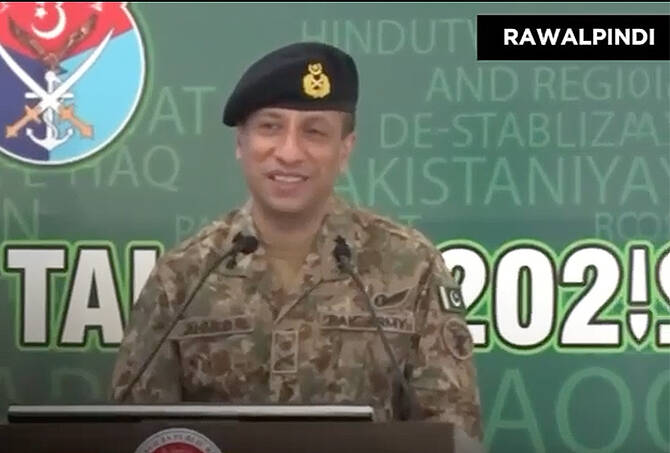
Pakistan's army spokesperson, Lt Gen Ahmed Sharif Chauhdry, addresses teaches at Hilal Talks 2025 in Rawalpindi, Pakistan, on May 29, 2025. (Radio Pakistan/Screengrab)
Short Url
Updated 29 May 2025
Follow

Pakistan army launches teachers’ awareness program on online ‘anti-state’ propaganda

  • 1,950 teachers from various regions of the country participate in Hilal Talks 2025 program run by army’s media wing
  • After latest military combat, social media citizens on both sides are vying to control narrative by peddling disinformation

ISLAMABAD: In a first, the Pakistan army’s media wing has launched the Hilal Talks 2025 program to raise awareness among Pakistani teachers about the “tactics and nefarious agendas of anti-state elements” on social media, Radio Pakistan reported on Thursday. 

While India and Pakistan announced a ceasefire after coming close to an all-out conflict earlier this month, social media citizens on both sides are vying to control public perceptions by peddling disinformation.

Platforms such as Facebook and X are still awash with misrepresented footage of the attacks that killed at least 70 people and sent thousands fleeing from their shared de facto Line of Control (LoC) border.

“Hilal Talks 2025 program has been launched under the auspices of ISPR,” Radio Pakistan reported, saying 1,950 teachers from various regions of the country were participating in the program run by the army’s media wing. 

“It is aimed at raising awareness about the tactics and nefarious agendas of anti-state elements on social media.”

The report said teachers “got the opportunity to understand the structure, role and working mechanism of Pakistan Army more closely.”

Indian and Pakistani media outlets have both amplified misinformation, including false or unverifiable claims of military victories that experts say have exacerbated tensions and contributed to a flood of hate speech.

Disinformation peaked when India launched deadly air strikes on May 7 targeting “terrorist camps” in Pakistan, two weeks after a deadly attack on the Indian-administered side of disputed Kashmir.

New Delhi blames Islamabad for backing the April 22 attack near the tourist town of Pahalgam, which killed 26 people — almost all of them Hindu men. Pakistan denies the claim.

After the first round of Indian air strikes, the Pakistani military shared footage that had previously circulated in reports about a 2023 Israeli air strike in Gaza. The clip quickly appeared on television and social media but was later retracted by numerous media outlets, including AFP.

AI-generated imagery has also muddied the waters, including a video that purportedly shows a Pakistan Army general saying the country lost two of its aircraft. AFP fact-checkers found the clip was altered from a 2024 press conference.

Both India and Pakistan have taken advantage of the information vacuum to raise alarm bells and promote their own claims and counter-claims.

Pakistan appears to have lifted a more than one-year-old ban on X the same day of the Indian strikes.

Pakistan’s National Cyber Emergency Response Team (NCERT) on May 8 issued an alert about “increased cyberattacks and misinformation via emails, social media, QR codes, and messaging apps.”

Both Pakistan’s Ministry of Economic Affairs and the Karachi Port Trust later said their X accounts had been hacked.

A post from the latter account said the port — one of South Asia’s busiest — was attacked by the Indian military. The page was later restored and the port authority said no attack had taken place.

India, meanwhile, has executed a sweeping crackdown targeting the social media accounts of Pakistani politicians, celebrities and media organizations.

The government ordered X to block more than 8,000 accounts and banned more than a dozen Pakistani YouTube channels for allegedly spreading “provocative” content, including news outlets.

Press Information Bureau (PIB) Fact Check, a government-run website, has also refuted more than 60 claims about the ongoing crisis, many having to do with supposed Pakistani military victories.

The avalanche of disinformation online has also been accompanied by a spike in hate speech offline.

With inputs from AFP


Sindh assembly passes resolution rejecting move to separate Karachi

Updated 21 February 2026
Follow

Sindh assembly passes resolution rejecting move to separate Karachi

  • Chief Minister Shah cites constitutional safeguards against altering provincial boundaries
  • Calls to separate Karachi intensified amid governance concerns after a mall fire last month

ISLAMABAD: The provincial assembly of Pakistan’s southern Sindh province on Saturday passed a resolution rejecting any move to separate Karachi, declaring its territorial integrity “non-negotiable” amid political calls to carve the city out as a separate administrative unit.

The resolution comes after fresh demands by the Muttahida Qaumi Movement (MQM) and other voices to grant Karachi provincial or federal status following governance challenges highlighted by the deadly Gul Plaza fire earlier this year that killed 80 people.

Karachi, Pakistan’s largest and most densely populated city, is the country’s main commercial hub and contributes a significant share to the national economy.

Chief Minister Syed Murad Ali Shah tabled the resolution in the assembly, condemning what he described as “divisive statements” about breaking up Sindh or detaching Karachi.

“The province that played a foundational role in the creation of Pakistan cannot allow the fragmentation of its own historic homeland,” Shah told lawmakers, adding that any attempt to divide Sindh or separate Karachi was contrary to the constitution and democratic norms.

Citing Article 239 of Pakistan’s 1973 Constitution, which requires the consent of not less than two-thirds of a provincial assembly to alter provincial boundaries, Shah said any such move could not proceed without the assembly’s approval.

“If any such move is attempted, it is this Assembly — by a two-thirds majority — that will decide,” he said.

The resolution reaffirmed that Karachi would “forever remain” an integral part of Sindh and directed the provincial government to forward the motion to the president, prime minister and parliamentary leadership for record.

Shah said the resolution was not aimed at anyone but referred to the shifting stance of MQM in the debate while warning that opposing the resolution would amount to supporting the division of Sindh.

The party has been a major political force in Karachi with a significant vote bank in the city and has frequently criticized Shah’s provincial administration over its governance of Pakistan’s largest metropolis.

Taha Ahmed Khan, a senior MQM leader, acknowledged that his party had “presented its demand openly on television channels with clear and logical arguments” to separate Karachi from Sindh.

“It is a purely constitutional debate,” he told Arab News by phone. “We are aware that the Pakistan Peoples Party, which rules the province, holds a two-thirds majority and that a new province cannot be created at this stage. But that does not mean new provinces can never be formed.”

Calls to alter Karachi’s status have periodically surfaced amid longstanding complaints over governance, infrastructure and administrative control in the megacity, though no formal proposal to redraw provincial boundaries has been introduced at the federal level.