Arab League welcomes EU shift on Israel as Western discourse begins to change 

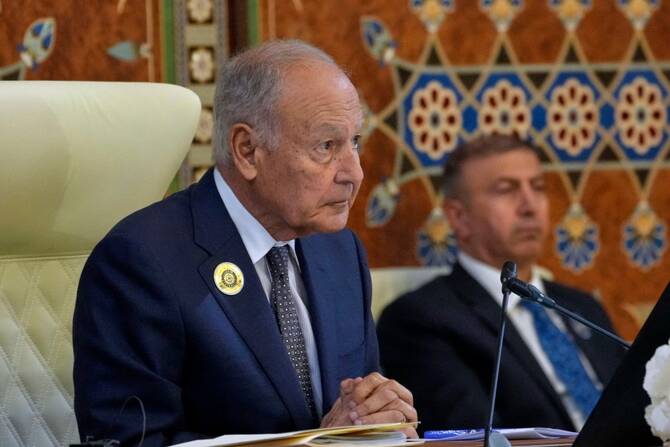
Arab League Secretary-General Ahmed Aboul Gheit attends the closing ceremony of the Arab League summit, in Baghdad, on May 17, 2025. (File/AFP)
Short Url
Updated 29 May 2025
Follow

Arab League welcomes EU shift on Israel as Western discourse begins to change 

  • EU backing for agreement review signals growing international pressure on Israel 
  • Arab League urges political solution amid mounting humanitarian crisis in Gaza 

DUBAI: The Arab League on Wednesday welcomed the shift in Western discourse on the Gaza conflict, praising the “strong majority” of EU member states backing a review of the EU-Israel partnership. 

At least 17 out of 27 EU member states are calling for a review of the EU-Israel Association Agreement. This review, initiated by a proposal from the Netherlands, is rooted in the agreement’s foundational requirement for adherence to human rights and democratic principles. 

The league noted that many Western governments, influential voices across political, civil, intellectual, and media sectors have begun to express deep concern over the catastrophic humanitarian situation in the Gaza Strip and the occupied Palestinian territories. 

For a time, these actors had been swayed by Israeli narratives surrounding the events of Oct. 7, 2023, remaining largely confined to a discourse emphasizing “Israel’s right to self-defense,” a statement by the Arab League said.  

The increasingly “visible brutality of military operations against civilians — especially women and children — has shattered the credibility of that argument,” the statement said.   

The Arab League stressed that such a narrative has proven hollow in the face of widespread violations of international humanitarian law. 

The league said that resolute positions aimed at recognizing the State of Palestine, threatening sanctions against Israel, banning arms sales, freezing free trade negotiations, and prohibiting the import of settler products represent significant steps toward increasing international pressure to end the war.  

These measures offer an encouraging prelude to a more accurate and just understanding of this long-standing conflict, aligned with the vision of a two-state solution, the league said.  

The recent Madrid Conference, attended by the secretary-general of the Arab League, marked a significant diplomatic effort to address the ongoing crisis. The gathering aimed to explore a viable political resolution to the conflict, emphasizing a two-state solution. 

Meanwhile, ongoing Israeli incursions into the West Bank and increasingly provocative actions in Jerusalem have further escalated tensions. Regional leaders and human rights organizations warn that the conflict has reached a dangerous low point, marked by systematic violations of international law. 


Hundreds mourn in Syria’s Homs after deadly mosque bombing

Updated 27 December 2025
Follow

Hundreds mourn in Syria’s Homs after deadly mosque bombing

  • Officials have said the preliminary investigations indicate explosive devices were planted inside the mosque but have not yet publicly identified a suspect

HOMS: Hundreds of mourners gathered Saturday despite rain and cold outside of a mosque in the Syrian city of Homs where a bombing the day before killed eight people and wounded 18.
The crowd gathered next to the Imam Ali ibn Abi Talib Mosque in the Wadi Al-Dhahab neighborhood, where the population is predominantly from the Alawite minority, before driving in convoys to bury the victims.
Officials have said the preliminary investigations indicate explosive devices were planted inside the mosque but have not yet publicly identified a suspect.
A little-known group calling itself Saraya Ansar Al-Sunna claimed responsibility for the attack in a statement posted on its Telegram channel, in which it indicated that the attack intended to target members of the Alawite sect, an offshoot of Shia Islam whom hard-line Islamists consider to be apostates.
The same group had previously claimed a suicide attack in June in which a gunman opened fire and then detonated an explosive vest inside a Greek Orthodox church in Dweil’a, on the outskirts of Damascus, killing 25 people as worshippers prayed on a Sunday.
A neighbor of the mosque, who asked to be identified only by the honorific Abu Ahmad (“father of Ahmad“) out of security concerns, said he was at home when he heard the sound of a “very very strong explosion.”
He and other neighbors went to the mosque and saw terrified people running out of it, he said. They entered and began trying to help the wounded, amid blood and scattered body parts on the floor.
While the neighborhood is primarily Alawite, he said the mosque had always been open to members of all sects to pray.
“It’s the house of God,” he said. “The mosque’s door is open to everyone. No one ever asked questions. Whoever wants to enter can enter.”
Mourners were unable to enter the mosque to pray Saturday because the crime scene remained cordoned off, so they prayed outside.
Some then marched through the streets chanting “Ya Ali,” in reference to the Prophet Muhammad’s cousin and son-in-law whom Shiite Muslims consider to be his rightful successor.