

Pakistanis among foreign students wary as Trump expands crackdown on elite universities

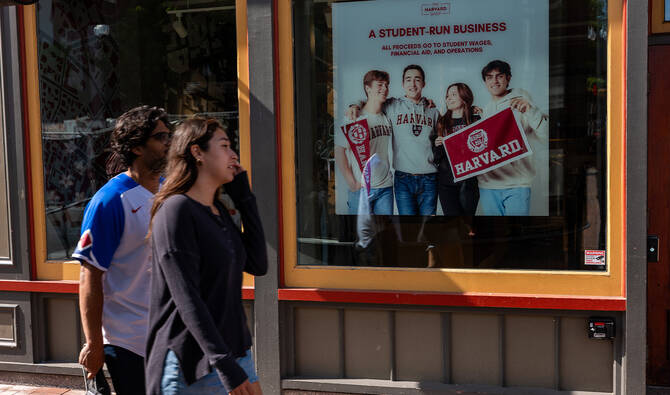
People walk near near Harvard University in Cambridge, Massachusetts, on May 28, 2025. (AFP/File)
Short Url
Updated 29 May 2025
Follow

Pakistanis among foreign students wary as Trump expands crackdown on elite universities

  • Trump’s crackdown is prompting some international students to abandon applications to campuses in the United States
  • Sial, Harvard student from Pakistan, says foreign students like him were “made to fight this battle which no one signed up for”

Cambridge, United States: Donald Trump’s expanding crackdown on elite universities is prompting some international students to abandon applications to campuses in the United States and spreading stress and anxiety among those already enrolled.

The president has upended the country’s reputation among foreign students, who number around one million, as he presses a campaign against US universities he sees as obstructing his “Make America Great Again” populist agenda.

He has blocked Harvard hosting international scholars in a maneuver being challenged legally, targeted non-citizen campus activists for deportation, and most recently suspended student visa processing across the board.

Harvard applied mathematics and economic student Abdullah Shahid Sial, 20, said the Trump administration’s campaign against US universities that the president accused of being hotbeds of liberal bias and anti-Semitism had been “dehumanizing.”

“It’s really unfortunate that this is the case for 18, 19, and 20-year-olds who came here without any family, and in most cases, haven’t been to the US before,” said Sial, who is from Pakistan and hopes to be able to return to Harvard next academic year.

Sial said he advised acquaintances to have backup plans if US colleges became inaccessible, and that a friend applied to Harvard’s law school, as well as Columbia’s, and two less reputable British institutions — ultimately opting to go to the UK.

“He definitely liked Harvard way more (but) he doesn’t want this amount of uncertainty surrounding his education,” Sial said.

Karl Molden, a Harvard government and classics student from Austria, said Trump’s move to block the university from hosting and enrolling foreign students meant he was unsure if he would be able to return after summer vacation.

While that decision — affecting some 27 percent of the overall Harvard population — was paused by a judge pending a hearing Thursday, the move still threw student plans into chaos.

“I kind of figured I would be in the target group of Trump. I’m personally right in the middle of it, so an option for me would be to study abroad... I have applied to study at Oxford because of all the action” taken by Trump, said Molden, 21.

“It’s just really hard”

Harvard academics say they have already started to feel the impact of Trump’s vendetta against the school, in feedback from colleagues based outside the United States.

“I’ve already heard this from professors in other countries who say ‘we encourage our best students to go to the United States’,” Harvard professor Ryan Enos told AFP at a noisy rally against Trump’s policies Tuesday, adding “we wonder if we can tell them that anymore.”

The halt to visa processing revealed this week is reportedly to allow for more stringent screening of applicants’ social media — and protest activity.

“International students already represent the most tracked and vetted category of nonimmigrants in the United States. It is a poor use of taxpayer dollars,” said the NAFSA Association of International Educators non-profit.

Trump, meanwhile, continued his assault on Harvard, saying university leaders have “got to behave themselves.

“Harvard is treating our country with great disrespect, and all they’re doing is getting in deeper and deeper,” he said Wednesday in the White House.

One Spanish student of politics and statistics, who declined to be named for fear of retaliation, told AFP she would not be deterred from pursuing her planned year abroad at Columbia University.

“It’s scary, because we think to ourselves that all our activity on social networks could be monitored, for example, if we like pro-Palestinian posts or anti-Trump posts. All of that could see us denied a visa,” she said.

Students due to return to Harvard after the summer break are in limbo pending a ruling on Harvard’s exclusion from the foreign student system.

“I’m completely in the dark,” said 20-year-old Alfred Williamson, a Welsh-Danish physics and government student in his second year at Harvard.

“As for my other options, and like all other international students, I’m just clinging on to the hope that Harvard will win this battle against the White House.”

Sial, the Harvard student from Pakistan, said foreign students like him were “made to fight this battle which no one signed up for.”

“It’s really unfortunate that it’s come down to that.”


Pakistan saw up to 17% drop in cross-border attacks after Afghan border closure — think tank

Updated 5 sec ago
Follow

Pakistan saw up to 17% drop in cross-border attacks after Afghan border closure — think tank

  • CRSS calls 2025 the deadliest year in a decade with 3,417 violence-linked fatalities nationwide
  • Violence remained concentrated in the western provinces as security forces killed 2,060 militants

ISLAMABAD: Pakistan recorded a sharp decline in cross-border militant attacks and violence-linked fatalities in the final months of 2025 after it closed its border with Afghanistan in October, even as the country endured its deadliest year in a decade overall, according to an annual security report released by a local think tank on Wednesday.

Pakistan has frequently accused Afghanistan of sheltering proscribed armed factions, such as the Tehreek-e-Taliban Pakistan (TTP) and the Balochistan Liberation Army (BLA), in the past, while also pointing a finger at the Taliban administration in Kabul for “facilitating” their attacks against Pakistani civilians and security forces.

The Center for Research and Security Studies (CRSS) said in its report that terrorist attacks fell by nearly 17% in December, following a 9% decline in November, after Pakistan shut the border on Oct. 11. It noted that violence-linked fatalities among civilians and security personnel also declined in the final quarter of the year, falling by nearly 4% and 19% respectively in November and December.

“Pakistan recorded a significant drop in cross-border terrorist attacks and violence-linked fatalities after it closed down the border to Afghanistan,” CRSS said.

Despite the late-year decline, the think tank said 2025 “went by as the most violent year for Pakistan in a decade,” with overall violence surging nearly 34% year-on-year.

Fatalities rose from 2,555 in 2024 to 3,417 in 2025 — an increase of 862 deaths — extending a five-year upward trend in violence that coincides with the Taliban’s return to power in Afghanistan in 2021, the report said.

“2025 marked another grim year for Pakistan’s security landscape,” it added, noting that violence has increased every year since 2021, with annual surges of nearly 38% in 2021, over 15% in 2022, 56% in 2023, nearly 67% in 2024 and 34% in 2025. 

REGIONAL CONCENTRATION

Violence remained heavily concentrated in Pakistan’s northwestern Khyber Pakhtunkhwa (KP) and southwestern Balochistan provinces, which together accounted for more than 96% of all fatalities and nearly 93% of violent incidents nationwide.

KP was the worst-hit region, recording 2,331 fatalities in 2025 — a 44% increase from 1,620 deaths in 2024 — accounting for more than 82% of the net national rise in violence.

Balochistan saw fatalities rise from 787 to 956, an increase of nearly 22%.

In contrast, Punjab and Sindh recorded relatively low levels of violence, together accounting for less than 3% of total casualties, which CRSS said pointed to “relative containment of violence despite the provinces’ large populations.”

The report also flagged the spread of violence into previously calmer regions, with Azad Jammu and Kashmir recording 15 fatalities in 2025 after reporting no violence a year earlier.

MILITANT DEATH TOLL

CRSS said 2025 was also the deadliest year in a decade for militant groups, with outlaws accounting for more than 60% of all fatalities.

“2025 turned out to be the deadliest year for outlaws in a decade,” the report said, with 2,060 militants killed during at least 392 security operations, surpassing the combined fatalities of civilians and security personnel.

Security forces, however, remained the primary targets of militant groups.

The army and Frontier Corps recorded 374 fatalities, including 22 officers, while police suffered 216 casualties.

The TTP claimed responsibility for the largest share of attacks on security personnel, followed by the BLA, the Baloch Liberation Front (BLF) and Daesh’s regional chapter.