

Thai, Cambodian army chiefs to meet over border clash

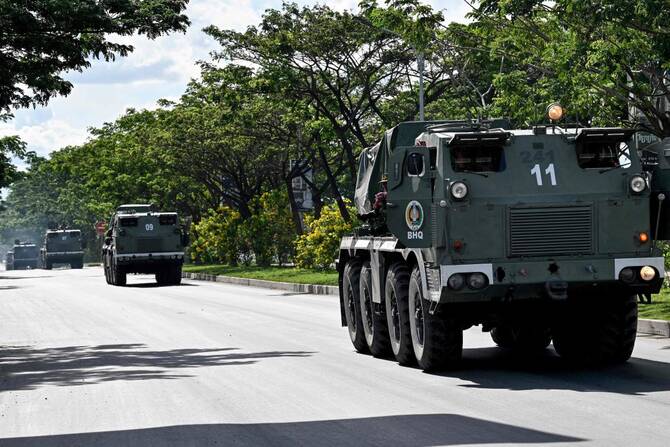
Neighboring Thailand and Cambodia have a long history of land disputes. Above, Cambodian soldiers drive BM-21 Grad self-propelled multiple rocket launchers along a street in Phnom Penh on May 28, 2025. (AFP)
Short Url
Updated 29 May 2025
Follow

Thai, Cambodian army chiefs to meet over border clash

  • A Cambodian soldier was killed on Wednesday during an exchange of gunfire with the Thai army at the border
  • Cambodia and Thailand have long been at odds over their more than 800-kilometer-long border

BANGKOK: The military chiefs of Thailand and Cambodia will meet Thursday, both governments said, after a Cambodian soldier was killed in a border clash.

Thailand’s Prime Minister Paetongtarn Shinawatra told reporters on Thursday that “both sides should remain calm and discuss to see what we can agree,” and called for peaceful discussion.

Her Cambodian counterpart Hun Manet wrote on Facebook that he hoped the meeting between the two army commanders “will yield positive results.”

Thai Defense Minister Phumtham Wechayachai told journalists the talks will be held on Thursday afternoon, adding that there had been a “misunderstanding by both sides.”

A Cambodian soldier was killed on Wednesday during an exchange of gunfire with the Thai army at the border, a Cambodian army spokesman said.

His death – a rare fatality along the long-sensitive frontier – came after Cambodian and Thai leaders attended a Southeast Asian summit where the regional ASEAN grouping vowed greater cooperation.

Thailand’s military said Wednesday that its soldiers fired in response to gunshots from Cambodia’s border force, leading to an exchange lasting around 10 minutes before the Thai side said the Cambodians requested a ceasefire.

Cambodian Royal Army spokesman Mao Phalla confirmed the clash on Wednesday, but said Thai soldiers had attacked Cambodian troops who were on border patrol duty in northern Preah Vihear province.

“Our soldier died in the trenches. The Thais came to attack us,” Mao Phalla said.

Cambodia and Thailand have long been at odds over their more than 800-kilometer-long (500-mile) border, which was largely drawn during the French occupation of Indochina.

Bloody military clashes between the Southeast Asian neighbors erupted in 2008 over the Preah Vihear temple near their shared border.

The row over a patch of land next to the 900-year-old temple led to several years of sporadic violence, resulting in at least 28 deaths before the International Court of Justice ruled the disputed area belonged to Cambodia.

In February, Bangkok formally protested to Phnom Penh after a video of women singing a patriotic Khmer song in front of another disputed temple was posted on social media.

On Thursday, influential former Cambodian prime minister Hun Sen – Hun Manet’s father, and an ally of Paetongtarn’s father, ex-Thai premier Thaksin Shinawatra – urged calm and a peaceful resolution to the ongoing border issues between the two countries.

Paetongtarn traveled to Cambodia in April for a two-day visit, during which she met Hun Manet to discuss cross-border cooperation on issues such as online scams and air pollution.


Japan reaffirms no-nukes pledge after senior official suggests acquiring weapons

Updated 3 sec ago
Follow

Japan reaffirms no-nukes pledge after senior official suggests acquiring weapons

  • The unnamed official said Japan needed nuclear weapons because of a worsening security environment
  • At a regular press briefing in Tokyo, Chief Cabinet Secretary Minoru Kihara said Japan’s nuclear policy had ‌not changed
TOKYO: Japan reaffirmed its decades-old pledge never to possess nuclear weapons on Friday after local media reported that a senior security official suggested the country should ​acquire them to deter potential aggressors. The unnamed official said Japan needed nuclear weapons because of a worsening security environment but acknowledged that such a move would be politically difficult, public broadcaster NHK and other outlets reported, describing the official as being from Prime Minister Sanae Takaichi’s office.
At a regular press briefing in Tokyo, Chief Cabinet Secretary Minoru Kihara said Japan’s nuclear policy had ‌not changed, but declined ‌to comment on the remarks or ‌to ⁠say whether ​the ‌person would remain in government. There is a growing political and public willingness in Japan to loosen its three non-nuclear principles not to possess, develop or allow nuclear weapons, a Reuters investigation published in August found.
This is driven in part by doubts over the reliability of US security guarantees under President Donald Trump and growing threats from nuclear-armed ⁠China, Russia and North Korea.
Japan hosts the largest overseas concentration of US military forces ‌and has maintained a security alliance with Washington ‍for decades.
Some lawmakers within Takaichi’s ‍ruling Liberal Democratic Party have said the United States should ‍be allowed to bring nuclear weapons into Japan on submarines or other platforms to reinforce deterrence. Takaichi last month stirred debate on her own stance by declining to say whether there would be any changes to the ​three principles when her administration formulates a new defense strategy next year.
“Putting these trial balloons out creates an opportunity ⁠to start to build consensus around the direction to move on changes in security policy,” said Stephen Nagy, professor at the department of politics and international studies at the International Christian University in Tokyo.
Beijing’s assertiveness and growing missile cooperation between Moscow and Pyongyang are “creating the momentum to really change Japan’s thinking about security,” he added.
Discussions about acquiring or hosting nuclear weapons are highly sensitive in the only country to have suffered atomic bombings, and risk unsettling neighboring countries, including China.
Ties between Tokyo and Beijing worsened last month after Takaichi said a ‌Chinese attack on Taiwan that also threatened Japan could constitute a “survival-threatening situation” and trigger a military response.