US court blocks Trump’s tariffs, says president exceeded his authority

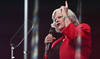
In this photo taken on on April 2, 2025, US President Donald Trump holds a chart as he delivers remarks on reciprocal tariffs at the White House in Washington. On May 28, the Court of International Trade ruled that Trump overstepped his authority. (AFP)
Short Url
Updated 29 May 2025
Follow

US court blocks Trump’s tariffs, says president exceeded his authority

  • Court cites that Constitution grants Congress power to regulate international commerce
  • Trump spokesman slams ‘unelected judges’ over tariff ruling

NEW YORK: A US trade court on Wednesday blocked President Donald Trump’s tariffs from going into effect in a sweeping ruling that the president overstepped his authority by imposing across-the-board duties on imports from nations that sell more to the United States than they buy.
The Court of International Trade said the US Constitution gives Congress exclusive authority to regulate commerce with other countries that is not overridden by the president’s emergency powers to safeguard the US economy.
“The court does not pass upon the wisdom or likely effectiveness of the President’s use of tariffs as leverage. That use is impermissible not because it is unwise or ineffective, but because [federal law] does not allow it,” a three-judge panel said in the decision.
The Trump administration minutes later filed a notice of appeal and questioned the authority of the court. The decisions of the Manhattan-based Court of International Trade, which hears disputes involving international trade and customs laws, can be appealed to the US Court of Appeals for the Federal Circuit in Washington, D.C., and ultimately the US Supreme Court.
Trump has made charging US importers tariffs on goods from foreign countries the central policy of his ongoing trade wars, which have severely disrupted global trade flows and roiled financial markets.
Companies of all sizes have been whipsawed by Trump’s swift imposition of tariffs and sudden reversals as they seek to manage supply chains, production, staffing and prices.

White House reacts

A White House spokesperson on Wednesday said US trade deficits with other countries constituted “a national emergency that has decimated American communities, left our workers behind, and weakened our defense industrial base – facts that the court did not dispute.”
“It is not for unelected judges to decide how to properly address a national emergency,” Kush Desai, the spokesperson, said in a statement.
Financial markets cheered the ruling. The US dollar rallied following the court’s order, surging against currencies such as the euro, yen and the Swiss franc in particular.
Wall Street futures rose and equities across Asia also rose.
The ruling, if it stands, blows a giant hole through Trump’s strategy to use steep tariffs to wring concessions from trading partners, draw manufacturing jobs back to US shores and shrink a $1.2 trillion US goods trade deficit, which were among his key campaign promises.
Without the instant leverage provided by the tariffs of 10 percent to 54 percent that Trump declared under the International Emergency Economic Powers Act (IEEPA) — which is meant to address “unusual and extraordinary” threats during a national emergency — the Trump administration would have to take a slower approach of lengthier trade investigations under other trade laws to back its tariff threats.
The ruling came in a pair of lawsuits, one filed by the nonpartisan Liberty Justice Center on behalf of five small US businesses that import goods from countries targeted by the duties and the other by 13 US states.
The companies, which range from a New York wine and spirits importer to a Virginia-based maker of educational kits and musical instruments, have said the tariffs will hurt their ability to do business.
“There is no question here of narrowly tailored relief; if the challenged Tariff Orders are unlawful as to Plaintiffs they are unlawful as to all,” the trade court wrote in its decision.
At least five other legal challenges to the tariffs are pending.
Oregon Attorney General Dan Rayfield, a Democrat whose office is leading the states’ lawsuit, called Trump’s tariffs unlawful, reckless and economically devastating.
“This ruling reaffirms that our laws matter, and that trade decisions can’t be made on the president’s whim,” Rayfield said in a statement.
Trump has claimed broad authority to set tariffs under IEEPA. The law has historically been used to impose sanctions on enemies of the US or freeze their assets. Trump is the first US president to use it to impose tariffs.
The Justice Department has said the lawsuits should be dismissed because the plaintiffs have not been harmed by tariffs that they have not yet paid, and because only Congress, not private businesses, can challenge a national emergency declared by the president under IEEPA.
In imposing the tariffs in early April, Trump called the trade deficit a national emergency that justified his 10 percent across-the-board tariff on all imports, with higher rates for countries with which the United States has the largest trade deficits, particularly China.
Many of those country-specific tariffs were paused a week later. The Trump administration on May 12 said it was also temporarily reducing the steepest tariffs on China while working on a longer-term trade deal. Both countries agreed to cut tariffs on each other for at least 90 days.


Nigerian villagers are rattled by US airstrikes that made their homes shake and the sky glow red

Updated 4 sec ago
Follow

Nigerian villagers are rattled by US airstrikes that made their homes shake and the sky glow red

JABO: Sanusi Madabo, a 40-year-old farmer in the Nigerian village of Jabo, was preparing for bed on Thursday night when he heard a loud noise that sounded like a plane crashing. He rushed outside his mud house with his wife to see the sky glowing a bright red.
The light burned bright for hours, Madabo said: “It was almost like daytime.”
He did not learn until later that he had witnessed a USattack on an alleged camp of the militant Daesh group.
US President Donald Trump announced late Thursday that the United States had launched a “powerful and deadly strike” against Daesh militants in Nigeria. The Nigerian government has since confirmed that it cooperated with the US government in its strike.
A panicked village
Nigerian government spokesperson Mohammed Idris said Friday that the strikes were launched from the Gulf of Guinea in the Atlantic Ocean shortly after midnight and involved “16 GPS-guided precision” missiles and also MQ-9 Reaper drones.
Idris said the strikes targeted areas used as “staging grounds by foreign” Daesh fighters who had sneaked into Nigeria from the Sahel, the southern fringe of Africa’s vast Sahara Desert. The government did not release any casualty figures among the militants.
Residents of Jabo, a village in the northwestern Nigerian state of Sokoto, spoke to The Associated Press on Friday about panic and confusion among the villagers following the strikes, which they said hit not far from Jabo’s outskirts. There were no casualties among the villagers.
They said that Jabo has never been attacked as part of the violence the US says is widespread — though such attacks regularly occur in neighboring villages.
Abubakar Sani, who lives on the edge of the village, recalled the “intense heat” as the strikes hit.
“Our rooms began to shake, and then fire broke out,” he told the AP.
“The Nigerian government should take appropriate measures to protect us as citizens,” he added. “We have never experienced anything like this before.”
It’s a ‘new phase of an old conflict’
The strikes are the outcome of a months long tense diplomatic clash between the West African nation and the US
The Trump administration has said Nigeria is experiencing a genocide of Christians, a claim the Nigerian government has rejected.
However, Nigeria’s Ministry of Foreign Affairs now said the strikes resulted from intelligence sharing and strategic coordination between the two governments.
Yusuf Tuggar, Nigeria’s foreign minister, called the airstrikes a “new phase of an old conflict” and said he expected more strikes to follow.
“For us, it is something that has been ongoing,” Tuggar added, referring to attacks that have targeted Christians and Muslims in Nigeria for years.
Bulama Bukarti, a security analyst on sub-Saharan Africa, said the residents’ fear is compounded by a lack of information.
Nigerian security forces have since cordoned off the area of the strikes and access was not allowed.
Bukarti said transparency would go a long way to calm the local residents. “The more opaque the governments are, the more panic there will be on the ground, and that is what will escalate tensions.”
Foreign fighters operate in Nigeria
Analysts say the strikes might have been intended for the Lakurawa group, a relatively new entrant to Nigeria’s complex security crisis.
The group’s first attack was recorded around 2018 in the northwestern region before the Nigerian government officially announced its presence last year. The composition of the group has been documented by security researchers as primarily consisting of foreigners from the Sahel.
However, experts say ties between the Lakurawa group and Daesh are unproven. The Islamic State West African Province — a Daesh affiliate in Nigeria — has its strongholds in the northeastern part of the country, where it is currently involved in a power struggle with its parent organization, Boko Haram.
“What might have happened is that, working with the American government, Nigeria identified Lakurawa as a threat and identified camps that belong to the group,” Bukarti said.
Still, some local people feel vulnerable.
Aliyu Garba, a Jabo village leader, told the AP that debris left after the strikes was scattered, and that residents had rushed to the scene. Some picked up pieces of the debris, hoping for valuable metal to trade, and Garba said he fears they could get hurt.
The strikes rattled 17-year-old Balira Sa’idu, who has been preparing for her upcoming marriage.
“I am supposed to be thinking about my wedding, but right now I am panicking,” she said. “The strike has changed everything. My family is afraid, and I don’t even know if it is safe to continue with the wedding plan in Jabo.”