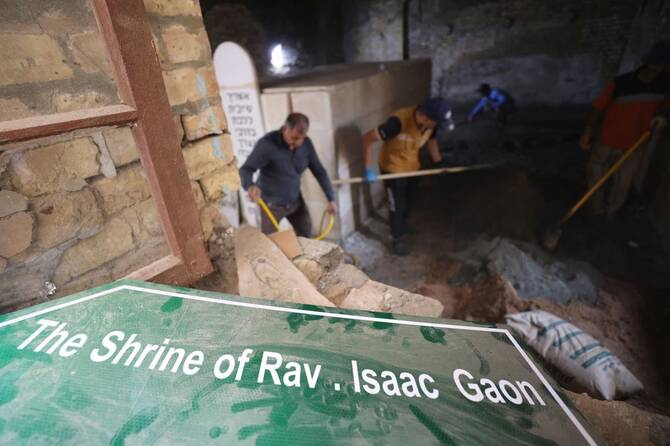

BAGHDAD: In a vibrant Baghdad district, laborers are working tirelessly to repair the centuries-old shrine of a revered rabbi in an effort to revive the long-faded heritage of Iraq’s Jewish community.
A few months ago, the tomb of Rabbi Isaac Gaon was filled with rubbish. Its door was rusted, the windows shattered and the walls stained black from decades of neglect.
Today, marble tiling covers the once-small grave, and at its center stands a large tombstone inscribed with a verse, the rabbi’s name and the year he died: 688. A silver menorah hangs on the wall behind it.
“It was a garbage dump and we were not allowed to restore it,” said the head of Iraq’s Jewish community, Khalida Elyahu, 62.
The Jewish community in Iraq was once one of the largest in the Middle East, but now it has dwindled to just dozens.
Baghdad today has one synagogue left, but it has no rabbis. And many houses that once belonged to Jews are abandoned and dilapidated.
The Jewish community itself is funding the shrine’s restoration, at an estimated cost of $150,000.
The project will bring “a revival for our community, both within and outside Iraq,” Elyahu said.
With the backing of Iraqi officials, she said she hopes to restore more neglected sites.
Little information is available about Rabbi Isaac. But when Iraq’s National Security Adviser Qassem Al-Araji visited the tomb earlier this year, he said the rabbi had been a finance official.
Rabbi Isaac Gaon was prominent during the Gaonic period, also known as the era of Babylonian academies for rabbis.
The term “Gaon” is likely to refer to his position as the head of one such academy.
His name was mentioned in the 10th century by another rabbi, who told a tale that never appeared elsewhere, according to Professor Simcha Gross from the University of Pennsylvania.
“There is only one single story,” said Gross.
It goes that Rabbi Isaac led 90,000 Jews to meet Ali Ibn Abi Talib, the fourth Islamic caliph and a relation of the Prophet Muhammad, who is also revered by Shiites as the first Imam, during one of his conquests in central Iraq.
“We have no other evidence for this event, and there are reasons to be skeptical,” Gross said.
Nothing else is known about Rabbi Isaac, not even his religious opinions.
But the tale has origins that are not without context, said Gross.
In the 10th century, minorities — Christians, Jews, and Zoroastrians — began to tell stories of how they greeted “Muslim conquerors” because “their privileges including taxes were dependent on whether or not they were believed to have welcomed the Muslims,” he said.
At that same time, Jewish shrines started to appear, even though Jewish roots in Iraq date back some 2,600 years.
According to biblical tradition, Jews arrived in Iraq in 586 BC as prisoners of Babylonian king Nebuchadnezzar II after he destroyed Solomon’s Temple in Jerusalem.
In Iraq, they wrote the Babylonian Talmud.
Thousands of years later, in Ottoman-ruled Baghdad, Jews made up 40 percent of the population.
A turning point was the 1941 pogrom in Baghdad when more than 100 Jews were killed.
Like other Jewish communities in the Arab region, their history has changed since the Palestinian Nakba — “catastrophe” in Arabic — and Israel’s creation in 1948. Soon afterwards, almost all of Iraq’s 135,000 Jews went into exile.
Decades of conflict and instability — Saddam Hussein’s dictatorship, the 2003 US-led invasion and the ensuing violence — completed the community’s erosion.
Some who stayed on converted to other religions, or do not reveal their faith.
Today, 50 synagogues and Jewish sites remain, Elyahu said. Most are crumbling, and some have become warehouses.
Rabbi Isaac’s shrine once included a synagogue and a school, but has been reduced to the small room housing the grave, the restoration’s supervisor said.
“It took us two months to clean it of garbage,” said the supervisor, who asked to remain anonymous.
Now “we are receiving requests from outside Iraq to visit it.”
Decades ago people would come to pray and light candles, believing in the rabbi’s “healing powers.”
Mussa Hayawi, 64, lives nearby. He recounted stories from his childhood in a quarter which was, until the 1940s, one of several Jewish districts in Baghdad.
He said women used to soak themselves in water from the shrine’s well, hoping to conceive.
Rabbi Isaac “was a revered man.” People came “to pray for their sick, to ask for a baby, or the release of a prisoner,” Hayawi said.