

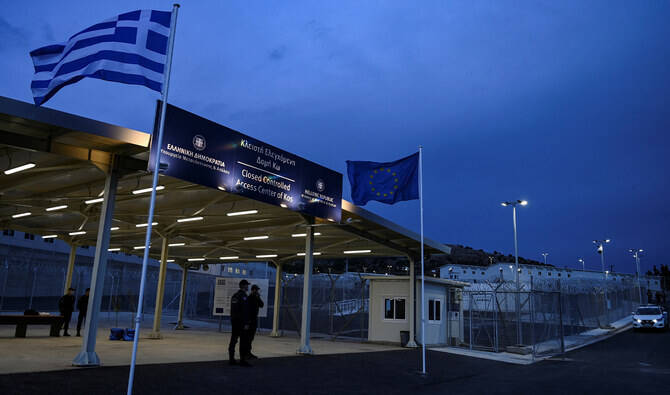
Greece drafts tougher law for rejected asylum seekers, PM says 

Greece has prepared legislation that will introduce tougher penalties for rejected asylum seekers and speed up returns to their home countries, Prime Minister Kyriakos Mitsotakis said on Wednesday. (AFP/File)
Short Url
Updated 28 May 2025
Follow

Greece drafts tougher law for rejected asylum seekers, PM says 

  • Migration remains a politically charged issue in Greece
  • Mitsotakis has pledged to toughen his stance

ATHENS: Greece has prepared legislation that will introduce tougher penalties for rejected asylum seekers and speed up returns to their home countries, Prime Minister Kyriakos Mitsotakis said on Wednesday.

The Mediterranean nation was on the frontline of a 2015-2016 migration crisis when more than a million people fleeing war and poverty in the Middle East and Africa crossed into Europe.

The surge in arrivals triggered calls for countries on Europe’s southern frontier like Greece and Italy to shore up their borders.

The numbers have since fallen. But migration remains a politically charged issue in Greece, and Mitsotakis has pledged to toughen his stance.

“Penalties will be heavier for those who enter the country illegally or stay in our country, if their asylum application is being rejected,” Mitsotakis told a cabinet meeting on Wednesday, which discussed a new draft law on illegal migration.

Mitsotakis said the bill will also aim to speed up returns through a “more effective and fair mechanism.” The regulations will need parliamentary approval before taking effect.

Migrant flows to Greece dropped 30 percent in the first four months of this year compared to the previous year as fewer people entered along its eastern border with Turkiye.

But sea arrivals from Libya to the outlying islands of Crete and Gavdos have surged in recent months along a new smuggling route on the Mediterranean Sea. Thousands of rejected asylum seekers are stranded in Greece.

In order to accelerate asylum processes and reduce pressure on asylum systems, the EU’s executive last week proposed amending European law to allow member states to deport rejected asylum seekers if they can be sent to a third country deemed safe by the bloc.


China FM tells EU diplomats not to blame Beijing for bloc’s problems

Updated 1 sec ago
Follow

China FM tells EU diplomats not to blame Beijing for bloc’s problems

BEIJING: China’s foreign minister told his French and German counterparts that Beijing was not to blame for Europe’s economic and security problems as he pushed for more cooperation at a summit in Munich, a foreign ministry statement said Saturday.
Wang Yi made the comments at a meeting with France’s Jean-Noel Barrot and Germany’s Johann Wadephul on the sidelines of the Munich Security Conference on Friday.
He sought to promote China as a reliable partner of the European Union at a time when the bloc is trying to reduce its dependence on both Beijing and an increasingly unpredictable Washington.
“China’s development is an opportunity for Europe, and Europe’s challenges do not come from China,” Wang said, according to the statement.
Warning that “unilateralism, protectionism, and power politics” were on the rise globally, he said he hoped Europe would “pursue a rational and pragmatic policy toward China.”
“The two sides are partners, not adversaries; interdependence is not a risk; intertwined interests are not a threat; and open cooperation will not harm security.”
The meeting came against the backdrop of trade tensions between the two giant economies and disputes over what the EU sees as China’s support for Russia’s war in Ukraine.
The EU is seeking to cut its reliance on China for strategic goods like rare earths while also rebalancing a trade relationship that sees it run a large deficit with the world’s second-largest economy.
In recent years, the two sides have clashed over Chinese electric-vehicle exports, which threaten Europe’s car industry and which Brussels argues are based on unfair subsidies, and Chinese tariffs on EU goods ranging from cheese to cognac.
Wang urged Germany and France to help “give a clear direction for the development of China-Europe relations.”
In a separate meeting with Wadephul — also on Friday — Wang touted economic and trade cooperation as “the cornerstone of China-Germany ties,” according to a foreign ministry readout.
Wang also met Britain’s foreign minister Yvette Cooper, telling her that Beijing and London should “explore more potential for cooperation,” while the two sides also discussed Ukraine and Iran.