At least 22 wounded in drone strike in northwestern Pakistani district — officials

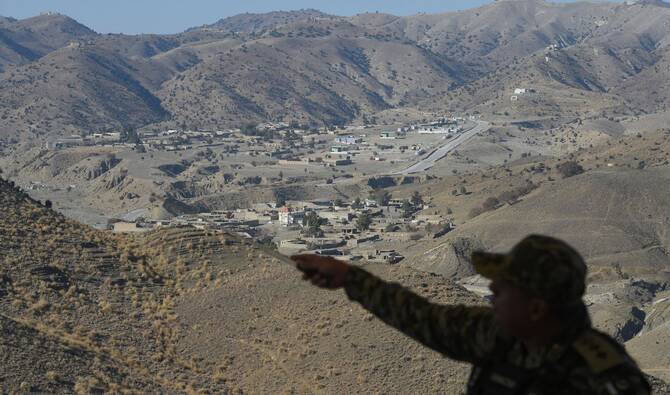
A Pakistani army officer briefs the media about the border terminal in Ghulam Khan, a town in North Waziristan, on the border between Pakistan and Afghanistan, on January 27, 2019. (AFP/ file)
Short Url
Updated 28 May 2025
Follow

At least 22 wounded in drone strike in northwestern Pakistani district — officials

  • Suspected drone strike killed four children in North Waziristan earlier in May, prompting province-wide protests
  • In latest incident, unidentified quadcopter detonated explosive device in Azam Warsak town in South Waziristan

PESHAWAR: At least 22 people, including children, were wounded in a suspected quadcopter attack near a volleyball ground in Pakistan’s northwestern South Waziristan district, police said on Wednesday, adding that it was unclear who was behind the assault. 

Earlier this month, a suspected drone strike killed four children and wounded five others in North Waziristan district in the Khyber Pakhtunkhwa province, prompting thousands of residents to stage a protest by placing the children’s bodies on a main road to demand justice. It wasn’t immediately clear who was behind the May 5 attack in the town of Mir Ali, which has been a stronghold of the Pakistani Taliban in the past. 

In the latest incident, Lower South Waziristan police spokesperson Habib Islam told Arab News an unidentified quadcopter drone detonated an explosive device on Tuesday evening in the town of Azam Warsak.

The blast occurred just before sunset as residents, including children, were playing a volleyball game nearby, leaving approximately two dozen civilians wounded.

“The origin and operators of the drone remain undetermined at this stage,” Islam said. 

“A comprehensive joint investigation involving security forces and civilian authorities is currently underway to establish the chain of command behind this attack. We will pursue all evidentiary leads to conclusively identify and bring the perpetrators to justice.”

Dr. Jan Muhammad Shinwari, the Medical Superintendent at Wana’s District Headquarters Hospital (DHQ) in South Waziristan, said 22 injured had been admitted to the facility.

“Most of the injured have now been discharged after being provided medical treatment,” Shinwari told Arab News. “Two of the children were referred to the adjacent Dera Ismail Khan hospital who were now said to be in stable condition.”

Zubair Wazir, a Member of the National Assembly (MNA) from the South Waziristan district, called the drone strike “a tragic development.”

“It was brutal, inhumane and senseless,” he told Arab News, condemning the killing of civilians on Pakistani soil.

“We hold the government responsible for the deaths of innocent people attacked while playing volleyball. This time, we will launch a forceful protest to prevent such incidents from recurring.”

Wazir said he had held a series of meetings with top security and civil officials, who assured him a thorough investigation would be conducted and those responsible held accountable.

Local elder Saleh Jan called the attack a “flagrant human rights violation.”

“This attack has poured fuel on the fire of local anger. We are trapped in a nightmare, helpless, with no clear path to stop these atrocities,” he said. “Who will answer for our safety? Who will shield us from the next strike?”

There have been civilian casualties in military strikes in some parts of the country in recent years. In March, 11 people, including women and children, were killed when a drone attack targeted a house in the northwestern city of Mardan.

A statement by the provincial government at the time had only said that there was “collateral damage” in an operation that was conducted to target militants in a remote village. Residents in March also rallied until the government agreed to compensate the victims’ families.

Officials say militants have also been using quadcopters to target troops, but it was still unclear who was responsible for the drone attacks in Mir Ali and Azam Warsak.

The latest civilian casualties came amid ongoing military operations against the Pakistani Taliban, which have a strong presence in the northwestern Khyber Pakhtunkhwa province bordering Afghanistan. The Pakistani Taliban, known as Tehreek-e-Taliban Pakistan, are a separate insurgent group from the Afghan Taliban, and they often target troops in the region.

Several districts in KP, especially North and South Waziristan, were long a base for the Pakistani Taliban and other militant groups. The TTP have stepped up attacks in the region in recent months.

With inputs from AP

IMF board to approve Pakistan reviews today ‘if all goes well,’ say officials

Updated 08 December 2025
Follow

IMF board to approve Pakistan reviews today ‘if all goes well,’ say officials

  • IMF’s executive board is scheduled to meet today to discuss the disbursement of $1.2 billion
  • Economists say the money will boost Pakistan’s forex reserves, send positive signals to investors

KARACHI: The International Monetary Fund’s (IMF) executive board is scheduled to meet today, Monday, to approve the release of about $1.2 billion for Pakistan under the lender’s two loan facilities, said IMF officials who requested not to be named.

The IMF officials confirmed the executive board was going to decide on the Fund’s second review under the $7 billion Extended Fund Facility (EFF) and first review under the $1.4 billion Resilience and Sustainability Facility (RSF), a financing tool that provides long-term, low-cost loans to help countries address climate risks.

“The board meeting will be taking place as planned,” an IMF official told Arab News.

“The board is on today yes as per the calendar,” said another.

A well-placed official at Pakistan’s finance ministry also confirmed the board meeting was scheduled today to discuss the next tranche for Pakistan.

The IMF executive board’s meeting comes nearly two months after a staff-level agreement (SLA) was signed between the two sides in October.

Procedurally, the SLAs are subject to approval by the executive board, though it is largely viewed as a formality.

“If all goes well, the reviews should pass,” said the second IMF official.

On approval, Pakistan will have access to about $1 billion under the EFF and about $200 million under the RSF, the IMF said in a statement in October after the SLA.

The fresh transfer will bring total disbursements under the two arrangements to about $3.3 billion, it added.

Experts see smooth sailing for Pakistan in terms of the passing of the two reviews, saying the IMF disbursements will help the cash-strapped nation to strengthen its balance of payments position.

Samiullah Tariq, group head of research at Pakistan Kuwait Investment Company Limited, said the IMF board’s approval will show that Pakistan’s economy is on the right path.

“It obviously will help strengthen [the country’s] external sector, the balance of payments,” he told Arab News.

Until recently, Pakistan grappled with a macroeconomic crisis that drained its financial resources and triggered a balance of payments crisis.

Pakistan has reported financial gains since 2022, recording current account surpluses and taming inflation that touched unprecedented levels in mid-2023.

Economists also viewed the IMF’s bailout packages as crucial for cash-strapped Pakistan, which has relied heavily on financing from bilateral partners such as Saudi Arabia, China and the United Arab Emirates, as well as multilateral lenders.

Saudi Arabia, through the Saudi Fund for Development, last week extended the term of its $3 billion deposit for another year to help Pakistan boost its foreign exchange reserves, which stood at $14.5 billion as of November 28, according to State Bank of Pakistan statements.

“In our view this [IMF tranche] will be approved,” said Shankar Talreja, head of research at Karachi-based brokerage Topline Securities Limited.

“This will help strengthen reserves and will eventually help a rating upgrade going forward,” he said.

The IMF board’s nod, Talreja said, would also send a signal to the international and local investors regarding the continuation of the reform agenda by Pakistan’s government.