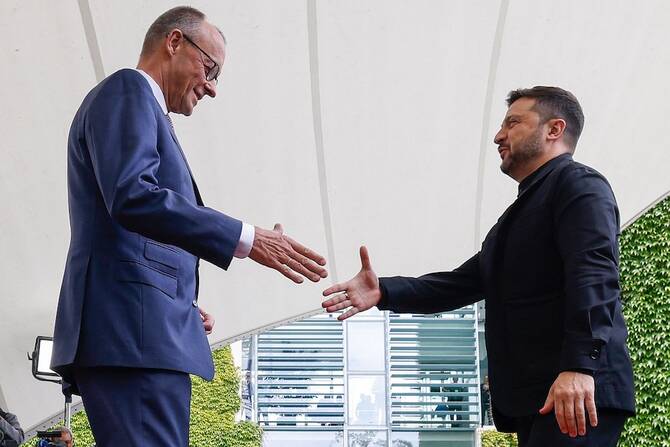

BERLIN: Ukrainian President Volodymyr Zelensky met with new German Chancellor Friedrich Merz in Berlin on Wednesday as Ukraine seeks further military support amid a recent escalation in Russia’s bombing campaign, despite US-led efforts to end the war.
Germany has been the second-biggest supplier of military aid to Ukraine after the United States. Merz has plunged into diplomatic efforts to try to secure a ceasefire and keep Western support for Ukraine intact since becoming Germany’s leader three weeks ago. European leaders have accused Russian President Vladimir Putin of dragging his feet in US-led peace talks.
German Foreign Minister Johann Wadephul was set to meet in Washington with US Secretary of State Marco Rubio on Wednesday.
Zelensky said Tuesday that Ukraine is ready to hold peace talks at the highest level, including a trilateral meeting with himself, Putin and US President Donald Trump.
“We are ready to meet at the level of leaders. Both the American side knows this, and the Russian side knows this,” he said. Zelensky said he would accept any configuration of talks, whether that includes one trilateral meeting or separate meetings with Trump.
Kremlin spokesman Dmitry Peskov said that Russia is grateful to Trump for his mediation efforts.
“At the same time, there is a big number of nuances to be discussed that can’t be neglected and which neither party is going to sacrifice, because of its national interests,” Peskov told reporters. “Just like the United States, Russia has its national interests that are of primary importance to us.”
He said that Moscow will “soon” deliver its promised memorandum on a framework for a peace settlement.
Taurus cruise missiles may be discussed
Merz said on Monday that Germany and other major allies are no longer imposing any range restrictions on weapons supplied to Ukraine as it fights to repel Russia’s full-scale invasion, which began in February 2022.
Merz’s government hasn’t said whether it will supply its Taurus long-range cruise missiles to Ukraine, something his predecessor, Olaf Scholz, refused to do and which Merz advocated for as opposition leader. The government has said it would no longer provide full details of the weapons it’s supplying to Ukraine, unlike Scholz’s administration, citing the need for “strategic ambiguity.”
Taurus missiles have a range of up to 500 kilometers (310 miles). The German- and Swedish-made missiles, which are equipped with stealth technology, would be able to reach targets deep in Russia from Ukrainian soil, including the Black Sea. Ukraine wants the missiles to complement the long-range Storm Shadow missiles sent by Britain and France’s nearly identical Scalp cruise missiles.
Zelensky said that he plans to discuss the supply and use of long-range weapons in his talks with Merz. The Ukrainian leader said Tuesday that he hasn’t received any indications from Germany that their policy of limiting the use of Western weapons against Russian targets has changed.
Ukraine needs $30 billion in additional financing to help it compete with Russia in the production of drones and missiles, Zelensky said. Russia is aiming to produce 300-350 drones per day, he said.
Front-line fighting, deep strikes continue
Meanwhile, fighting has continued along the roughly 1,000-kilometer (620-mile) front line, where Ukraine’s army is shorthanded against its bigger adversary. Zelensky claimed Tuesday that Russia is mobilizing up to 45,000 men every month, while Ukraine mobilizes between 25,000-27,000.
Both sides are continuing to conduct deep strikes. Russia launched its biggest drone attack of the war against Ukraine on Sunday.
Russian air defenses downed 296 Ukrainian drones over 13 Russian regions late Tuesday and early Wednesday, Russia’s Defense Ministry said, in what appeared to be one of the biggest Ukrainian drone assaults of the war.
Ukraine is increasing its domestic production of drones and missiles, according to Zelensky. He said late Tuesday that Ukraine wants European countries to help it invest in the manufacturing of attack drones, air defense interceptors, cruise missiles and ballistic systems.
Moscow Mayor Sergei Sobyanin said that air defenses shot down Ukrainian 33 drones heading toward the capital.
Andrei Vorobyov, the governor of the Moscow region, said that 42 drones were downed. He said that drone fragments damaged three residential buildings in the village of Troitskoye, but no one was hurt.
Moscow airports delayed or diverted hundreds of flights.
Overnight, Russian forces launched an attack on Ukraine using five Iskander ballistic missiles, one guided air-launched missile and 88 drones, Ukraine’s Air Force said Wednesday. Air defense units shot down 34 drones, and 37 drones were jammed.
Ukraine’s railway infrastructure and equipment in the Kharkiv, Donetsk and Sumy regions also came under fire overnight and Wednesday morning, Ukraine’s state railway company Ukrzaliznytsia said. No casualties were reported.
In Kharkiv region, railway traffic was temporarily suspended so that police and emergency workers could clear debris from a downed drone that landed on the tracks. In Sloviansk in the Donetsk region, the attack shattered windows at the station building, and drone debris slightly damaged a train car.