Saudi project clears 1,504 mines in Yemen 

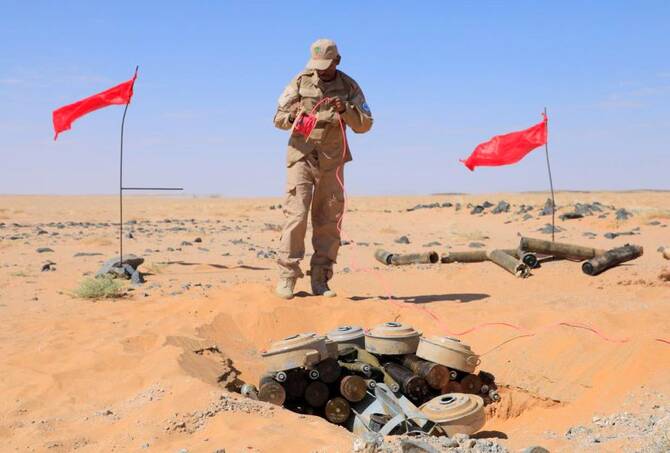
The project trains local demining engineers and provides them with modern equipment. (Supplied/Project Masam)
Short Url
Updated 27 May 2025
Follow

Saudi project clears 1,504 mines in Yemen 

  • Total included 1,459 unexploded ordnance, 40 anti-tank mines, four anti-personnel mines and one improvised explosive device
  • Ousama Al-Gosaibi, the initiative’s managing director, said that 495,855 mines have been cleared since the project began in 2018

RIYADH: Members of Saudi Arabia’s Project Masam removed 1,504 explosive devices from various regions of Yemen last week. 

The total included 1,459 unexploded ordnance, 40 anti-tank mines, four anti-personnel mines and one improvised explosive device, according to a recent report. 

Ousama Al-Gosaibi, the initiative’s managing director, said that 495,855 mines have been cleared since the project began in 2018.

The explosives were planted indiscriminately and posed a threat to civilians, including children, women and the elderly. 

The demining operations took place in Marib, Aden, Jouf, Shabwa, Taiz, Hodeidah, Lahij, Sanaa, Al-Bayda, Al-Dhale and Saada. 

The project trains local demining engineers and provides them with modern equipment. It also offers support to Yemenis injured by the devices.

Teams are tasked with clearing villages, roads and schools to facilitate the safe movement of civilians and delivery of humanitarian aid.


Saudi Arabia looks to become carbon trading hub for Global South

Updated 6 sec ago
Follow

Saudi Arabia looks to become carbon trading hub for Global South

  • Kingdom eyes partnerships with Asian companies

TOKYO: Saudi Arabia is looking to become a carbon trading hub for the Global South and is eyeing partnerships with Asian companies to trade on its exchange, Japan’s Nikkei newspaper has reported.

Saudi Arabia’s Voluntary Carbon Market recently signed a memorandum of understanding with Japanese trading house Marubeni “for collaboration on carbon markets,” and has also linked up with Climate Bridge International, a Singapore-headquartered carbon finance company, as an advisory partner.

Fadi Saadeh, acting CEO of Saudi Arabia’s Voluntary Carbon Market company, said it was important for Saudi Arabia to have a market to trade carbon credits that arise from the phasing out of coal.

A carbon credit represents a tonne of CO2 or CO2-equivalent greenhouse gases reduced or removed by verified projects like reforestation or carbon removal schemes. In the voluntary carbon market, companies can buy the credits to offset their emissions to meet their net-zero goals, while the sellers of the credits can use the funds received to invest in more green projects.

VCM was set up in 2022 by Saudi Arabia’s Public Investment Fund and the Saudi Tadawul Group, the country's exchange operator.

Saadeh said VCM was geographically well located to capture demand from the Global South and could leverage existing relationships and investments that companies like Saudi Aramco have forged over the years.

“In Saudi Arabia three years ago there were zero project developers for carbon credits,” Saadeh said. “Today, because of VCM and the ecosystem around the world, we have more than 25 project developers in Saudi Arabia.” He added that the energy transition would take time.