

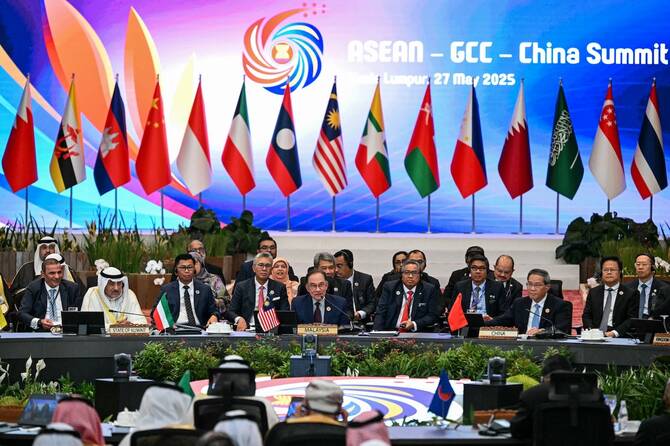

KUALA LUMPUR/DUBAI: Leaders of the Gulf Cooperation Council and Association of Southeast Asian Nations convened in Kuala Lumpur on Tuesday for the second ASEAN-GCC Summit and a historic three-way meeting with China.
The ASEAN-GCC Summit and the inaugural ASEAN-GCC-China Trilateral Summit were held alongside the 46th ASEAN Summit, which Malaysia is hosting as the Southeast Asian bloc’s chair this year.
Malaysian Prime Minister Anwar Ibrahim, who opened the sessions, said the ASEAN-GCC relationship would be “key in enhancing inter-regional collaboration, building resilience and securing sustainable prosperity for all.”
Strategic cooperation between the 10-member grouping of Southeast Asian nations and the alliance of six Gulf states was established in October 2023, when they held their first summit hosted by Saudi Arabia.
Their meeting in Kuala Lumpur — and the inclusion of China in the talks — comes against a backdrop of geopolitical uncertainty, recently heightened by global tariffs imposed last month by US President Donald Trump.
While most countries were granted a 90-day reprieve from the measures, Southeast Asia’s major economies have since been engaged in efforts to diversify their trading networks.
ASEAN and GCC representatives — including Qatari Emir Sheikh Tamim Al-Thani, the crown princes of Bahrain and Kuwait, and Saudi Foreign Minister Prince Faisal bin Farhan — have agreed to increase bilateral trade and engage in free trade negotiations.
The GCC is now ASEAN’s seventh-largest trading partner, with total trade reaching $130.7 billion in 2023.
“We aim to increase this figure to $180 billion by 2032, as there remains substantial untapped potential in bilateral trade and investment,” Kuwait’s Crown Prince Sheikh Sabah Al-Khalid, who is also the president of the current session of the Supreme Council of the GCC, said during the summit.
“We would like to underscore the importance of continuing cooperation in the fields of economy, trade, investment and the arts, and we look forward to the positive outcomes of free trade agreement negotiations between both sides, which will open up investment opportunities and support regional development.”
As the Southeast Asian and Gulf leaders were joined by Beijing’s delegation, led by Chinese Premier Li Qiang, Anwar welcomed the tripartite meeting as a “landmark moment” in international cooperation.
“I am confident that ASEAN, the GCC and China can draw upon our unique strengths to shape a future that is more connected, more resilient and more prosperous for generations to come,” he said.
“ASEAN has long demonstrated that regionalism, anchored in consensus, respect and openness, can succeed. We have thrived in our longstanding partnerships with the GCC and China. Today, we have the opportunity to elevate these ties.”
The combined economies of the GCC, ASEAN, and China now total nearly $25 trillion, with a combined population exceeding 2 billion.
“China has long been a very strategic partner with ASEAN, being the largest trading partner of all ASEAN countries, and it has long taken part in ASEAN-related meetings ranging from ASEAN Plus to ARF (ASEAN Regional Forum),” Dr. Oh Ei Sun, principal advisor at the Pacific Research Center in Kuala Lumpur, told Arab News.
“China has the technology, GCC the money, and ASEAN the market ... As protectionism and unilateralism are on the rise globally, these groupings see the need to strengthen multilateralism, not the least with bringing themselves closer together.”
Amid global turbulence, economic fragmentation and shifting power dynamics, the Kuala Lumpur summits showed the growing ambitions of Southeast Asia and the Gulf region to play a more influential role in international markets and geopolitical affairs.
“This isn’t just another summit, it signals that these regions want a bigger say in how the global economy is run and despite the external factors,” said Kamles Kumar, associate director at Asia Group Advisors in Kuala Lumpur.
“The Global South is no longer content to be on the sidelines.”
China’s participation could be seen as Beijing’s intent to stay close to rising regional alliances, especially in the face of US policies.
“It’s about influence with securing energy links with the Gulf and reinforcing trade ties with ASEAN, while positioning itself as an indispensable partner in South-South cooperation,” Kumar said.
“There is a recognition that momentum is shifting. The quiet push for deeper ASEAN economic cooperation, including conversations around regional supply chains, green infrastructure, and trade integration, is drawing attention. China’s presence underscores that no major player wants to be left out of what comes next.”


