

No breach reported by any Pakistani government, private agency amid global data leak — official 

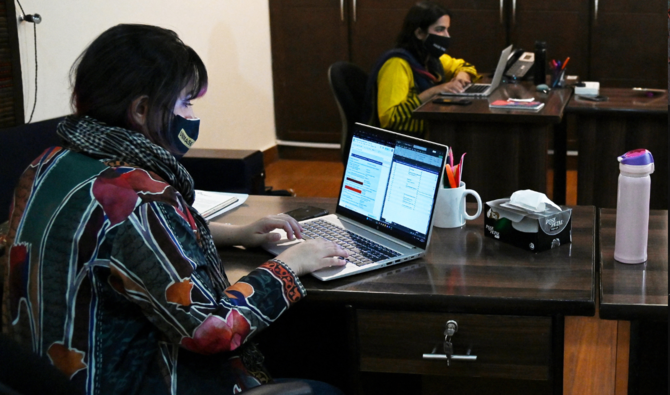
In this photograph taken on October 21, 2024, staff members work at the Digital Rights Foundation (DRF), an NGO aims to strengthen protections for human rights defenders in digital spaces, in Lahore. (AFP)
Short Url
Updated 27 May 2025
Follow

No breach reported by any Pakistani government, private agency amid global data leak — official 

  • Massive data breach has exposed 184 million passwords for Google, Microsoft, Facebook, other platforms
  • NCERT spokesman recommends changing all passwords, especially if they were reused across accounts

ISLAMABAD: A spokesperson for Pakistan’s National Cyber Emergency Response Team (NCERT) said on Tuesday no breach had been reported by any government agency or private company following a data breach affecting 184 million Internet users worldwide.

NCERT released an advisory on May 25 regarding a major global data exposure incident involving a publicly accessible, unencrypted file containing more than 184 million unique account credentials. The breach exposed usernames, passwords, email addresses, and associated URLs linked to services from Google, Microsoft, Apple, Facebook, Instagram, Snapchat, as well as government portals, banking institutions, and health care platforms worldwide.

“As of now, no incidents of data breach have been reported to NCERT by any government or private organization within Pakistan,” Syed Imran Haider, the NCERT spokesperson, told Arab News, adding that his organization’s incident management response team was “vigilant, in contact with all relevant departments, and working around the clock” to monitor the situation.

“We are closely engaged with global CERTs and international cybersecurity platforms.”

NCERT had provided cybersecurity guidelines to all government departments, and each organization had established its own infrastructure for data protection, Haider said. 

The leaked database is believed to have been compiled using infostealer malware, malicious software that extracts sensitive information from compromised systems, with the data then stored in plain text and left completely unprotected, with no encryption or password safeguarding, Haider explained. 

The NCERT advisory had recommended changing all passwords, especially those reused across accounts, and to activate multi-factor authentication on all services, particularly financial, email, and administrative accounts.

“Users are advised to use unique, complex passwords for every online service, avoid storing passwords in emails or unprotected files, consider a password manager to securely handle account credentials,” the NCERT spokesman said. 

Users were also advised to monitor account login activity for any anomalies and use credible online services that can help determine whether their email addresses, phone numbers, or other personal data have been exposed in a data breach.

Commenting on the potential impact of the breach, cybersecurity expert Dr. Shahid Sultan said Pakistani users were at risk of personal account hijacking, identity misuse, and targeted scams due to the leaked login credentials.

“Banking and financial service accounts may be compromised, enabling unauthorized transactions and potential financial loss,” he told Arab News, calling on all users and organizations to remain vigilant, report suspicious activities, and act on the precautionary measures suggested by NCERT.


Pakistan says it seized 32 square kilometers inside Afghanistan as border clashes escalate

Updated 28 February 2026
Follow

Pakistan says it seized 32 square kilometers inside Afghanistan as border clashes escalate

  • Security official describes ‘limited tactical action’ in Gudwana after Afghan assaults
  • Islamabad accuses Kabul of sheltering militants as UN, China and Russia urge restraint

ISLAMABAD: Pakistan has seized a 32-square-kilometer area inside Afghanistan following overnight fighting, a security official said on Saturday, as cross-border clashes between the two countries escalated sharply.

A Pakistani security official, speaking on condition of anonymity, said troops carried out a “limited tactical action” in the Gudwana area opposite the Zhob sector along the frontier, capturing Afghan territory after responding to attacks on Pakistani positions.

“On the night of Feb. 26/27, posts opposite the Zhob sector launched anticipated physical attacks on multiple Pakistani positions,” the official said, referring to fighters linked to Afghanistan’s Taliban authorities, whom Islamabad identifies as Tehreek-e-Taliban Afghanistan (TTA).

“In response to aggressive unprovoked fire and physical attacks, Pakistan security forces launched a limited tactical action on the night of Feb. 27/28 in the general area of Gudwana with a view to capture TTA Tahir Post,” he continued, adding that 32 square kilometers of Afghan territory were seized.

The official said special combat teams crossed the border after preparatory bombardment, supported by intelligence, surveillance and reconnaissance assets providing “real-time battlefield awareness.”

He said 24 Afghan Taliban fighters were killed and 37 wounded, with no Pakistani casualties reported.

The claims could not be independently verified, and there was no immediate confirmation from Taliban authorities in Kabul of any territorial loss in the Gudwana area.

The latest clashes erupted after Pakistani airstrikes targeted what Islamabad described as militant hideouts inside Afghanistan over the weekend, triggering retaliatory fire along the frontier and sharply escalating long-running tensions. Islamabad accuses Kabul of sheltering Pakistani Taliban militants responsible for attacks inside Pakistan, an allegation that Afghanistan denies.

Pakistan’s Information Minister Attaullah Tarar said on Saturday evening that 352 Afghan Taliban fighters had been killed and more than 535 wounded since the latest phase of hostilities began.

Tarar said Pakistani strikes had destroyed 130 check posts, 171 tanks and armored vehicles and targeted 41 locations across Afghanistan by air. Those figures could not be independently verified.

The United Nations, as well as China and Russia, have called for restraint.

The United States said Pakistan has the right to defend itself against cross-border militancy.