

‘Posterity won’t forgive us’: Pakistan urges world powers to secure ceasefire for Gaza

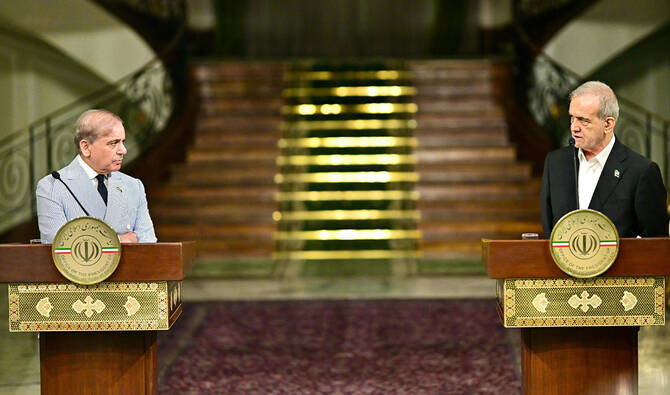
Prime Minister of Pakistan, Shehbaz Sharif, giving a joint press statement with President of Iran, Masoud Pezeshkian, in Tehran, Iran, on May 26, 2025. (PID)
Short Url
Updated 27 May 2025
Follow

‘Posterity won’t forgive us’: Pakistan urges world powers to secure ceasefire for Gaza

  • Israel’s military offensive has killed 53,900 Palestinians since Oct. 2023, according to Gaza health authorities
  • With food still critically short after nearly three-month blockade, Washington says it is working to restore ceasefire

ISLAMABAD: Pakistani Prime Minister Shehbaz Sharif on Monday called on international powers to ensure a lasting and immediate ceasefire in Gaza, warning that “posterity will not forgive us” if Israel’s military offensive in the besieged enclave continued.

Fierce Israeli attacks are ongoing, including most recently on a school building where dozens of Palestinians sheltering inside were killed.

With food still critically short after a nearly three-month blockade, Washington says it is working to restore a ceasefire more than 19 months into the war, but progress is elusive.

“We condemn the untold stories of miseries and atrocities in the land of Gaza where more than 50,000 Palestinians have been martyred and as I speak this story of bloodbath continues,” Sharif said in Tehran at a joint press conference with Iran’s President Masoud Pezeshkian.

“It’s high time that international community uses its influence to bring ceasefire and lasting ceasefire in that part of the world, otherwise posterity will not forgive us.”

Israel launched its latest air and ground war in Gaza after a cross-border attack by the Hamas group on October 7, 2023, which killed 1,200 people by Israeli tallies, with 251 hostages abducted into Gaza. The war has killed more than 53,900 Palestinians since, according to Gaza health authorities, and devastated the coastal strip. 

The entire 2.1 million population of Gaza is facing prolonged food shortages, with nearly half a million people in a catastrophic situation of hunger, acute malnutrition, starvation, illness and death, according to the World Health Organization. Food security groups say more than 93 percent of children in Gaza, about 930,000, are at risk of famine. Using satellite data, the United Nations estimated in February that 69 percent of the structures in Gaza have been damaged or destroyed.

With most of Gaza’s two million population squeezed into an ever narrowing zone on the coast and in the area around the southern city of Khan Younis by Israel’s military operation, international pressure to get aid in quickly has ratcheted up.

Israel’s initial blockade on Gaza, immediately following the October 7 attacks, prevented the entry of humanitarian aid for several weeks. As the war progressed, aid has been allowed in limited quantities.

Israel has recently announced that a new aid system, sponsored by the United States and run by private contractors, will soon begin operations from four distribution centers in the south of Gaza, but many details of how the system will work remain unclear. The UN has already said it will not work with the new system, which it says will leave aid distribution conditional on Israel’s political and military aims.

Israel says its forces will only provide security for the centers and will not distribute aid themselves.

Even as the aid has begun to slowly trickle in, the Israeli military has continued its intensified ground and air operation launched last week, which Prime Minister Benjamin Netanyahu said would end with Israel taking full control of the Gaza Strip.

Pakistan says defense pact with Saudi Arabia elevated brotherly ties to ‘new heights’

Updated 25 February 2026
Follow

Pakistan says defense pact with Saudi Arabia elevated brotherly ties to ‘new heights’

  • Pakistan, Saudi Arabia signed strategic defense pact last year pledging aggression against one will be treated as attack on both
  • Deputy PM Ishaq Dar says enduring bonds with Islamic and Arab nations form vital pillar of Pakistan’s foreign policy 

ISLAMABAD: Deputy Prime Minister Ishaq Dar said on Wednesday that Pakistan’s defense pact with Saudi Arabia elevated its brotherly ties with the Kingdom to “new heights,” stressing that close ties with Arab and Islamic nations form a key pillar of Islamabad’s foreign policy. 

Pakistan and Saudi Arabia signed a Strategic Mutual Defense Agreement on Sept. 17 last year, pledging that aggression against one country would be treated as an attack on both, enhancing joint deterrence and formalizing decades of military and security cooperation.

Both nations agreed in October 2025 to launch an economic cooperation framework to strengthen trade and investment ties. 

“In the Middle East, our landmark Strategic Mutual Defense Agreement with Saudi Arabia has elevated our brotherly ties to new heights,” Dar said while speaking at the Pakistan Governance Forum 2026 event in Islamabad. 

The Pakistani deputy prime minister was speaking on the topic “Navigating International Relations Amidst Changing Geo-Politics.”

Dar noted that Pakistan has reinforced partnerships with other Middle Eastern nations such as the UAE, Qatar, Jordan, Oman, Egypt and Bahrain. He said these partnerships have yielded “concrete agreements” in investment, agriculture, infrastructure, and energy sectors. 

“Our enduring bonds with Islamic and Arab nations form a vital pillar of our foreign policy, and we will continue to expand our partnerships across Asia, Latin America, and Africa,” he said. 

Dar pointed out that the presidents of Kazakhstan, Uzbekistan and Kyrgyzstan have undertaken visits to Pakistan in recent months, reflecting Central Asian nations’ desire to boost cooperation with Islamabad.

On South Asia, the Pakistani deputy PM said Pakistan has successfully transformed its fraternal ties with Bangladesh into “a substantive partnership.”

“Similarly, the trilateral mechanism involving China, Pakistan, and Bangladesh has been launched with a view to expanding and deepening regional cooperation and synergy,” the Pakistani minister said. 

He said Islamabad has strengthened its “all-weather” partnership with China via the second phase of the multi-billion-dollar China-Pakistan Economic Corridor agreement and “unwavering support” from both sides for each other’s core interests. 

Dar said Pakistan had also reinvigorated its partnership with the US, advancing cooperation in trade, technology, investment, and regional stability. 

“This calibrated approach has enhanced our ability to navigate complexity with skill and confidence, ensuring that our national interests are served without compromising our core foreign policy principles,” he said.