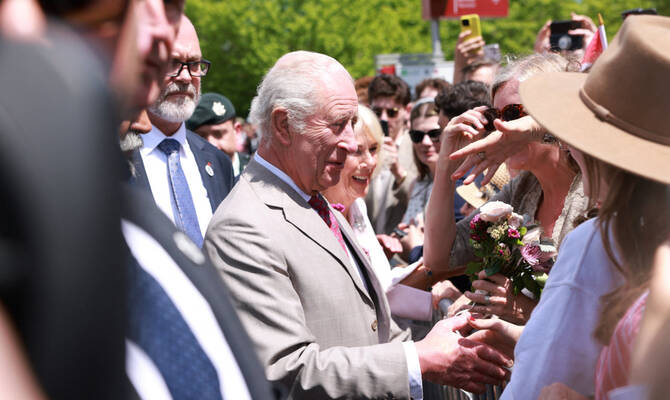
King Charles to outline Canada’s priorities in Parliament amid Trump annexation threat

Britain's King Charles III and Queen Camilla meet with community members at Lansdowne Park, in Ottawa, Ontario, Canada, May 26, 2025. (Reuters)
Short Url
Updated 27 May 2025
Follow

King Charles to outline Canada’s priorities in Parliament amid Trump annexation threat

  • It is rare for the monarch to deliver what’s called the speech from the throne in Canada
  • Charles’ mother, Queen Elizabeth II, did it twice in her 70-year reign, the last time in 1977

OTTAWA: King Charles III will outline new Prime Minister Mark Carney’s government priorities in a speech in the Canadian Parliament on Tuesday. It’s widely viewed as a show of support in the face of annexation threats by US President Donald Trump.

Trump’s repeated suggestion that the US annex Canada prompted Prime Minister Carney to invite Charles to give the speech from the throne. The king is the head of state in Canada, which is a member of the British Commonwealth of former colonies.

Carney said in a statement the visit speaks to the “vitality of our constitutional monarchy and our distinct identity.”

It is rare for the monarch to deliver what’s called the speech from the throne in Canada. Charles’ mother, Queen Elizabeth II, did it twice in her 70-year reign, the last time in 1977.

The speech is not written by the king or his UK advisers as Charles serves as a nonpartisan head of state. He will read what is put before him by Canada’s government.

Carney, the new prime minister and a former head of the Bank of England, and Canada’s first Indigenous governor general, Mary Simon, the king’s representative in Canada, met with the king on Monday.

Canadians are largely indifferent to the monarchy, but Carney has been eager to show the differences between Canada and the United States. The king’s visit clearly underscores Canada’s sovereignty, he said.

Carney won the job of prime minister by promising to confront the increased aggression shown by Trump.

The new US ambassador to Canada, Pete Hoekstra, said sending messages to the US isn’t necessary and Canadians should move on from the 51st state talk, telling the Canadian Broadcasting Corporation that if there’s a message to be sent there are easier ways to do that, such as calling him or calling the president.

“There are different ways to ‘send a message’ and a phone call is only of them,” said Daniel Beland, a political science professor at McGill University. “The King would normally add his own short introductory remarks and observers will be listening to them very carefully with the issue of Canada’s sovereignty in mind.”

A horse-drawn carriage will take the king and queen to the Senate of Canada Building for the
speech. It will accompanied by 28 horses, 14 before and 14 after. He will receive the Royal Salute from the 100-person guard of honor from the 3rd Battalion, Royal Canadian Regiment before entering the chamber for his speech.

The king will return to the UK after the speech and a visit to Canada’s National War Memorial.

Justin Vovk, a Canadian royal historian, said the king’s visit reminds him of when Queen Elizabeth opened the Parliament in Grenada, a member of the commonwealth, in 1985.

A US-led force invaded the islands in October 1983 without consulting the British government
following the killing of Grenada’s Marxist prime minister, Maurice Bishop.


Ukraine drops NATO goal as Trump envoy sees progress in peace talks

Updated 57 min 18 sec ago
Follow

Ukraine drops NATO goal as Trump envoy sees progress in peace talks

  • The move marks a major shift for Ukraine, which has fought to join NATO as a safeguard against Russian attacks and has such an aspiration included in its constitution

BERLIN/KYIV: President Volodymyr Zelensky offered to drop Ukraine’s aspirations to join the NATO military alliance as he held five hours of talks with US envoys in Berlin on Sunday to end the war with Russia, with negotiations set to continue on Monday.
Trump’s envoy Steve Witkoff said “a lot of progress was made” as he and Trump’s son-in-law Jared Kushner met Zelensky in the latest push to end Europe’s bloodiest conflict since World War Two, though full details were not divulged.
Zelensky’s adviser Dmytro Lytvyn said the president would comment on the talks on Monday once they were completed. Officials, Lytvyn said, were considering the draft documents.
“They went on for more than five hours and ended for today with an agreement to resume tomorrow morning,” Lytvyn told reporters in a WhatsApp chat.
Ahead of the talks, Zelensky offered to drop Ukraine’s goal to join NATO in exchange for Western security guarantees.
The move marks a major shift for Ukraine, which has fought to join NATO as a safeguard against Russian attacks and has such an aspiration included in its constitution. It also meets one of Russia’s war aims, although Kyiv has so far held firm against ceding territory to Moscow.
“Representatives held in-depth discussions regarding the 20-point plan for peace, economic agendas, and more. A lot of progress was made, and they will meet again tomorrow morning,” Witkoff said in a post on X.
The talks were hosted by German Chancellor Friedrich Merz, who a source said had made brief remarks before leaving the two sides to negotiate. Other European leaders are also due in Germany for talks on Monday.
“From the very beginning, Ukraine’s desire was to join NATO, these are real security guarantees. Some partners from the US and Europe did not support this direction,” Zelensky said in answer to questions from reporters in a WhatsApp chat.
“Thus, today, bilateral security guarantees between Ukraine and the US, Article 5-like guarantees for us from the US, and security guarantees from European colleagues, as well as other countries — Canada, Japan — are an opportunity to prevent another Russian invasion,” Zelensky said.
“And it is already a compromise on our part,” he said, adding the security guarantees should be legally binding.
Russian President Vladimir Putin has repeatedly demanded Ukraine officially renounce its NATO ambitions and withdraw troops from the about 10 percent of Donbas which Kyiv still controls. Moscow has also said Ukraine must be a neutral country and no NATO troops can be stationed in Ukraine.
Russian sources said earlier this year that Putin wants a “written” pledge by major Western powers not to enlarge the US-led NATO alliance eastwards — shorthand for formally ruling out membership to Ukraine, Georgia, Moldova and other former Soviet republics.
Sending Witkoff, who has led negotiations with Ukraine and Russia on a US peace proposal, appeared to be a signal that Washington saw a chance of progress nearly four years after Russia’s 2022 invasion.
Under pressure from Trump to sign a peace deal that initially backed Moscow’s demands, Zelensky accused Russia of dragging out the war through deadly bombings of cities and Ukraine’s power and water supplies.
A ceasefire along the current front lines would be a fair option, he added.

‘CRITICAL MOMENT’
Germany’s Defense Minister Boris Pistorius said it was a “good sign” Trump had sent his envoys while fielding questions in an interview with the ZDF broadcaster on the suitability of Witkoff and Kushner, two businessmen, as negotiators.
“It’s certainly anything but an ideal setup for such negotiations. That much is clear. But as they say, you can only dance with the people on the dance floor,” Pistorius said.
On the issue of Ukraine’s offer to give up its NATO aspirations in exchange for security guarantees, Pistorius said Ukraine had bitter prior experience of relying on security assurances. Kyiv had in 1994 agreed to give up its Soviet-era nuclear arsenal in exchange for territorial guarantees from the US, Russia and Britain.
“Therefore, it remains to be seen to what extent this statement Zelensky has now made will actually hold true, and what preconditions must be met,” Pistorius said.
“This concerns territorial issues, commitments from Russia and others,” he said, adding mere security guarantees, especially without significant US involvement, “wouldn’t be worth much.”
Britain, France and Germany have been working to refine the US proposals, which in a draft disclosed last month called for Kyiv to cede more territory, abandon its NATO ambitions and accept limits on its armed forces.
European allies have described this as a “critical moment” that could shape Ukraine’s future, and sought to shore up Kyiv’s finances by leveraging frozen Russian central bank assets to fund Kyiv’s military and civilian budget.