

India arrests police officer suspected of spying for Pakistan

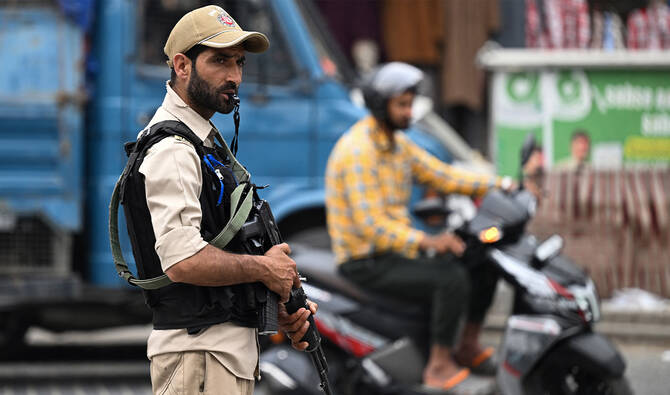
Indian police keep vigil along a street in Srinagar on May 1, 2025. (AFP/File)
Short Url
Updated 26 May 2025
Follow

India arrests police officer suspected of spying for Pakistan

  • The National Investigation Agency says the officer had been sharing ‘classified information related to national security’
  • Indian authorities have arrested at least 10 others on espionage charges after a military standoff with Pakistan this month

NEW DELHI, India: India’s counter-terrorism agency said Monday it arrested a paramilitary police officer for allegedly spying for arch-rival Pakistan, following their most serious conflict in decades.

At least 70 people died in fighting this month triggered by an April 22 attack on tourists in Indian-administered Kashmir that New Delhi accused Pakistan of backing — a charge Islamabad denies.

Muslim-majority Kashmir is claimed in full by both countries, which have fought multiple wars over the Himalayan territory since their 1947 independence from Britain.

The National Investigation Agency (NIA) said a Central Reserve Police Force officer was arrested in Delhi “for sharing sensitive information” with Pakistani agents.

“The accused, Moti Ram Jat, was actively involved in espionage activity and had been sharing classified information related to national security with Pakistan Intelligence Officers (PIOs) since 2023,” the NIA said.

Jat has been remanded into custody until June 6 by a special court, the agency said, as investigators question him.

Indian authorities have arrested at least 10 other people on espionage charges this month, according to local media.

A travel blogger was arrested in Haryana state on similar charges.

Police said the accused woman traveled to Pakistan at least twice and had been in contact with an official from the country’s embassy, local media reported.

Other arrests include a student, a security guard and a businessman.

The spate of arrests comes after the worst flare-up in violence between the nuclear-armed rivals since their last open conflict in 1999. A ceasefire was agreed after four days of missile, drone and artillery attacks.


Pakistan says defense pact with Saudi Arabia elevated brotherly ties to ‘new heights’

Updated 25 February 2026
Follow

Pakistan says defense pact with Saudi Arabia elevated brotherly ties to ‘new heights’

  • Pakistan, Saudi Arabia signed strategic defense pact last year pledging aggression against one will be treated as attack on both
  • Deputy PM Ishaq Dar says enduring bonds with Islamic and Arab nations form vital pillar of Pakistan’s foreign policy 

ISLAMABAD: Deputy Prime Minister Ishaq Dar said on Wednesday that Pakistan’s defense pact with Saudi Arabia elevated its brotherly ties with the Kingdom to “new heights,” stressing that close ties with Arab and Islamic nations form a key pillar of Islamabad’s foreign policy. 

Pakistan and Saudi Arabia signed a Strategic Mutual Defense Agreement on Sept. 17 last year, pledging that aggression against one country would be treated as an attack on both, enhancing joint deterrence and formalizing decades of military and security cooperation.

Both nations agreed in October 2025 to launch an economic cooperation framework to strengthen trade and investment ties. 

“In the Middle East, our landmark Strategic Mutual Defense Agreement with Saudi Arabia has elevated our brotherly ties to new heights,” Dar said while speaking at the Pakistan Governance Forum 2026 event in Islamabad. 

The Pakistani deputy prime minister was speaking on the topic “Navigating International Relations Amidst Changing Geo-Politics.”

Dar noted that Pakistan has reinforced partnerships with other Middle Eastern nations such as the UAE, Qatar, Jordan, Oman, Egypt and Bahrain. He said these partnerships have yielded “concrete agreements” in investment, agriculture, infrastructure, and energy sectors. 

“Our enduring bonds with Islamic and Arab nations form a vital pillar of our foreign policy, and we will continue to expand our partnerships across Asia, Latin America, and Africa,” he said. 

Dar pointed out that the presidents of Kazakhstan, Uzbekistan and Kyrgyzstan have undertaken visits to Pakistan in recent months, reflecting Central Asian nations’ desire to boost cooperation with Islamabad.

On South Asia, the Pakistani deputy PM said Pakistan has successfully transformed its fraternal ties with Bangladesh into “a substantive partnership.”

“Similarly, the trilateral mechanism involving China, Pakistan, and Bangladesh has been launched with a view to expanding and deepening regional cooperation and synergy,” the Pakistani minister said. 

He said Islamabad has strengthened its “all-weather” partnership with China via the second phase of the multi-billion-dollar China-Pakistan Economic Corridor agreement and “unwavering support” from both sides for each other’s core interests. 

Dar said Pakistan had also reinvigorated its partnership with the US, advancing cooperation in trade, technology, investment, and regional stability. 

“This calibrated approach has enhanced our ability to navigate complexity with skill and confidence, ensuring that our national interests are served without compromising our core foreign policy principles,” he said.