

Pakistan, Uzbekistan hope to finalize framework agreement for 573-km railway line via Afghanistan

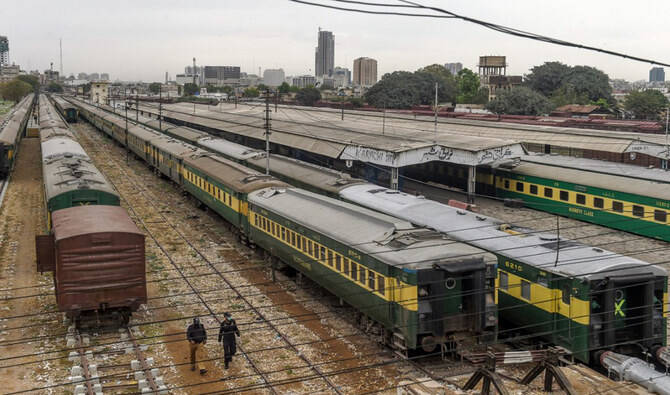
Policemen walk along trains stationed on a deserted platform at the Karachi Cantonment railway station in Karachi, Pakistan on March 26, 2020. (AFP/File)
Short Url
Updated 25 May 2025
Follow

Pakistan, Uzbekistan hope to finalize framework agreement for 573-km railway line via Afghanistan

  • The $4.8 billion project aims to enhance regional trade and logistics movement by connecting the three countries
  • It is part of Pakistan’s efforts to position itself as a key transit hub, connecting landlocked Central Asia to the world

ISLAMABAD: Pakistan’s Foreign Minister Ishaq Dar on Sunday discussed the Uzbekistan-Afghanistan-Pakistan (UAP) railway line project with his Uzbek counterpart Saidov Bakhtiyor Odilovich, the Pakistani foreign ministry said, adding the two figures expressed hope the project’s framework agreement would be completed soon.

The $4.8 billion Uzbekistan–Afghanistan–Pakistan railway line is an extensive project with the objective of creating a direct railway link between Uzbekistan and Pakistan, passing through Afghanistan’s territory.

It aims to enhance trade and logistics efficiency by establishing a 573-kilometer rail connection that would connect Termiz in Uzbekistan to the northwestern Pakistani city of Peshawar via Afghanistan’s Mazar-i-Sharif.

The project is part of Pakistan’s efforts to position itself as a key trade and transit hub, connecting landlocked Central Asian states to the global market through its strategic location.

“Foreign Minister Senator Mohammad Ishaq Dar today held a telephone conversation with the Foreign Minister of the Republic of Uzbekistan, Saidov Bakhtiyor Odilovich. The two leaders discussed existing bilateral relations, particularly Uzbekistan-Afghanistan-Pakistan (UAP) Railway Line Project,” the Pakistani foreign office said.

“They expressed the hope that framework agreement for the regional connectivity project will be finalized soon. Views were also exchanged on current regional situation.”

The three neighboring countries signed an agreement to build the regional connectivity project in February 2021. Dar also visited Afghanistan in April this year and discussed the project with the Afghan Taliban rulers in Kabul.

Pakistan is seeking to leverage its strategic position as a key trade and transit hub to connect Central Asia with global markets and since last year, there has been a flurry of high-level visits, investment discussions and other economic engagements between Islamabad and Central Asian republics.

Pakistan and Uzbekistan have also been working toward optimizing cargo flows, establishing green corridors at border customs points, and digitalization of customs clearance processes to facilitate smoother trade operations.


Pakistani, Bangladeshi officials discuss trade, investment and aviation as ties thaw

Updated 28 December 2025
Follow

Pakistani, Bangladeshi officials discuss trade, investment and aviation as ties thaw

  • Pakistan and Bangladesh were once one nation, but they split in 1971 as a result of a bloody civil war
  • Ties between Pakistan, Bangladesh have warmed up since last year and both nations have resumed sea trade

ISLAMABAD: Pakistan's High Commissioner to Bangladesh Imran Haider on Sunday met Chief Adviser Muhammad Yunus in Dhaka, the latter's office said on, with the two figures discussing trade, investment and aviation.

Pakistan and Bangladesh were once one nation, but they split in 1971 as a result of a bloody civil war, which saw the part previously referred to as East Pakistan seceding to form the independent nation of Bangladesh.

Ties between Pakistan and Bangladesh have warmed up since former prime minister Sheikh Hasina’s ouster as a result of a student-led uprising in August 2024. Relations remain frosty between Dhaka and New Delhi over India’s decision to grant asylum to Hasina.

Pakistan has attempted to forge closer ties with Bangladesh in recent months and both South Asian nations last year began sea trade, followed by efforts to expand government-to-government commerce.

"During the meeting, both sides discussed ways to expand cooperation in trade, investment, and aviation as well as scaling up cultural, educational and medical exchanges to further strengthen bilateral relations between the two South Asian nations," Yunus's office said in a statement on X.

In 2023-24 Pakistan exported goods worth $661 million to Bangladesh, while its imports were only $57 million, according to the Trade Development Authority of Pakistan. In Aug. this year, the Pakistani and Bangladeshi commerce ministries signed a memorandum of understanding to establish a Joint Working Group on Trade, aiming to raise their bilateral trade volume to $1 billion in the financial year that began in July.

The Pakistani high commissioner noted that bilateral trade has recorded a 20 percent growth compared to last year, with business communities from both countries actively exploring new investment opportunities, according to the statement.

He highlighted a significant increase in cultural exchanges, adding that Bangladeshi students have shown strong interest in higher education opportunities in Pakistan, particularly in medical sciences, nanotechnology, and artificial intelligence. Haider also said that Dhaka-Karachi direct flights are expected to start in January.

"Chief Adviser Professor Muhammad Yunus welcomed the growing interactions between the two countries and emphasized the importance of increased visits as well as cultural, educational and people-to-people exchanges among SAARC (South Asian Association for Regional Cooperation) member states," the statement read.

"Professor Yunus also underscored the need to further boost Bangladesh–Pakistan trade and expressed hope that during Mr. Haider’s tenure, both countries would explore new avenues for investment and joint venture businesses."