

MENA tech startups close significant funding rounds

Founded in 2020 by Ahmad Hammouda and Seif Amr, Thndr enables users to invest in stocks, bonds, and funds through mobile platforms. (Supplied)
Short Url
Updated 24 May 2025
Follow

MENA tech startups close significant funding rounds

  • Strategic investments boost investor confidence in startup landscape

RIYADH: A series of significant funding rounds and strategic investments have bolstered the Middle East and North Africa tech and startup landscape recently, with a focus on expanding regional ecosystems and scaling innovative solutions. 

Among the notable developments, Aramco’s Wa’ed Ventures co-led a $19 million series B extension investment in US-based Graphiant, alongside stc Group’s Tali Ventures. 

This investment is part of a broader $102 million series B round that also includes Sequoia Capital, Two Bear Capital, and IAG Capital Partners. 

Founded in 2020 by Khalid Raza, Graphiant provides a Network-as-a-Service platform designed to deliver secure and high-performance enterprise connectivity across hybrid and multi-cloud environments. 

As part of the funding agreement, Graphiant will establish its regional headquarters in Riyadh to support Saudi Arabia’s ambition to become a global technology hub. 

Anas Al-Gahtani, acting CEO of Wa’ed Ventures, said: “By enabling enterprises to deploy secure, high-performance connectivity across multi-cloud and hybrid environments, Graphiant is solving foundational challenges for digital transformation.”

VUZ secures $12m pre-series C to expand immersive media platform globally 

Saudi Arabia-based immersive media platform VUZ has raised $12 million in a pre-series C funding round, with the International Finance Corporation — part of the World Bank Group — joining as a strategic investor. 

The round also included participation from Al Jazira Capital, Crosswork VC Success Fund, existing investors, and several Saudi family offices, bringing VUZ’s total funding to over $35 million. 

Founded in the UAE in 2017 by Khaled Zaatarah, VUZ offers immersive live content across extended reality, virtual reality, augmented reality, and AI-powered streaming. 


Founded in 2020 by Ahmad Hammouda and Seif Amr, Thndr enables users to invest in stocks, bonds, and funds through  mobile platforms. (Supplied)

The new capital will support VUZ’s global expansion across Saudi Arabia, the UAE, Africa, Asia, and the US, while enhancing its AI-driven streaming technologies and live spatial experiences. The company previously closed a $20 million series B round in October 2022.

Saudi spacetech SARsatX raises $2.6m seed funding to scale satellite development 

Saudi Arabian spacetech startup SARsatX has raised $2.6 million in a seed round led by TONOMUS, with participation from Wa’ed Ventures, Access Bridge Ventures, and KAUST Innovation Ventures. 

Founded in 2019 by Ahmed Al-Zubairi and Muhannad Al-Mutiry as a spin-off from King Abdullah University of Science and Technology’s TAQADAM Accelerator, SARsatX designs and builds small satellites equipped with synthetic aperture radar technology. 

The satellites provide Earth observation data used in applications such as deforestation monitoring, oil leakage detection, disaster management, and border security. 

The company intends to use the funds to accelerate technology development and scale satellite deployment.

Saudi e-commerce app Ziadah closes seed round 

Ziadah, a Saudi Arabia-based e-commerce platform, has closed a seed funding round from an undisclosed angel investor. 

Founded in 2024 by Ali Al-Dahnin and Mahmoud Omar, Ziadah offers online stores behavior-driven marketing tools aimed at increasing sales. 

The company plans to use the investment to enhance customer engagement features and expand its services to more merchants across the region.

Egypt’s Thndr raises $15.7m to expand digital investment platform across MENA 

Thndr, a Cairo-based digital investment platform, announced a $15.7 million funding round led by Prosus, with participation from Y Combinator, BECO Capital, Endeavor Catalyst, and others. 

Founded in 2020 by Ahmad Hammouda and Seif Amr, Thndr enables users to invest in stocks, bonds, and funds through a mobile platform with low commissions. 

We’re building a product, network, and monetization model that’s hyper-local, with the infrastr- ucture to scale globally.

Khaled Zaatarah, VUZ founder and CEO

The new funds will support regional expansion focusing on the UAE and Saudi Arabia. 

Hammouda said: “We believe the time is now to build the region’s leading investment-first money app.”

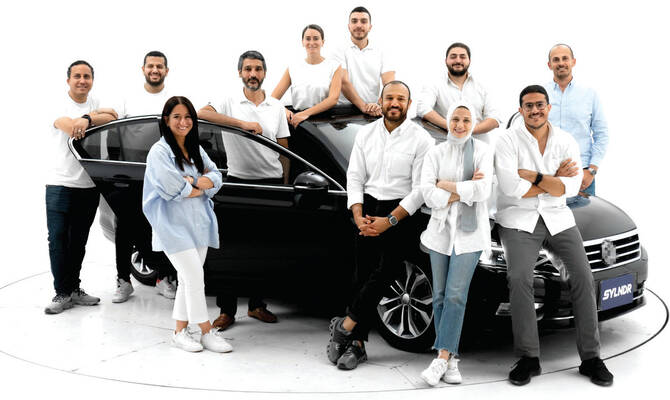
Sylndr secures $15.7m series A to accelerate Egypt used-car platform growth 

Cairo-based Sylndr, a used-car platform, has raised $15.7 million in a series A round led by DPI Venture Capital through the Nclude Fund. Other investors include Algebra Ventures, Nuwa Capital, and Raed Ventures. Sylndr facilitates vehicle buying, selling, and financing. 

Founded in 2021 by Omar El-Defrawy, the company will use the funds to expand across Egypt, improve pricing intelligence, inventory, fintech capabilities, and strengthen partnerships with dealers and lenders. 

El-Defrawy said: “This round allows us to scale nationally and expand our product offering.”

UAE’s Tarjama secures $15m series A to scale Arabic AI ecosystem 

Tarjama, a UAE-based language technology company, has closed a $15 million series A funding round led by Global Ventures, with participation from Wamda Capital, TA Ventures, and Phaze Capital,as well as Golden Gate Ventures and Endeavor Catalyst. 

Founded in 2009 by Nour Al-Hassan, Tarjama serves over 700 clients globally with solutions across more than 50 languages and 22 Arabic dialects. 

The company recently launched Pronoia V2, an Arabic-first large language model that it claims outperforms GPT-4o and Cohere in Arabic tasks. 

Al-Hassan said: “Arabic has been underserved by AI for too long. Our flagship product, Pronoia, changes that — it is far faster, more secure, and cost-effective.”

Kuwait’s Circle raises $6m series A for regional q-commerce expansion 

Circle, a Kuwait-based quick-commerce startup, has raised $6 million in series A funding from unnamed investors. 

Founded in 2020 by Altaf Al-Thekair, Circle offers delivery of groceries and daily essentials within 20 minutes through its app and network of dark stores and fulfillment centers. 

The company intends to use the funding to support regional expansion plans targeting key MENA markets by early 2026. 

CEO Al-Thekair stated: “Securing this funding is a major milestone that propels us toward our vision of reshaping quick commerce in the MENA region.” 

EFG Finance approves acquisition of B2B platform Fatura by MaxAB-Wasoko 

EFG Finance, part of EFG Holding, has approved the acquisition of its B2B platform Fatura by MaxAB-Wasoko, a regional retail and supply chain super app. 

EFG becomes a major shareholder in MaxAB-Wasoko and gains a board seat. 

Fatura operates an asset-light marketplace with 626 wholesalers across 16 cities, expanding MaxAB’s product and logistics capabilities. 

The acquisition is expected to contribute 25 percent of Egypt’s revenue by year-end and accelerate MaxAB-Wasoko’s pan-African expansion.

Egyptian fintech ElGameya raises seven-figure round to expand savings app 

ElGameya, an Egyptian fintech, has raised a seven-figure US dollar investment round led by AYADY for Investment and Development, with participation from Jedar Capital, Cubit Ventures, and others. 

Founded in 2020 by Ahmed Abdeen, the company offers a mobile app enabling users to join customizable savings circles with secure transactions, 

The funding will be used to scale ElGameya’s reach and develop new products targeting underserved communities. 

Abu Dhabi-based EQIQ doubles fund size to $30m 

EQIQ, a venture capital fund and venture builder focused on Iraq, is doubling its fund size from $15 million to $30 million to increase investments in the e-commerce, logistics, and fintech sectors. 

Founded by Mohamed Al-Hakim and Said Rahmani, EQIQ has deployed $8.5 million across five startups, including three co-built ventures. 

The fund is backed by local and regional investors and aims to create a technology ecosystem to serve millions in Iraq.  

Standard Chartered’s SC Ventures partners with DIFC 

SC Ventures, the innovation and venture arm of Standard Chartered, has partnered with Dubai International Financial Centre Innovation Hub to launch the National Venture Studio in the city. 

The initiative utilizes SC Ventures’ Venture Building-as-a-Service model to support startup development through ideation, prototyping, founder matching, and scaling. 

Participants will also have access to co-hosted events, research, and ecosystem-building programs within DIFC.


Mapping Saudi soils to grow better crops

Updated 19 December 2025
Follow

Mapping Saudi soils to grow better crops

  • Palm trees, root crops, and coastal plants reveal the land’s story

RIYADH: Saudi Arabia’s land tells stories written beneath the feet. From fertile plains and rugged highlands to vast deserts, the Kingdom’s diverse landscapes shape what can grow, where it grows, and how agriculture can thrive.

Alongside geography and climate, soil conditions play a decisive role in agricultural success. Understanding soil types across the Kingdom helps determine which crops can flourish and what interventions may be needed to sustain them.

In an interview with Arab News, Turki Almutairi, a senior environmental specialist at the National Afforestation Center under the National Center for Vegetation Cover Development and Combating Desertification, outlined the main soil types found across Saudi Arabia.

High amount of salt makes the soil unfit for the production of most crops, even if the soil is fertile. (Supplied)

“The dominant soil in the Kingdom are sandy desert soils, alongside calcareous soils in the central region. Rocky and stony soils are present along mountainous and hilly landscapes,” he said.

“Alluvial soils are common in wadies (valleys), while saline and sodic soils are located in depressions (Sabkhas) and along coastlines. Pockets of clayed soils can be also found around few sites along the Kingdom.”

The Kingdom’s vast territory gives rise to unique soil characteristics in each region, enabling different crops to grow depending on local conditions.

“Soil is the growing medium for plants. The role of soil includes structural stabilization, providing nutrients and a communication medium for plants,” Basil Nasir, soil lead at engineering consultancy William Sale Partnership, told Arab News.

Basil Nasir, soil lead at the engineering consultant company, William Sale Partnership (WSP). (Supplied)

According to Nasir, assessing soil use is essential before determining whether it is fertile or infertile, as different soils support different plant types.

“The soil used for trees differs from the soil used for ornamental plants and from the soil used for aquatic plants. It varies according to the specific needs of each plant, and based on this, we determine what the soil requires and assess its fertility,” he said.

Nasir explained that soil characteristics are shaped by both physical and chemical components. In addition to water and air, mineral particles such as sand, silt and clay are key indicators of soil health. Organic matter, derived from plant and animal remains, forms the fourth major component.

The balance between these elements determines soil behavior. One important physical trait is water-holding capacity, which influences what types of plants a soil can support.


Opinion

This section contains relevant reference points, placed in (Opinion field)

“If the soil is like dunes, adding water will cause it to run off, but if the soil is clay, its ability to retain water will be very high. If you add water and return the next day, you will find that the water is still there,” said Nasir.

Chemical properties, such as whether soil is alkaline or acidic, are equally important. Understanding both physical and chemical traits allows for proper assessment and treatment when needed.

“What determines whether a plant is suitable for a particular environment is primarily the plant's nature. For example, some plants have fibrous roots and therefore do not require well-draining soil,” Nasir added.

“A palm tree, for example, does not care whether it was planted in one soil or the other because its roots are fibrous. Therefore, palm trees are strong plants and are suitable to grow in both dry and wetlands, while preferring sandy areas.”

Soil Salinity can be treated through Soil leaching which means washing the soil with certain amount of water to reduce the salt in it. (Supplied)

Crops such as potatoes, onions, carrots and beetroots — where the edible part grows underground — typically thrive in sandy soils. As a result, plantations of these crops are commonly found in northern regions such as Hail and in Wadi Ad-Dawasir.

In the eastern region, including Al-Ahsa, wetlands are more common due to climatic conditions. Growing plants in such environments often requires human intervention.

“Plants that are coastal or could be found in lagoons or lakes must have some sort of soil around them, like lotus flowers and mangrove trees.”

“An important parameter to keep in mind is that there is no air in its soil, and they are adapted to this condition. However, the lack of air, along with the presence of organic matter, will create a situation where anaerobic bacteria react with the soil, potentially causing diseases we can easily avoid,” said Nasir.

He emphasized that removing organic matter from such soils is essential to ensure plant survival in aquatic environments.

Mountainous and rocky regions in Saudi Arabia are generally volcanic, resulting in low water-holding capacity and challenging growing conditions. However, volcanic ash contributes to high fertility, allowing certain crops to flourish.

As a result, western regions support tree crops such as coffee, mangoes, some banana varieties and pomegranates.

There are various types of soils such as clay, sandy, silty and loamy. Each type provides excellent conditions for specific plants. (Supplied)

As development accelerates across the Kingdom, soil improvement efforts are expanding under the National Greening Program.

“Soil is considered fundamental for the National Greening Program’s objectives. Understanding the soil variability along the Kingdom is a precondition for fostering sustainable soil management,” Almutairi told Arab News.

Adding, “In this line, the NGP is working towards the establishment of the Saudi Soil Information System (TURBA-KSA), which consists of mapping soils and its functional properties in the Kingdom using state-of-the-art technology.”

He also noted the creation of the “Land Rehabilitation Watch” to report, verify and monitor land rehabilitation nationwide.

“This milestone allows the Kingdom to understand how soil and land health are progressing against national and international targets of land degradation neutrality. Documenting good soil and land management practices is also important, so that those successful practices could be scaled up along the Kingdom, which is a priority task for NGP,” he said.

Raising public awareness is another key pillar of the program.

“Assessing different emerging technologies and soil amendments is a daily activity of NGP, as it then provides technical support to partners on the selection and application of these technologies.”

DID YOU KNOW?

• Saudi Arabia cultivates around 1 million hectares, mainly in Riyadh, Qassim, Hail, and Jouf.

• Farming follows the seasons: winter brings onions, garlic, and carrots, while summer yields watermelon, tomatoes, and cucumbers.

• The Kingdom is a top date producer, with over 31 million palm trees generating nearly 1.54 million tons, especially in Riyadh and Qassim.

Almutairi stressed that soil is often overlooked because it lies unseen beneath the surface, despite its critical role.

Yet soil produces 95 percent of food, stores water, holds more carbon than vegetation and the atmosphere, suppresses contaminants, regulates water, carbon and nutrient cycles, and hosts microorganisms linked to the human microbiome.

He emphasized the need to engage the general public, particularly urban communities disconnected from nature. Education helps people understand where food comes from and how contact with soil — such as walking barefoot — can support well-being. Healthy soils also contribute to cleaner water and air, he added.

Almutairi also called for stronger advocacy among decision-makers, noting that investment in healthy soils supports climate action, food security and sustainable development.

He concluded that key strategies include officially observing UN World Soil Day on Dec. 5, integrating soil education into curricula, launching annual social media campaigns, using art to raise awareness, and organizing public events that connect soils to everyday life.
