

Pakistan tells UN India politicizing river flows by halting Indus treaty

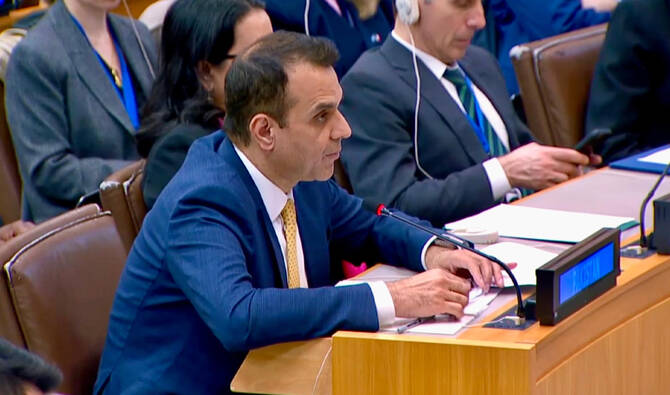
Ambassador Usman Jadoon, Pakistan’s deputy permanent representative to the UN, addresses the Arria Formula Meeting on Protecting Water in Armed Conflict at the United Nations Headquarters, in New York, US, on May 23, 2025. (X/@PakistanUN_NY)
Short Url
Updated 24 May 2025
Follow

Pakistan tells UN India politicizing river flows by halting Indus treaty

  • Ambassador Usman Jadoon calls access to clean water a fundamental human right
  • He says India announced treaty suspension to cut off the lifeline of 240 million people

ISLAMABAD: Pakistan told a United Nations forum this week India was using river waters as a political weapon by suspending the Indus Waters Treaty (IWT), warning that Islamabad would not allow New Delhi to cut off the lifeline of 240 million people or turn water into a tool of coercion.

The remarks came during an Arria-formula meeting of the UN Security Council, an informal session allowing open discussion on pressing international issues. The forum was held as tensions escalated following India’s decision to suspend the 1960 IWT.

While New Delhi has cited a recent militant attack in Indian-administered Kashmir to justify the move, Islamabad has denied any involvement and warned that blocking Pakistan’s access to river waters threatens regional stability and violates international law.

Addressing the forum on Friday, Ambassador Usman Jadoon, Pakistan’s deputy permanent representative to the UN, emphasized that access to clean water was a fundamental human right. He condemned India’s actions, pointing out the suspension of the IWT constitutes a grave violation of international law.

“India’s decision to illegally and unilaterally suspend the 1960 Indus Waters Treaty, aiming to impede the flow of water guaranteed to Pakistan under the Treaty, is a grave violation of international law, including human rights law, the treaty law and customary international law,” Jadoon said.

He further criticized statements from Indian leadership suggesting intentions to “starve the people of Pakistan,” describing such rhetoric as dangerous and perverse.

Jadoon called upon India to adhere to its legal obligations and refrain from actions that could disrupt the flow of rivers vital to Pakistan’s population.

“We strongly condemn India’s unlawful announcement to hold the Treaty in abeyance and call upon India to strictly abide by its legal obligations and refrain from stopping, diverting or restricting rivers that are a lifeline for 240 million people of Pakistan,” he continued. “We will never accept any such moves.”

The IWT, brokered by the World Bank in 1960, has been a cornerstone of water-sharing between the two nations. Its suspension marks a significant escalation in India-Pakistan relations, with potential implications for regional stability and humanitarian concerns.


Pakistan PM calls for faster CPEC implementation, pledges security for Chinese workers

Updated 27 February 2026
Follow

Pakistan PM calls for faster CPEC implementation, pledges security for Chinese workers

  • Shehbaz Sharif pushes expanded cooperation in agriculture, IT and mining under CPEC phase two
  • Chinese envoy reaffirms Beijing’s support for Pakistan’s sovereignty and economic development

ISLAMABAD: Prime Minister Shehbaz Sharif on Friday called for speeding up projects under the China-Pakistan Economic Corridor (CPEC) and pledged stronger security guarantees for Chinese workers and investments, during a meeting with China’s ambassador in Islamabad.

Sharif made the remarks as the two countries strive to launch the second phase of CPEC, a multibillion-dollar infrastructure and energy initiative launched in 2015 as part of China’s Belt and Road Initiative (BRI).

CPEC’s first phase focused largely on power generation and transport infrastructure aimed at easing Pakistan’s chronic energy shortages and improving connectivity. The second phase seeks to expand cooperation into industrial development, with an emphasis on special economic zones and export-oriented growth.

“While highlighting the importance of accelerating ongoing CPEC projects, the Prime Minister stressed on the need to enhance cooperation in agriculture and IT and mining & minerals,” said a statement circulated by the PM Office after the meeting.

“He also underscored Pakistan’s resolve to provide a secure and conducive environment for Chinese personnel, investments, and institutions in Pakistan,” it added.

Chinese nationals and projects in Pakistan have faced security threats in the past, including attacks by militant groups targeting infrastructure sites and convoys. Islamabad has repeatedly vowed to tighten security and has deployed special protection units for Chinese workers.

China is Pakistan’s closest ally in the region and a key economic partner, with CPEC widely regarded by Islamabad as central to long-term economic growth.

During the meeting, the prime minister conveyed greetings to Chinese President Xi Jinping and Premier Li Qiang, particularly on the occasion of the Chinese New Year.

China’s Ambassador to Pakistan, Jiang Zaidong, reiterated Beijing’s support for Pakistan’s sovereignty and socioeconomic development, according to the statement. Both sides also exchanged views on regional and international issues and agreed to maintain close coordination.