

Pakistan tells UN India politicizing river flows by halting Indus treaty

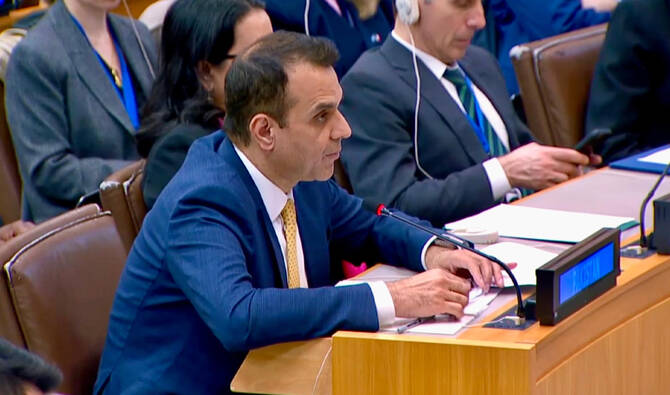
Ambassador Usman Jadoon, Pakistan’s deputy permanent representative to the UN, addresses the Arria Formula Meeting on Protecting Water in Armed Conflict at the United Nations Headquarters, in New York, US, on May 23, 2025. (X/@PakistanUN_NY)
Short Url
Updated 24 May 2025
Follow

Pakistan tells UN India politicizing river flows by halting Indus treaty

  • Ambassador Usman Jadoon calls access to clean water a fundamental human right
  • He says India announced treaty suspension to cut off the lifeline of 240 million people

ISLAMABAD: Pakistan told a United Nations forum this week India was using river waters as a political weapon by suspending the Indus Waters Treaty (IWT), warning that Islamabad would not allow New Delhi to cut off the lifeline of 240 million people or turn water into a tool of coercion.

The remarks came during an Arria-formula meeting of the UN Security Council, an informal session allowing open discussion on pressing international issues. The forum was held as tensions escalated following India’s decision to suspend the 1960 IWT.

While New Delhi has cited a recent militant attack in Indian-administered Kashmir to justify the move, Islamabad has denied any involvement and warned that blocking Pakistan’s access to river waters threatens regional stability and violates international law.

Addressing the forum on Friday, Ambassador Usman Jadoon, Pakistan’s deputy permanent representative to the UN, emphasized that access to clean water was a fundamental human right. He condemned India’s actions, pointing out the suspension of the IWT constitutes a grave violation of international law.

“India’s decision to illegally and unilaterally suspend the 1960 Indus Waters Treaty, aiming to impede the flow of water guaranteed to Pakistan under the Treaty, is a grave violation of international law, including human rights law, the treaty law and customary international law,” Jadoon said.

He further criticized statements from Indian leadership suggesting intentions to “starve the people of Pakistan,” describing such rhetoric as dangerous and perverse.

Jadoon called upon India to adhere to its legal obligations and refrain from actions that could disrupt the flow of rivers vital to Pakistan’s population.

“We strongly condemn India’s unlawful announcement to hold the Treaty in abeyance and call upon India to strictly abide by its legal obligations and refrain from stopping, diverting or restricting rivers that are a lifeline for 240 million people of Pakistan,” he continued. “We will never accept any such moves.”

The IWT, brokered by the World Bank in 1960, has been a cornerstone of water-sharing between the two nations. Its suspension marks a significant escalation in India-Pakistan relations, with potential implications for regional stability and humanitarian concerns.


Pakistan, ADB sign $730 loan agreements to boost SOE reforms, energy infrastructure

Updated 25 December 2025
Follow

Pakistan, ADB sign $730 loan agreements to boost SOE reforms, energy infrastructure

  • Both sign $330 million Power Transmission Strengthening Project and $400 million SOE Transformation Program loan agreements
  • Economic Affairs Division official says Transmission Project will secure Pakistan’s energy future by strengthening national grid’s backbone

KARACHI: Pakistan and the Asian Development Bank (ADB) on Thursday signed two loan agreements totaling $730 million to boost reforms in state-owned enterprises (SOEs) and energy infrastructure in the country, the bank said.

The first of the two agreements pertains to the SOE Transformation Program worth $400 million while the second loan, worth $330 million, is for a Power Transmission Strengthening Project, the lender said. 

The agreements were signed by ADB Country Director for Pakistan Emma Fan and Pakistan’s Secretary of Economic Affairs Division Humair Karim. 

“The agreements demonstrate ADB’s enduring commitment to supporting sustainable and inclusive economic growth in Pakistan,” the ADB said. 

Pakistan’s SOEs have incurred losses worth billions of dollars over the years due to financial mismanagement and corruption. These entities, including the country’s national airline Pakistan International Airlines, which was sold to a private group this week, have relied on subsequent government bailouts over the years to operate.

The ADB approved the $400 million loan for SOE reforms on Dec. 12. It said the program seeks to improve governance and optimize the performance of Pakistan’s commercial SOEs. 

Karim highlighted that the Power Transmission Strengthening Project will enable reliable evacuation of 2,300 MW from Pakistan’s upcoming hydropower projects, relieve overloading of existing transmission lines and enhance resilience under contingency conditions, the Press Information Department (PID) said. 

“The Secretary emphasized that both initiatives are transformative in nature as the Transmission Project will secure Pakistan’s energy future by strengthening the backbone of the national grid whereas the SOE Program will enhance transparency, efficiency and sustainability of state-owned enterprises nationwide,” the PID said. 

The ADB has supported reforms by Pakistan to strengthen its public finance and social protection systems. It has also undertaken programs in the country to help with post-flood reconstruction, improve food security and social and human capital. 

To date, ADB says it has committed 764 public sector loans, grants and technical assistance totaling $43.4 billion to Pakistan.