

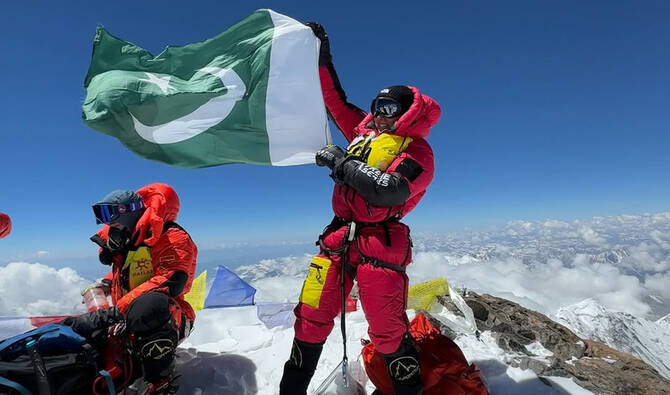
Pakistan PM says encouraging to see women like Naila Kiani setting records in mountaineering

This photo, posted on May 23, 2025, shows Pakistani mountaineer Naila Kiani after scaling Kanchenjunga peak, between Nepal and India. (Photo courtesy: Instagram/@naila._.kiani)
Short Url
Updated 24 May 2025
Follow

Pakistan PM says encouraging to see women like Naila Kiani setting records in mountaineering

  • Kiani on Friday summitted Kanchenjunga to become first Pakistani woman to summit 12 ‘eight-thousanders’
  • She stands on the threshold of joining only 17 women who have conquered all 14 peaks above 8,000 meters

ISLAMABAD: Prime Minister Shehbaz Sharif on Saturday praised Pakistani mountaineer Naila Kiani for scaling 8,586-meter Kanchenjunga, the world’s third highest peak, saying it was encouraging to see Pakistani women making records in such difficult sport.

With the ascent of Kanchenjunga on Friday, Kiani became the first Pakistani woman to scale 12 of the world’s 14 peaks above the height of 8,000 meters, according to Alpine Club of Pakistan (ACP), which arranges various expeditions.

The Pakistani mountaineer stands on the threshold of joining a global elite of only 17 women who have conquered all 14 eight-thousanders, Imagine Nepal, her expedition organizer, said after Friday’s summit.

“Pakistanis are making their country proud in every field of sports,” Sharif said in a statement. “It is encouraging to see Pakistani women setting records in a difficult sport like mountaineering.”

Kiani has previously summited Mount Makalu (8,485m), Broad Peak (8,047 meters), Annapurna (8,091 meters), K2 (8,611 meters), Lhotse (8,516 meters), Gasherbrum 1 (8,068 meters), Gasherbrum II (8,035 meters), Nanga Parbat (8,125 meters), Mount Everest (8,849 meters), Manaslu (8,156 meters) and Cho Oyu (8,201 meters) mountains.

The ACP described Kiani’s feat as a “monumental milestone” in the history of Pakistani mountaineering and a moment of immense national pride.

“From the towering heights of Everest and K2 to the perilous slopes of Annapurna and Lhotse, her journey tells a powerful story of grit, resilience and an unshakable will,” it said on Friday.

“This is not just a personal achievement— it is a symbol of empowerment for women in sports, a beacon of hope and inspiration for Pakistan, and a proud moment for every mountaineering enthusiast.”


EU, Pakistan sign €60 million loan agreement for clean drinking water in Karachi

Updated 17 December 2025
Follow

EU, Pakistan sign €60 million loan agreement for clean drinking water in Karachi

  • Project will finance rehabilitation, construction of water treatment facilities in Karachi city, says European Investment Bank
  • As per a report in 2023, 90 percent of water samples collected from various places in city was deemed unfit for drinking

ISLAMABAD: The European Investment Bank (EIB) and Pakistan’s government on Wednesday signed a €60 million loan agreement, the first between the two sides in a decade, to support the delivery of clean drinking water in Karachi, the EU said in a statement. 

The Karachi Water Infrastructure Framework, approved in August this year by the EIB, will finance the rehabilitation and construction of water treatment facilities in Pakistan’s most populous city of Karachi to increase safe water supply and improve water security. 

The agreement was signed between the two sides at the sidelines of the 15th Pak-EU Joint Commission in Brussels, state broadcaster Radio Pakistan reported. 

“Today, the @EIB signed its first loan agreement with Pakistan in a decade: a €60 million loan supporting the delivery of clean drinking water for #Karachi,” the EU said on social media platform X. 

Radio Pakistan said the agreement reflects Pakistan’s commitment to modernize essential urban services and promote climate-resilient infrastructure.

“The declaration demonstrates the continued momentum in Pakistan-EU cooperation and highlights shared priorities in sustainable development, public service delivery, and climate and environmental resilience,” it said. 

Karachi has a chronic clean drinking water problem. As per a Karachi Water and Sewerage Corporation (KWSC) study conducted in 2023, 90 percent of water from samples collected from various places in the city was deemed unsafe for drinking purposes, contaminated with E. coli, coliform bacteria, and other harmful pathogens. 

The problem has forced most residents of the city to get their water through drilled motor-operated wells (known as ‘bores’), even as groundwater in the coastal city tends to be salty and unfit for human consumption.

Other options for residents include either buying unfiltered water from private water tanker operators, who fill up at a network of legal and illegal water hydrants across the city, or buying it from reverse osmosis plants that they visit to fill up bottles or have delivered to their homes.

The EU provides Pakistan about €100 million annually in grants for development and cooperation. This includes efforts to achieve green inclusive growth, increase education and employment skills, promote good governance, human rights, rule of law and ensure sustainable management of natural resources.